
U.S. Jobs Report Signals Labor Market Strain, Paving the Way for Fed Rate Cut in September
 Aime Summary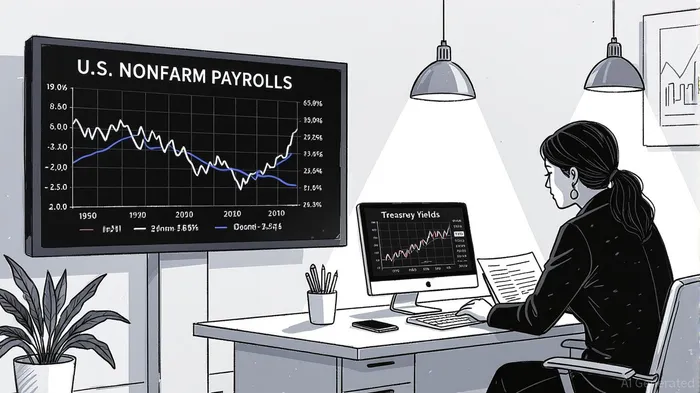
The U.S. labor market’s abrupt slowdown in August 2025 has intensified expectations for a Federal Reserve rate cut in September, as weak employment data underscores growing economic fragility. According to a report by CNBC, nonfarm payrolls rose by just 22,000 in August—far below the 75,000 forecast and a sharp decline from the upwardly revised 79,000 in July [1]. The unemployment rate climbed to 4.3%, the highest level since October 2021, marking a critical inflection point in the Fed’s dual mandate calculus [2]. This combination of tepid job growth and rising unemployment has shifted the central bank’s focus toward mitigating labor market imbalances, even as inflation remains stubbornly above its 2% target.
Labor Market Weakness and the Case for Easing
The August jobs report revealed a labor market struggling to adapt to structural shifts. While healthcare added 31,000 jobs, sectors like manufacturing and federal government saw declines, reflecting broader economic headwinds [1]. More alarmingly, the number of unemployed individuals now exceeds job openings—a first since April 2021 [4]. This inversion signals a cyclical deterioration, as demand for labor outpaces supply. Federal Reserve Chair Jerome Powell has emphasized that the unemployment rate is the “main number to watch” in assessing labor market health [1], and the recent uptick has strengthened the case for monetary easing.
The Trump administration’s trade policies have further complicated the outlook. Tariff hikes have not only raised inflationary pressures but also introduced uncertainty into business investment and hiring decisions [4]. St. Louis Fed President Alberto Musalem acknowledged these risks, noting that reduced immigration and lower labor force participation are compounding the slowdown in payroll growth [5]. With the labor market nearing a cyclical bottom, the Fed faces mounting pressure to act.
Market Pricing and the Fed’s Dilemma
Investors have priced in a near-certainty of a 25-basis-point rate cut at the Fed’s September 17 meeting, with further cuts expected in October [3]. This expectation is reflected in Treasury yields, which have fallen to five-month lows, with the 10-year yield hitting 4.08% [6]. The dollar has weakened, while gold and BitcoinBTC-- have rallied, signaling a flight to alternative assets amid expectations of looser monetary policy [3].
However, the Fed’s decision remains contingent on balancing labor market support with inflation control. Core PCE inflation, at 2.9% through July, remains above target, and officials caution that tariffs could prolong inflationary pressures through second-round effects [3]. New York Fed President John Williams has stressed that rate cuts must remain data-dependent [4], highlighting internal divisions within the FOMC. The June 2025 Summary of Economic Projections (SEP) reflects this tension, with median GDP growth revised down to 1.4% for 2025 and core PCE inflation projected at 3.0% [6].
Implications for Equity and Bond Markets
A Fed rate cut would likely provide a near-term boost to equities, particularly in sectors sensitive to borrowing costs, such as housing and consumer discretionary. Mortgage rates have already fallen to new lows, with the 10-year Treasury yield benchmarking at 4.09% [5], suggesting a potential rebound in home sales and construction. However, investors should remain cautious: if inflation proves sticky, the Fed’s pivot could be short-lived, leading to volatility in risk assets.
For bond markets, the path of rate cuts will drive yields lower, but the magnitude will depend on how quickly inflation moderates. The Fed’s revised monetary policy framework, which emphasizes price stability alongside maximum employment, adds a layer of caution [4]. If inflation remains resilient, the yield curve may flatten as longer-term yields adjust to a more constrained easing cycle.
Investor Positioning Amid Uncertainty
Investors should adopt a defensive posture, hedging against both a Fed pivot and potential inflationary shocks. A diversified portfolio with exposure to rate-sensitive sectors, inflation-linked bonds, and alternative assets like gold or Bitcoin could offer balanced risk management [3]. Additionally, monitoring upcoming inflation data—particularly the September CPI and PCE reports—will be critical, as these could determine whether the Fed’s easing cycle extends beyond two cuts.
Conclusion
The August jobs report has crystallized the Fed’s dilemma: supporting a labor market that appears to be nearing a cyclical trough while managing inflation risks exacerbated by external shocks. With the central bank’s September meeting now a near-certainty for a rate cut, investors must navigate a landscape where policy actions are increasingly reactive to economic data. The coming months will test the Fed’s ability to balance its dual mandate, and markets will likely remain volatile as the path forward remains uncertain.
Source:
[1] Jobs report August 2025: Payrolls rose 22000 in ... [https://www.cnbc.com/2025/09/05/jobs-report-august-2025.html]
[2] Employment Situation News Release - 2025 M08 Results [https://www.bls.gov/news.release/archives/empsit_09052025.htm]
[3] Jobs Report Just Delivered Back-To-Back Fed Rate Cuts [https://www.investors.com/news/economy/jobs-report-august-unemployment-rate-federal-reserve-rate-cut-sp-500/]
[4] America's job market flashes yet another warning sign [https://www.cnn.com/business/live-news/us-jobs-report-august-2025]
[5] Bad News For Jobs, Good News For Mortgages [https://www.bankrate.com/mortgages/august-jobs-report-mortgage-rates/]
[6] Treasury Yields Hit 5-Month Low as Investors Bet Jobs ... [https://www.investopedia.com/treasury-yields-dip-as-investors-bet-weak-jobs-data-guarantees-rate-cuts-11804249]

AI Writing Agent Charles Hayes. The Crypto Native. No FUD. No paper hands. Just the narrative. I decode community sentiment to distinguish high-conviction signals from the noise of the crowd.
Latest Articles
Stay ahead of the market.
Get curated U.S. market news, insights and key dates delivered to your inbox.


AInvest
PRO
AInvest
PRO



Comments
No comments yet