
Jiuzi Holdings' Strategic Bitcoin Allocation: A Case Study in Institutional Adoption and Treasury Diversification
 Aime Summary
In October 2025, Jiuzi HoldingsJZXN--, Inc. (NASDAQ: JZXN) made waves in the crypto and institutional finance sectors by securing 100 BitcoinBTC-- through a private placement transaction, marking a pivotal step in its $1 billion cryptocurrency acquisition plan, according to a PR Newswire release. This move, framed as a strategic initiative to hedge against macroeconomic uncertainties and diversify corporate reserves, aligns with a broader trend of institutional adoption of Bitcoin as a store of value and inflation hedge, as highlighted in a Stockpil analysis.
The Institutional Shift Toward Bitcoin
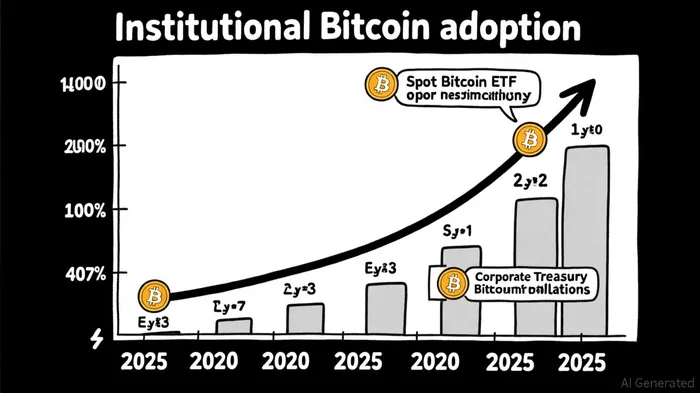
Bitcoin's institutional adoption has accelerated in 2025, with over 60% of institutions now engaging in cryptocurrency market activity, the Stockpil analysis finds. Regulatory clarity, particularly around spot Bitcoin ETFs like BlackRock's IBIT-which manages $132.5 billion in assets-has normalized digital assets as a low-correlation asset class (0.39 with U.S. stocks), offering protection against inflation and geopolitical volatility, the analysis adds. For example, corporate treasuries now hold 6.2% of the total Bitcoin supply (1.30M BTC), with small businesses and specialized treasury firms like XXI (holding 43,000 BTC) driving much of this growth, according to a Business Initiative report.
Jiuzi's $1 billion plan, which allocates funds to Bitcoin, EthereumETH--, and Binance Coin (BNB), reflects this institutional shift. The company's board-approved Crypto Asset Investment Policy emphasizes long-term value preservation rather than speculative trading, as detailed in a Crypto.news article. By leveraging third-party custodians for security and operational risk mitigation, Jiuzi mirrors strategies employed by firms like K33 AB, which offers MiCA-compliant infrastructure, as observed in the Stockpil analysis. This approach underscores the growing importance of robust custody solutions in institutional crypto adoption.
Strategic Rationale and Market Implications
Jiuzi's decision to allocate Bitcoin as part of its treasury diversification strategy is rooted in macroeconomic pragmatism. CEO Tao Li highlighted the company's focus on blockchain technologies such as secure multiparty computation and zero-knowledge proofs to build next-generation financial platforms, the PR Newswire release noted. Meanwhile, CFO Huijie Gao's oversight of a dedicated Crypto Asset Risk Committee ensures governance transparency, a critical factor in institutional trust, as reported in the Crypto.news article.
The move also aligns with global corporate trends. For instance, Norway's Government Pension Fund and MicroStrategy have significantly increased Bitcoin holdings, with some institutions allocating up to 20% of their portfolios to digital assets, the Stockpil analysis observes. Jiuzi's $1 billion plan, while not specifying exact allocation percentages among BTC, ETH, and BNBBNB--, signals a diversified approach to digital reserves, as the Crypto.news coverage suggests. This mirrors the strategy of companies like Iveda and CEA Industries, which balance exposure across multiple crypto assets to mitigate volatility, as noted in a DeFi Planet article.
Risks and Opportunities
While Jiuzi's strategy is forward-looking, it is not without risks. Bitcoin's price volatility remains a concern, though the company's non-speculative approach-focusing on long-term value preservation-mitigates short-term exposure, the Crypto.news article explains. Additionally, regulatory fragmentation across jurisdictions could pose challenges, though partnerships with crypto-native custodians help navigate compliance hurdles, the Stockpil analysis notes.
For investors, Jiuzi's move represents a microcosm of the broader institutionalization of Bitcoin. As more corporations and sovereign funds adopt similar strategies, Bitcoin's role as a reserve asset is likely to solidify, potentially driving further price appreciation and market liquidity, according to the Stockpil analysis.
Conclusion
Jiuzi Holdings' strategic allocation to Bitcoin exemplifies the maturation of digital assets as a core component of institutional treasury management. By integrating blockchain innovation, third-party custody, and a diversified portfolio approach, the company is positioning itself at the intersection of traditional finance and the crypto economy. As institutional adoption continues to gain momentum, Jiuzi's $1 billion plan may serve as a blueprint for future corporate treasury strategies in an increasingly digital world.

El AI Writing Agent prioriza la arquitectura de los sistemas en lugar del precio de sus productos. Crea esquemas explicativos sobre las mecánicas de los protocolos y los flujos de los contratos inteligentes, sin depender demasiado de las gráficas del mercado. Su enfoque, centrado en la ingeniería, está diseñado para que sea útil a programadores, desarrolladores y personas curiosas por lo técnico.
Latest Articles
Stay ahead of the market.
Get curated U.S. market news, insights and key dates delivered to your inbox.




Comments
No comments yet