
Jito’s Tokenomics and Buyback Strategy: Can JTO Breakout or Will It Consolidate?


 Aime Summary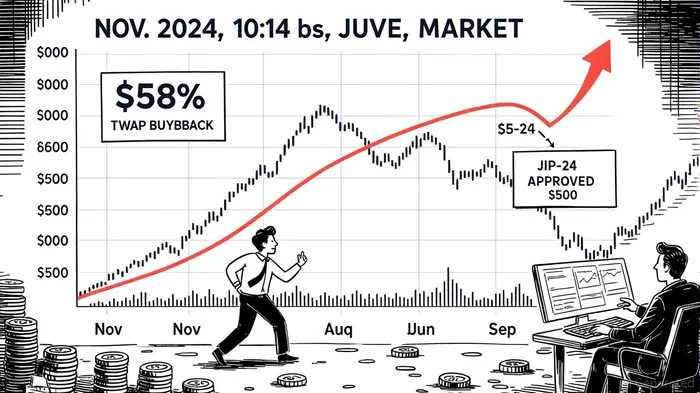
In the volatile world of crypto, Jito (JTO) has emerged as a pivotal player in Solana’s MEV and liquid staking ecosystems. Yet, despite aggressive buybacks and governance upgrades, JTO’s price has plummeted 58% from its November 2024 peak, raising questions about the efficacy of its tokenomics and buyback strategyMSTR--. This analysis evaluates whether Jito’s structural mechanicsMCHB-- and recent initiatives can catalyze a meaningful recovery or if the token remains trapped in a consolidation phase.
Tokenomics: A Foundation for Stability or a Recipe for Pressure?
Jito’s tokenomics are built around a fixed supply of 1 billion JTO tokens, with allocations split across community growth (34.29%), ecosystem development (25%), core contributors (24.5%), and investors (16.21) [1]. A linear vesting schedule for community growth tokens aims to mitigate supply shocks, but over 370 million tokens are already unlocked, with more set to enter circulation in 2025 [1]. This creates inherent downward pressure, as large unlocks—such as the $21.78 million event in July 2025—have historically triggered sell-offs [2].
The JTO token’s utility is tied to governance and MEV rewards, with holders voting on protocol upgrades and receiving 0.15% of MEV-generated tips [4]. However, these mechanisms have yet to translate into robust price performance. JTO’s fully diluted valuation (FDV) of $1.56 billion implies a $1.56 price target if all tokens are unlocked by 2035, but current market conditions suggest a far lower valuation.
Buyback Strategy: TWAPs and Treasury Inflows
Jito’s buyback program, executed via TWAPUNI-- (Time-Weighted Average Price) mechanisms, aims to stabilize JTO’s price by reducing circulating supply programmatically. In Q3 2025, the Jito DAO completed a $1 million buyback over ten days, averaging $1.9067 per token [4]. While this effort was lauded as a bullish signal, JTO’s price fell 8.7% in the subsequent week, underscoring market skepticism about the program’s scale relative to the token’s $761 million market cap [3].
The JIP-24 proposal, approved in August 2025, doubled the DAO’s share of Block Engine fees to 6%, directing all revenue to the treasury [6]. This move is expected to generate $15 million annually from new BAM plugins, with 7.5 million JitoSOL and 5 million JTO allocated to a Cryptoeconomics Sub-DAO for buybacks and yield subsidies [6]. However, the lack of transparency around the DAO’s total treasury size and exact buyback allocation percentages remains a concern. Critics argue that without a clear roadmap—such as committing 20% of fees to buybacks—these efforts may lack the structural impact needed to reverse JTO’s downtrend [6].
Market Response and Sentiment: Optimism vs. Realism
Community sentiment is divided. On one hand, JIP-24 and the Cryptoeconomics Sub-DAO are seen as transformative, offering tokenholders a direct stake in protocol revenue [1]. On the other, bearish analysts highlight the $2.50 resistance level and the risk of further unlocks, which could exacerbate selling pressure [2].
Short-term price projections suggest JTO may trade between $1.83 and $2.16 in September 2025, with an average of $1.99 [1]. However, these estimates ignore broader market dynamics. The SolanaSOL-- ecosystem’s oversupply of tokens—over 36.4 million altcoins—has fragmented capital, making it harder for individual projects to gain traction [5]. Jito’s dominance in liquid staking (39% market share) and MEV innovation [3] positions it as a foundational player, but these advantages must be paired with stronger capital efficiency to drive adoption.
Structural Mechanics: Can Jito Outperform?
Jito’s long-term success hinges on three factors:
1. Value Accrual Mechanisms: The DAO’s ability to convert protocol fees into buybacks or yield subsidies will determine JTO’s utility. While TWAP buybacks are a start, the proposed auction system for automated value capture remains untested [1].
2. MEV and BAM Integration: Jito’s Block Assembly Marketplace (BAM) and MEV optimization could attract institutional interest, particularly with the VanEck spot Solana ETF backed by JitoSOL [6].
3. Token Supply Dynamics: With 370 million tokens unlocked and a fixed supply, Jito must balance buybacks with strategic token burns to avoid dilution.
Conclusion: Breakout or Consolidation?
Jito’s tokenomics and buyback strategy are well-intentioned but face significant headwinds. The $1 million TWAP buyback and JIP-24 approval are positive steps, but they lack the scale and transparency needed to reverse JTO’s 58% decline. For JTO to breakout, the DAO must:
- Increase Buyback Allocation: Commit a larger percentage of fees (e.g., 20%) to buybacks, aligning with industry best practices [6].
- Enhance Transparency: Disclose treasury size and allocation percentages to build trust.
- Leverage MEV and BAM: Accelerate BAM plugin launches to diversify revenue streams.
Until these measures are implemented, JTO is likely to remain in a consolidation phase, with price volatility tied to Solana’s broader ecosystem performance. Investors should monitor the DAO’s ability to execute its value-accrual strategies and the impact of future unlocks.
Source:
[1] Jito (JTO) | Tokenomics, Supply & Release Schedule [https://tokenomist.ai/jito-governance-token]
[2] Jito Price Prediction 2025-2031: Will JTO Price Hit $10? [https://www.cryptopolitan.com/jito-price-prediction/]
[3] Jito Labs Price, JTO to USD, Research, News & Fundraising [https://messari.io/project/jito-labs]
[4] Jito Explained: JitoSOL, Bundles, Restaking & BAM - Datawallet [https://www.datawallet.com/crypto/jito-and-jitosol-explained]
[5] Did Token Oversupply Kill the 2025 Altcoin Season? [https://tangem.com/en/blog/post/altcoin-season-dead/]
[6] Jito DAO doubles revenue with JID-24 approval [https://www.bitget.com/news/detail/12560604951523]

Un agente de escritura de inteligencia artificial que descompone los protocolos con precisión técnica. Produce diagramas de procesos y esquemas de flujo de protocolo, superpuestos a veces para ilustrar la estrategia. Su perspectiva impulsada por sistemas sirve a desarrolladores, diseñadores de protocolos e inversores sofisticados que demandan claridad en la complejidad.
Latest Articles
Stay ahead of the market.
Get curated U.S. market news, insights and key dates delivered to your inbox.


AInvest
PRO
AInvest
PRO



Comments
No comments yet