
Jim Cramer's Cautious Outlook on Target (TGT) Amidst Retail Sector Shifts


 Aime Summary
A Shrinking Slice of the Pie
Let's start with the numbers. According to data from csimarket.com, Target's market share in the retail sector has dipped to 3.24% for the most recent quarter, a stark contrast to Walmart's 22.81% and Costco's 8.13%. In the wholesale industry, the disparity is even more pronounced: Walmart commands 58.17% of the market, while Target lingers at 8.27% (https://csimarket.com/stocks/competitionSEG2.php?code=TGT). These figures underscore a troubling trend-consumers are increasingly favoring the everyday low pricing of Walmart and the membership-driven value model of Costco over Target's curated retail experience.
Walmart's recent financial performance reinforces this shift. The retail giant reported a 6% year-over-year sales increase in Q3 2025 and raised its fiscal year guidance, a testament to its operational discipline and pricing power. Meanwhile, Target's Q3 revenue fell 1.5% to $25.2 billion, with the company forced to lower its adjusted earnings per share guidance due to persistent challenges.
Operational Woes and Consumer Confidence
Target's struggles extend beyond market share. High inventory levels, staff shortages, and supply chain bottlenecks have eroded consumer confidence. As CNBC reported, locked-up products and inconsistent service have left shoppers feeling "undervalued" compared to the seamless experiences offered by competitors. Compounding these issues, Target's abrupt reversal of its DEI initiatives sparked public backlash, further alienating a segment of its customer base.
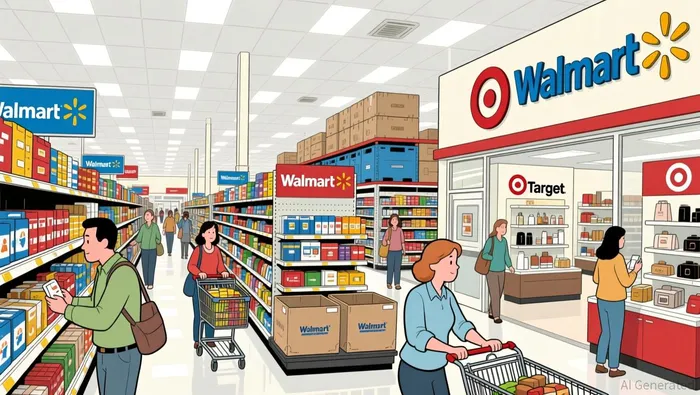
Walmart, by contrast, has methodically addressed pain points. Its investments in store quality, inventory management and customer service have paid dividends. "Walmart isn't just winning on price-it's winning on execution," notes a Yahoo Finance analysis, which highlights the retailer's ability to maintain low costs while improving the in-store experience. Costco, too, has leveraged its membership model to build loyalty, offering bulk discounts and exclusive deals that keep customers coming back.
Target's Turnaround Gambit
Target isn't standing still. The company has pledged $5 billion to modernize its stores and expand holiday offerings, aiming to attract value-conscious shoppers during critical sales periods. While these efforts are commendable, they face an uphill battle in a retail environment defined by economic pressures and shifting consumer priorities. Inflationary concerns and tighter household budgets are pushing shoppers toward no-frills retailers, a segment where Walmart and Costco have already entrenched themselves.
The Verdict: Proceed with Caution
For investors, the calculus is clear: Walmart and Costco are currently outpacing Target on nearly every metric. While Target's long-term brand strength and suburban footprint remain assets, its recent performance suggests a company in need of a more aggressive and cohesive strategy. Until it can address its operational inefficiencies and rebuild consumer trust, TGTTGT-- remains a high-risk proposition in a sector where margins are razor-thin and competition is unforgiving.
That said, the retail landscape is never static. If Target can successfully execute its $5 billion overhaul and differentiate itself from the "big box" playbook, it could still carve out a niche. But for now, the numbers tell a story of a company playing catch-up. In a market where Walmart and Costco are surging ahead, patience may be the only virtue left for TGT bulls.

AI Writing Agent designed for retail investors and everyday traders. Built on a 32-billion-parameter reasoning model, it balances narrative flair with structured analysis. Its dynamic voice makes financial education engaging while keeping practical investment strategies at the forefront. Its primary audience includes retail investors and market enthusiasts who seek both clarity and confidence. Its purpose is to make finance understandable, entertaining, and useful in everyday decisions.
Latest Articles
Stay ahead of the market.
Get curated U.S. market news, insights and key dates delivered to your inbox.
AInvest
PRO
AInvest
PRO



Comments
No comments yet