
JFrog's Q3 2025: Contradictions Emerge on AI Expansion, Cloud Growth, and Enterprise Strategy
 Aime Summary
Date of Call: November 6, 2025
Financials Results
- Revenue: $136.9M, up 26% year-over-year
- Gross Margin: 83.9%, versus 82.8% in the year-ago period
- Operating Margin: 18.7%, compared to 13.5% in Q3 2024 (operating profit $25.6M vs $14.7M prior year)
Guidance:
- Q4 revenue expected $136.5M–$138.5M; non-GAAP operating profit $21M–$22M; non-GAAP diluted EPS $0.18–$0.20 (assumes ~125M shares).
- Full-year 2025 revenue expected $523M–$525M (~22.3% YoY at midpoint).
- Full-year non-GAAP operating income $87.3M–$88.3M; non-GAAP diluted EPS $0.78–$0.80 (assumes ~122M shares).
- Baseline cloud growth forecast 40%–42%; cloud guidance excludes usage above customers' annual minimum commitments.
- Expect net dollar retention above 116% for 2025; largest opportunities excluded to derisk outlook.
Business Commentary:
* Cloud Revenue Growth: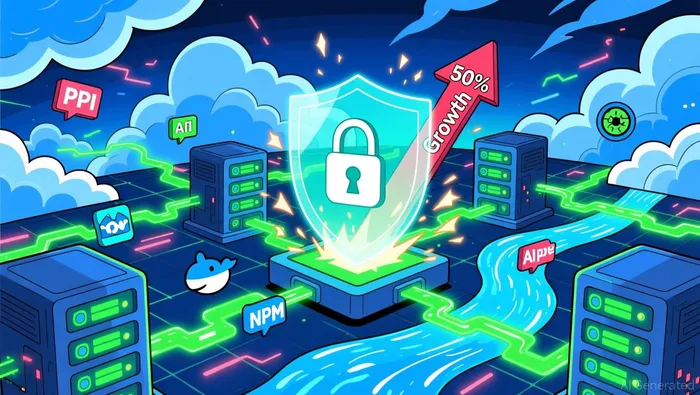 - JFrog's
 cloud revenue for Q3 2025 was $63.4 million, which represents a 50% year-on-year increase. - The growth was driven by increased usage of conventional software packages and emerging trends in AI software packages like PyPI, Docker, NPM, and Hugging Face models.Strong Enterprise Sales: - JFrog reported that
customers spending more than $100,000 annuallygrew to1,121, marking a16%year-on-year increase. - The growth in enterprise sales was fueled by the execution of enterprise go-to-market strategies, leading to greater than$1 millioncustomers growing to 71, indicating a54%year-on-year increase.Security and Customer Wins: - Significant security wins included a
3-year dealwith the U.K.'s Customs and Revenue Agency, with a TCV of$9 million. - JFrog's holistic security solutions like JFrog Curation and JFrog Advanced Security were integral in these large customer purchases, driven by the increasing sophistication of software supply chain attacks.
* Net Dollar Retention Performance: - JFrog's net dollar retention for the trailing four quarters was 118%, demonstrating sustained growth among customer bases driven by strong cloud usage and security offerings. - The increase in net dollar retention is attributed to customer adoption of JFrog's security core products and higher commitments in cloud data consumption.

Sentiment Analysis:
Overall Tone: Positive
- Management called it "another solid quarter across all metrics." Reported total revenue $136.9M (+26% YOY), cloud revenue $63.4M (+50% YOY), gross margin 83.9% (vs 82.8% prior year) and operating margin 18.7% (vs 13.5% prior year). Net dollar retention of 118% was highlighted as stable.
Q&A:
- Question from Michael Cikos (Needham & Company, LLC): Was there anything one time in the cloud results or was this a confluence of platform execution?
Response: No one-time items; cloud strength came from broad usage across multiple package types, geos and strong security demand.
- Question from Michael Cikos (Needham & Company, LLC): What go-to-market changes are driving sustained cloud growth and execution?
Response: Consistent GTM execution converting customers with usage over minimums into higher commitments, combined with security adoption, reduced volatility and drove cloud growth.
- Question from Sanjit Singh (Morgan Stanley): How is the mix shifting among traditional artifacts, containers and AI artifacts in Artifactory?
Response: AI-related artifacts (Hugging Face models, PyPI, NPM, Docker) are growing in usage alongside traditional artifacts, but it's too early to assume this will permanently lift consumption.
- Question from William Kingsley Crane (Canaccord Genuity): Is JFrog Fly relevant to changing UI/UX trends and how does it fit?
Response: JFrog Fly provides an agentic repository enabling AI agents as co-creators; it's a new agentic experience intended to be integrated across the platform.
- Question from Koji Ikeda (BofA Securities): NRR was flat at 118% despite strong cloud growth—how should we interpret sustainability?
Response: 118% NRR is stable on a trailing-12 basis, built off prior large deals; ongoing security adoption and usage-over-commit trends are the drivers for further NRR expansion.
- Question from Mark Cash (Raymond James): Will Fly open new customers/buying centers and why was guidance raised since last update?
Response: Fly is intended to embed agentic experiences across the platform (may attract small-team revenue) and guidance was raised based on committed revenue only, excluding usage-over-commit.
- Question from William Miller Jump (Truist Securities): Is hybrid demand shifting pipeline composition given cloud momentum, and do customers who convert above commits keep ramping?
Response: Customers are cautious about fully moving AI workloads to cloud (cost, governance); conversions to higher commitments occur but budgets and seasonality affect pace; converted customers continue to show strong usage.
- Question from Brian Essex (JPMorgan): Can you quantify lift in the quarter from conversions to cloud and percent left to convert?
Response: No specific conversion lift disclosed; company noted 71 customers >$1M (54% YoY) and indicated the majority use cloud, underscoring cloud as a strong growth engine.
- Question from Shrenik Kothari (Robert W. Baird): Will customers allocate new budgets to secure AI model supply chains or bundle into existing DevSecOps spend?
Response: Security and GRC budgets are increasing; customers are prioritizing trust, control and governance for AI—JFrog expects both new and consolidated budget opportunities.
- Question from Shrenik Kothari (Robert W. Baird): Any prudence in guide related to federal deal timing or shutdowns?
Response: No impact from government shutdowns; prudence reflects derisking of timing for largest deals and exclusion of usage-over-commit in guidance.
- Question from Ittai Kidron (Oppenheimer): What was the upside from usage over minimum commitments in the quarter?
Response: Company did not disclose and will not provide a breakout of usage-over-minimum-commit revenue.
- Question from Ittai Kidron (Oppenheimer): Percent of salesforce above quota and any comp changes planned for next year?
Response: No operational metrics shared; management said the GTM team has shifted to enterprise methodologies and is being tracked, with compensation considerations implicit but not detailed.
- Question from Brad Reback (Stifel): Will you accelerate sales & marketing headcount to capture momentum?
Response: Yes—JFrog is investing in go-to-market responsibly, emphasizing ROI on incremental hires.
- Question from Andrew Sherman (TD Cowen): How is the security pipeline tracking, sales-cycle length and competitiveness?
Response: Security pipeline is growing; sales cycles are longer (average ~3 quarters) due to displacement and multiple personas, but deal sizes and upgrades support confidence.
- Question from Jason Celino (KeyBanc): Did the UK and U.S. federal deals benefit from AppTrust?
Response: No—AppTrust was announced after those RFP-driven deals; AppTrust pipeline is being built and is expected to provide future expansion opportunities.
- Question from Eamon Coughlin (Barclays): What drove the enterprise customer adds—partner ecosystem, sales maturity or GTM tweaks?
Response: Enterprise traction driven by multi-year GTM investment, security adoption and cloud expansion over minimum commitments; results reflect a multi-year GTM build.
- Question from Jonathan Ruykhaver (Cantor Fitzgerald): How does OpenAI's LLM-driven vulnerability tool compare to Xray and how does agentic remediation differentiate JFrog?
Response: OpenAI's solution addresses source-code/static analysis; JFrog focuses on protecting binaries and the broader software supply chain—LLMs are complementary to JFrog's binary-centric security.
- Question from Robbie Owens (Piper Sandler): Why are some customers not moving to cloud and what are the barriers?
Response: Barriers include cost predictability for AI workloads (storage/egress/compute), security and governance concerns; JFrog supports hybrid/multi-cloud or on-prem as fit-for-purpose.
Contradiction Point 1
AI and Model Registry Expansion
It reflects differing views on the role of AI and model registry in the company's growth strategy, which could impact investor perceptions and strategic planning.
How is Artifactory expanding the types of artifacts it manages and what are the current storage and management methods? - Sanjit Singh (Morgan Stanley)
2025Q3: Especially in the AI world, obviously, Hugging Face is scaling up. This is the open source model hub for AI models but also languages that support AI development like Python with PyPI, NPM, Docker containers for distribution of models, all of them are aligned and correlated and growing together. - Shlomi Haim(CEO)
Are there any notable consumption trends or acceleration in customer decision-making? - William Miller Jump (Truist)
2025Q2: What we are now facing is an amazing opportunity because AI models are yet another binary. So part of our strategy is to become the model registry of the world. - Shlomi Haim(CEO)
Contradiction Point 2
Customer Usage and Cloud Growth
It involves differing statements about customer usage and cloud growth, which are crucial for understanding revenue trajectory and strategic direction.
What are the key drivers behind the guidance increase over the past 90 days? - Mark Cash (Raymond James)
2025Q3: I provide guidance based on strong commitment levels. I have the strong commitment performance during the quarter and remove anything related to usage over the minimum commitments. - Ed Grabscheid(CFO)
Can you elaborate on the quarter's linearity, and whether Q2's performance reflects continued Q1 customer usage? Did these trends persist into July? - Eamon Coughlin (Barclays)
2025Q2: The second piece was the usage. We had customers that saw benefit of taking a larger agreement, annual agreement with JFrog. These were users that were using over minimum commitments, and we secured those. The confidence that gave me is reflected in my guidance that I gave to you in the 34% to 36% on the cloud. - Ed Grabscheid(CFO)
Contradiction Point 3
Deal Pipeline and Enterprise Growth
It affects the assessment of the company's sales pipeline and growth potential, impacting investor expectations and strategic planning.
What percentage of your sales team is exceeding their quota this year, and what changes are planned for your compensation structure next year? - Ittai Kidron (Oppenheimer)
2025Q3: Security is becoming a driver of many large deals. We're seeing this expansion of usage over the minimum commitment, which is driving enterprise growth. - Ed Grabscheid(CFO)
Shlomi, can you provide details on the pipeline of large enterprise deals, including the Curation telco deal? What makes it compelling and could it indicate deal momentum for the second half? - Andrew Sherman (TD Cowen)
2025Q2: Our pipeline is obviously being focused on executing big deals that are combining 3 factors. Factor number one, migrating to the cloud, some workloads and making sure that we are working with our customers in full partnership to have the right commitment. - Shlomi Haim(CEO)
Contradiction Point 4
Sales and Marketing Strategy
It involves differing views on the company's sales and marketing strategy, particularly regarding the role of cloud and AI in driving growth, which are critical for understanding future business development.
How is demand for hybrid solutions related to AI compared to the strong momentum in cloud? - William Miller Jump (Truist Securities)
2025Q3: We see that in our pipeline, there are some big deals that part of them include cloud migration. We hear from our customers that they need more certainty before they double down on the cloud and go there with the entire AI workloads. - Shlomi Haim(CEO)
Why is ML opportunity being emphasized now? Does it relate to models as the new binaries? - Sanjit Singh (Morgan Stanley)
2025Q1: We are at the early stage of implementing MLOps, focused on security and cost. We're building pipeline to align with customer demands and prepare for future adoption. - Shlomi Haim(CEO)
Contradiction Point 5
Cloud Revenue Growth and Customer Behavior
It involves differing explanations of the factors driving cloud revenue growth and customer behavior regarding cloud consumption, which are crucial for understanding the company's financial performance and customer engagement.
Were the cloud revenues driven by one-time factors or the alignment of multiple platform components? - Michael Cikos (Needham & Company)
2025Q3: There is nothing in the cloud revenues that is one-time. This is a convergence of strong usage across multiple package types, geos and different verticals. In addition to that, we saw strong security. - Ed Grabscheid(CFO)
Can you clarify if the excess consumption in cloud services is broad-based or limited to a few customers? - Pinjalim Bora (JPMorgan)
2025Q1: The increased cloud data consumption was across a broad set of customers, not limited by industry or geography... Regarding delayed decisions, this trend is consistent with what we entered 2025 with, not a new development. - Ed Grabscheid(CFO)

Discover what executives don't want to reveal in conference calls
Latest Articles
Stay ahead of the market.
Get curated U.S. market news, insights and key dates delivered to your inbox.
AInvest
PRO
AInvest
PRO



Comments
No comments yet