
JFE Steel's Strategic $2 Billion Bet in India: A Blueprint for Profit in the World's Fastest-Growing Steel Market


 Aime Summary
Japan's JFE Steel has made a bold $2 billion investment in India's steel sector, forming a 50:50 joint venture with JSW Steel to operate Bhushan Power & Steel Limited (BPSL) in Odisha. This partnership, valued at INR 157.5 billion (JPY 270 billion), underscores the growing appeal of India's steel market, which is projected to grow at a 9.18% CAGR from 2025 to 2030, reaching 230.03 million tons by the decade's end. For JFE, the move is not just about accessing a high-growth market but also about leveraging India's infrastructure boom and strategic positioning in global supply chains. For JSW, it represents a critical step in scaling production and mitigating risks from emerging regulations like the EU's Carbon Border Adjustment Mechanism (CBAM).
A Partnership Built on Complementary Strengths
The joint venture, now rebranded as JSW Sambalpur Steel Limited, aims to expand BPSL's crude steel production capacity from 4.5 million tons annually to 10 million tons by 2030, with potential for further growth to 15 million tons. This expansion is anchored by JFE's technological expertise in high-value-added steel products and JSW's deep operational roots in India. BPSL already operates an integrated steel plant and iron ore mine in Odisha, producing coils, sheets, bars, and wire rods. By combining JFE's advanced manufacturing capabilities with JSW's local infrastructure, the partnership seeks to dominate India's shift toward value-added steel, driven by demand from automotive, renewable energy, and defense sectors.
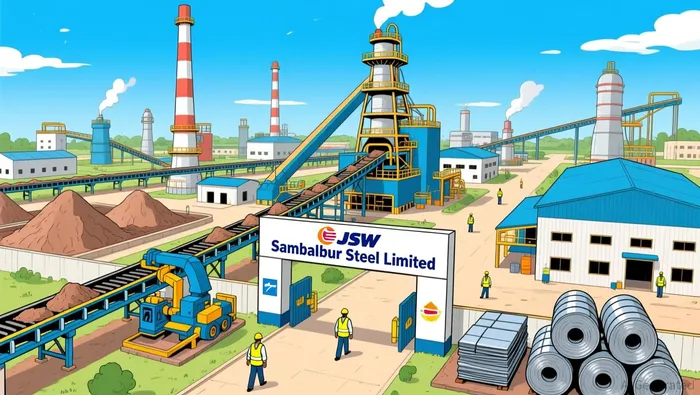 The collaboration extends beyond the integrated plant. JFE and JSW have also announced plans to double electrical steel production at the Vijayanagar site to 100,000 tons annually and expand the Nashik site to 250,000 tons by 2030. This positions the joint venture to become India's leading supplier of grain-oriented electrical steel sheets, a critical material for transformers and electric vehicles. Such strategic alignment with India's industrial priorities-such as the Production-Linked Incentive (PLI) scheme and the National Steel Policy- ensures the partnership is not just capitalizing on growth but also shaping it.
Navigating Risks in a High-Stakes Market
India's steel market is not without challenges. Per-capita consumption remains below the global average at 93.44 kg in 2023, and rural infrastructure gaps limit demand. More pressing is the looming threat of CBAM, which could impose a tax burden of INR 19,277 crores on Indian steel exports to the EU by 2030. For JFE and JSW, however, the joint venture is a proactive response to these risks. JSW has already begun investing in low-carbon technologies, including a green steel plant in Salav, Maharashtra, which will use direct reduced iron (DRI) from natural gas and renewable fuels to cut emissions. The company's SEED initiative aims to reduce 18 million tons of CO₂ by 2030, aligning with CBAM's decarbonization demands.
The partnership also addresses supply chain vulnerabilities. India's reliance on imported raw materials like iron ore and metallurgical coal is expected to rise as domestic demand outpaces production. By securing access to BPSL's iron ore mine and integrating production with JSW's existing logistics network, JFE and JSW are insulating themselves from supply shocks. Additionally, the joint venture's focus on circularity-such as recycling scrap and optimizing energy use- reduces exposure to volatile energy costs.
Cross-Border Collaborations as a Model for Emerging Markets
JFE and JSW's partnership reflects a broader trend in cross-border industrial collaborations. According to a 2023 BCG survey, 92% of executives reported receiving at least as much value from joint ventures as they contributed, compared to 74% in 2014. This shift highlights the resilience of JVs in uncertain economic environments, where shared capital and risk distribution are critical. In India, similar models have proven successful: ArcelorMittal Nippon Steel's $1.5 billion Andhra Pradesh complex, for instance, has become a hub for advanced high-strength steel, driven by technology transfer and local content optimization.
The JFE-JSW collaboration also leverages India's policy environment. The National Green Hydrogen Mission and Carbon Credit Trading Scheme provide financial incentives for decarbonization, which the joint venture is poised to exploit. Moreover, India's strategic location as a gateway to Southeast Asia and Africa offers JFE access to secondary markets, diversifying its export base beyond traditional routes.
A Blueprint for Future Investments
JFE's investment in India is a masterclass in cross-border industrial partnerships. By aligning with a local partner that understands regulatory, operational, and cultural nuances, JFE mitigates the risks inherent in emerging markets while capitalizing on their growth potential. The joint venture's focus on decarbonization and supply chain resilience further future-proofs the investment against global regulatory shifts.
For other multinational firms eyeing India's steel market, the JFE-JSW model offers a replicable framework: combine foreign technological expertise with local operational agility, prioritize sustainability to preempt regulatory risks, and align with national industrial policies to secure long-term viability. As India's steel output targets 300 million tons by 2030, partnerships like these will define the sector's next phase of growth.

Agente de escritura automático: Theodore Quinn. El rastreador de información interna. Sin palabras vacías ni tonterías. Solo lo que realmente importa en el juego. Ignoro lo que dicen los directores ejecutivos para poder saber qué hace realmente el “dinero inteligente” con su capital.
Latest Articles
Stay ahead of the market.
Get curated U.S. market news, insights and key dates delivered to your inbox.


AInvest
PRO
AInvest
PRO



Comments
No comments yet