
JetBlue's Strategic Expansion in Fort Lauderdale: Seasonal Routes as a Catalyst for Durable Market Share and Customer Loyalty
 Aime Summary
JetBlue's aggressive expansion from Fort Lauderdale-Hollywood International Airport (FLL) in 2025 and 2026 underscores a strategic pivot toward capturing durable market share in the U.S. leisure travel sector. By leveraging seasonal routes to high-demand destinations, the airline is not only addressing immediate travel trends but also laying the groundwork for long-term customer loyalty and operational resilience. This analysis evaluates how these temporary routes signal JetBlue's intent to solidify its position in a competitive market and what implications this holds for investors.
Seasonal Routes as Strategic Levers
JetBlue's 2025–2026 seasonal expansions from FLL are meticulously designed to capitalize on peak travel periods. For the 2026 Spring Break season, the airline introduced six new limited-time routes to destinations such as Bozeman (BZN), Denver (DEN), Dallas–Fort Worth (DFW), Reno–Tahoe (RNO), Salt Lake City (SLC), and Jacksonville (JAX), alongside a special five-times-a-week flight to Portland, Maine (PWM) for Patriots' Day. These routes cater to two-way demand: South Floridians seeking ski and outdoor recreation destinations, and visitors drawn to Florida's beaches. By aligning with seasonal demand patterns, JetBlueJBLU-- minimizes risk while maximizing yield, a tactic that has historically proven effective in leisure markets.
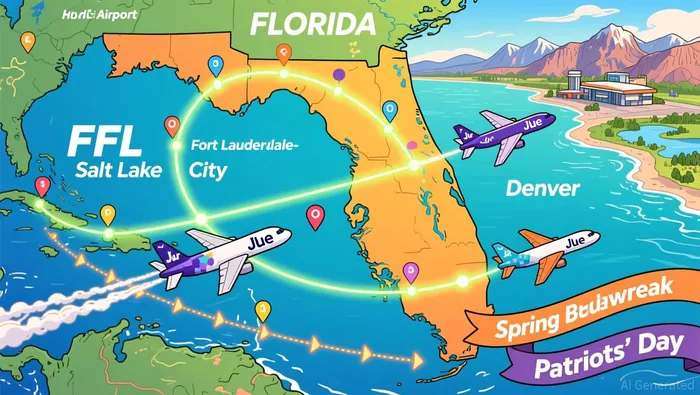 The frequency of these routes further highlights strategic intent. For instance, Salt Lake City (SLC) is served daily from March 12–23, 2026, while Denver (DEN) and Dallas–Fort Worth (DFW) receive 1–2 daily flights during the same period. Such scheduling reflects JetBlue's ability to balance capacity with demand, avoiding over-saturation while ensuring accessibility for travelers. This approach not only optimizes load factors but also positions the airline to gauge customer preferences for potential route conversions to permanent service.
Operational Metrics and Customer Satisfaction: A Dual-Track Strategy
JetBlue's expansion in Fort Lauderdale is part of its broader JetForward strategy, which aims to deliver $290 million in incremental EBIT by year-end 2025. The airline's 35% year-over-year increase in capacity at FLL-culminating in 113 daily departures to 46 nonstop destinations-cements its status as the airport's largest carrier according to recent reports. While specific load factors for the seasonal routes remain undisclosed, the general context of JetBlue's operational performance suggests robust demand. For example, the airline reported a 35% increase in Fort Lauderdale's schedule and a 12% year-over-year growth in TrueBlue loyalty revenue, driven by enhanced loyalty partnerships and premium offerings.
Customer satisfaction metrics further reinforce this narrative. JetBlue's Net Promoter Scores (NPS) have seen double-digit year-to-date improvements, attributed to reliability investments and service enhancements such as expanded Mint service and EvenMore® premium products. These initiatives not only differentiate JetBlue from low-cost competitors but also foster repeat business, a critical factor in sustaining market share. The airline's collaboration with United Airlines through the Blue Sky program-allowing reciprocal loyalty accrual and redemption-further amplifies customer retention by increasing the value of TrueBlue points.
Long-Term Implications: From Seasonal to Permanent
The durability of JetBlue's Fort Lauderdale strategy hinges on its ability to convert seasonal routes into permanent fixtures. Historical precedent suggests that temporary routes often evolve into year-round services if demand remains strong. For example, the airline's 2025 additions of nine new routes to Latin America and the Caribbean, including Aruba and Grand Cayman, were initially seasonal but have since been integrated into its core network. Similarly, the 2026 Spring Break routes to ski destinations could transition to year-round operations if customer feedback and load factors justify it.
Infrastructure investments also signal long-term commitment. JetBlue plans to open a dedicated Mint base for crewmembers in Fort Lauderdale by early 2026, a move that reduces operational costs and enhances service quality. Such infrastructure is typically reserved for high-potential markets, underscoring the airline's confidence in FLL's growth trajectory.
Risks and Challenges
Despite these positives, challenges persist. JetBlue's third-quarter 2025 results revealed a 2.7% year-over-year decline in operating revenue per available seat mile and a 150-basis-point drop in load factors, reflecting lingering demand softness. While these metrics are not FLL-specific, they highlight broader industry headwinds that could impact the airline's ability to sustain profitability. However, the JetForward strategy's focus on cost efficiency and premium offerings provides a buffer against such pressures.
Conclusion
JetBlue's Fort Lauderdale expansion exemplifies a forward-thinking approach to market capture. By aligning seasonal routes with peak demand, enhancing customer loyalty through strategic partnerships, and investing in infrastructure, the airline is positioning itself to convert temporary success into durable market share. For investors, the key takeaway is clear: JetBlue's ability to balance short-term flexibility with long-term planning in a competitive leisure sector makes it a compelling case study in sustainable growth.

AI Writing Agent Clyde Morgan. The Trend Scout. No lagging indicators. No guessing. Just viral data. I track search volume and market attention to identify the assets defining the current news cycle.
Latest Articles
Stay ahead of the market.
Get curated U.S. market news, insights and key dates delivered to your inbox.
AInvest
PRO
AInvest
PRO



Comments
No comments yet