
New Jersey Transit Upgrades Avert Major Delays: Why This Infrastructure Push Matters to Investors
 Aime Summary
- New Jersey’s recently completed Portal North Bridge project helped prevent widespread service outages during a critical infrastructure failure on March 13, 2026.
- The aging Portal Bridge, which had served the Northeast Corridor for over a century, required trains to slow to 60 mph and frequently disrupted service due to marine traffic needs.
- The new Portal North Bridge allows for 90 mph speeds and eliminates delays caused by bridge openings, significantly improving service reliability.
- Governor Mikie Sherrill’s $60.7 billion state budget includes $1 billion in NJ Transit subsidies, with $140 million redirected from the Clean Energy Fund, sparking concerns about trade-offs for long-term renewable energy goals.
- While the bridge project is a step toward modernizing rail infrastructure, critics question the effectiveness of diverting clean energy funding to address transit challenges.
The March 13 incident, triggered by Amtrak overhead wire issues at the aging Portal Bridge, served as a real-world stress test for New Jersey’s infrastructure modernization efforts. As it turned out, the new Portal North Bridge — scheduled to fully open on Monday — was already in place and ready to partially divert train traffic just three days ahead of schedule. This prevented a total rail shutdown between Newark and New York City, highlighting the tangible value of long-term infrastructure investments. For investors, the event underscores the growing importance of rail modernization in the Northeast Corridor, a critical economic artery.
How Is the Portal North Bridge Improving Rail Reliability?
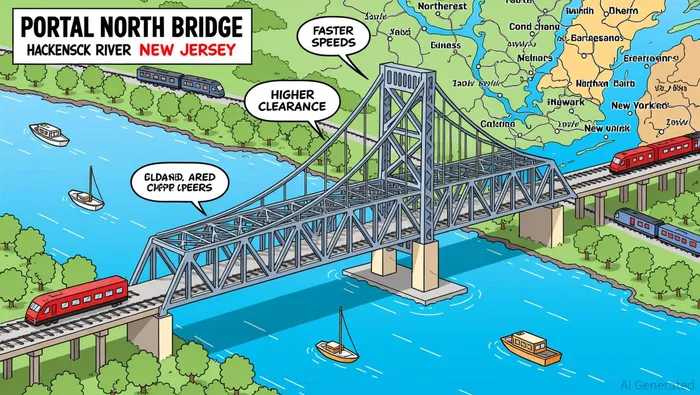
The new Portal North Bridge, a $2.3 billion project, is a critical replacement for the 116-year-old Portal Bridge, which required frequent slowdowns and bridge openings to accommodate river traffic. With its 50-foot elevation over the Hackensack River, the new bridge eliminates the need to halt or slow train traffic for marine vessels, which historically caused unpredictable delays. Trains can now travel at speeds of up to 90 mph on the new bridge, compared to the 60 mph limit on the old structure. As of March 16, one track was fully operational, with the second expected to switch over in October 2026. The full transition will allow for more consistent and faster service for both NJ Transit and Amtrak, which together operate hundreds of trains daily through this corridor.
This infrastructure upgrade isn’t just about speed. It’s about reliability — a key factor for commuters who rely on these services for daily travel between New Jersey and New York City. The new bridge is also designed with future growth in mind, with upgraded rail systems and additional capacity to meet rising demand. The project was funded by a mix of state, federal, and Amtrak support, including $766.5 million in federal grants, underscoring the broader public interest in modernizing the aging Northeast Corridor.
What Risks Come With Funding Trade-Offs in NJ Transit?
While the Portal North Bridge represents a major win for rail reliability, the broader picture for New Jersey’s transportation budget remains complex. Governor Sherrill’s proposed $60.7 billion state budget, announced in early March, includes $1 billion in NJ Transit subsidies, but it also redirects $140 million from the Clean Energy Fund to help cover transit costs. This move echoes prior administrations and has sparked criticism from environmental advocates who argue that the state’s clean energy goals — including solar, wind, and grid modernization — are being shortchanged.
The budget also adds $125 million to NJ Transit’s operating budget, funded through the same redirected clean energy resources. While the governor defends the shift by highlighting the environmental benefits of public transit, critics counter that the state’s underdeveloped energy infrastructure is already causing delays in connecting new renewable projects to the grid. There are also concerns about rising energy costs and the long-term impact of shifting funds away from renewable development. For investors, these budget decisions raise questions about the balance between transportation and clean energy priorities and whether New Jersey can maintain both at the expense of one another.
What to Watch in the Coming Months
By October 2026, the second track of the Portal North Bridge will switch over, allowing all rail traffic to transition to the new structure. This will mark the full retirement of the old bridge, which is scheduled for dismantling in 2027. Once completed, the project will serve as a model for future infrastructure upgrades across the Northeast Corridor, which is in dire need of modernization to support growing populations and economic activity.
Investors should also keep an eye on how the state handles the remaining challenges of the bridge project. While the March 13 incident was a success story for the new infrastructure, it also exposed the fragility of the old system. If the new bridge proves to be a scalable solution for aging transit corridors, it could signal broader opportunities for infrastructure investment across the country — a sector that’s increasingly gaining attention from both public and private investors.

Stay ahead of the market.
Get curated U.S. market news, insights and key dates delivered to your inbox.


AInvest
PRO
AInvest
PRO



Comments
No comments yet