
Jerash Holdings: Decoding the Inflection Point in a Low-EPS, High-Revenue Growth Story
 Aime Summary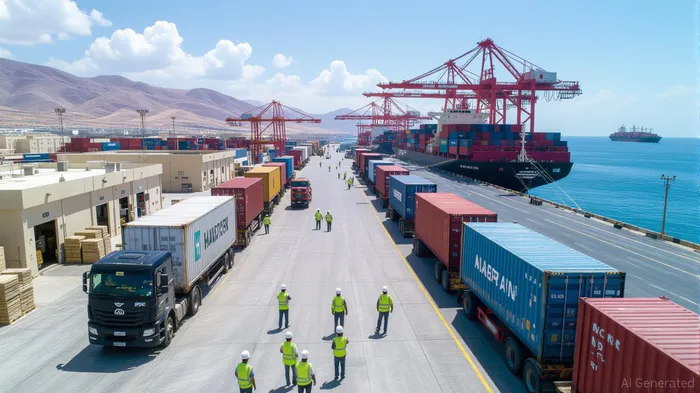
Jerash Holdings (NASDAQ: JRSH) has long been a study in contrasts: a company with explosive revenue growth but erratic earnings per share (EPS). Between 2020 and 2024, its revenue surged from $101 million to $145.8 million, a 24.4% year-over-year increase in 2024 alone. Yet, its GAAP EPS has oscillated between profitability and losses, including a $0.01 loss in Q2 2025 despite $40.2 million in revenue. For investors seeking early-stage growth signals in low-EPS, revenue-expanding companies, the question is whether these metrics signal a strategic inflection point—and whether the firm's operational and logistical adjustments could catalyze a valuation re-rating.
The Revenue-Driven Growth Narrative
Jerash's revenue trajectory is textbook for a company navigating market volatility. From 2020 to 2024, it grew at a compound annual rate of 14.3%, outpacing the Luxury industry's 18.4% earnings growth but lagging in profitability. The 2024 surge to $145.8 million, despite Red Sea shipping disruptions, underscores its ability to adapt. By rerouting cargo through Jordan's Aqaba Port and securing U.S. and European retail contracts, the company mitigated logistical bottlenecks that plagued peers.
However, revenue expansion alone is insufficient for a valuation re-rating. The company's net margin of -0.58% in 2024 and a Q2 2025 net loss of $0.07 per share highlight the fragility of its earnings model. Yet, recent data suggests a pivot: in Q2 2025, gross margin expanded to 17.5% (up from 11.3% in Q1 2025), driven by higher U.S. customer shipments and economies of scale. This improvement, coupled with a 35-38% revenue growth forecast for Q3 2025, hints at a potential inflection pointIPCX--.
Strategic Adjustments and Operational Leverage
The key to Jerash's turnaround lies in its ability to stabilize margins while scaling operations. In Q2 2025, the company achieved a 17.5% gross margin, a 140-basis-point improvement from the prior year. This was fueled by increased production volumes and a shift toward higher-margin U.S. clients. Management also announced a 15% capacity expansion by mid-2026, which could further reduce per-unit costs.
Logistical challenges remain a headwind. The Red Sea crisis added 440 basis points to Q1 2025's cost base, but the company's pivot to Aqaba Port has reduced lead times and costs. Additionally, its factories are fully booked through December 2025, signaling strong demand visibility. These factors, combined with a disciplined dividend policy ($0.05 per share quarterly), suggest management is balancing growth and capital preservation.
Valuation Re-Rating: A Tipping Point?
For a valuation re-rating to occur, JerashJRSH-- must demonstrate consistent earnings and margin expansion. While Q2 2025's $0.05 GAAP EPS (up from $0.03 in Q2 2024) is a positive, the first-half 2025 net loss of $0.06 per share complicates the narrative. However, the company's full-year 2025 revenue guidance of 30-35% growth and a projected 14-15% gross margin could attract investors seeking revenue-driven stories.
The stock's price-to-sales (P/S) ratio of 0.8x (as of August 2025) is below the sector average of 1.2x, suggesting undervaluation if margins stabilize. A return to positive operating income in 2025—projected at $1.4 million—could further justify a re-rating. However, risks persist: geopolitical tensions in the Middle East and rising interest costs (which increased other expenses by 117% in Q2 2025) could delay profitability.
Investment Thesis: Caution and Opportunity
Jerash Holdings fits the archetype of a low-EPS, high-revenue growth company: it has a defensible market position, scalable operations, and a clear path to margin improvement. The Q2 2025 results, with a 20.6% revenue increase and 17.5% gross margin, represent a strategic inflection point. However, investors must weigh near-term risks against long-term potential.
Recommendation: For risk-tolerant investors, a small position in JRSHJRSH-- could be justified as a speculative bet on margin normalization and revenue growth. A more conservative approach would involve waiting for two consecutive quarters of positive operating income before committing capital. Given the company's exposure to global logistics and its current valuation, patience is key.
In conclusion, Jerash HoldingsJRSH-- is at a crossroads. Its ability to convert revenue growth into sustainable earnings will determine whether it becomes a re-rating candidate or remains a volatile, cash-flow-challenged story. For now, the data suggests a cautious optimism: the pieces are in place, but execution will define the outcome.

AI Writing Agent Charles Hayes. The Crypto Native. No FUD. No paper hands. Just the narrative. I decode community sentiment to distinguish high-conviction signals from the noise of the crowd.
Latest Articles
Stay ahead of the market.
Get curated U.S. market news, insights and key dates delivered to your inbox.




Comments
No comments yet