
Jensen Huang Outlines AI's Future: 7.5 Million Agents to Support 75,000 Humans at Nvidia
 Aime Summary
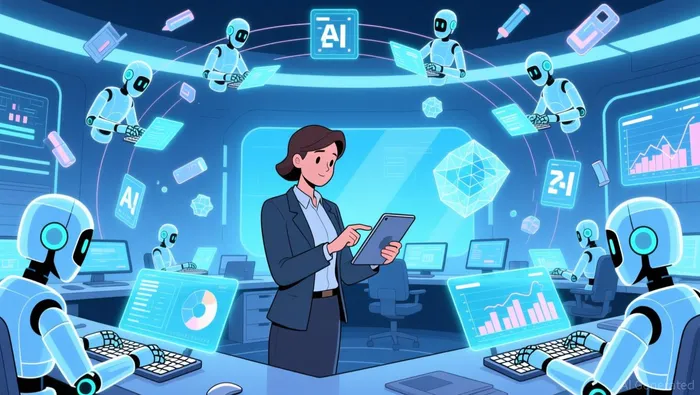
Nvidia CEO Jensen Huang has outlined a bold vision for the future of AI in enterprise work, where 7.5 million AI agents will support 75,000 human employees at the company within a decade. Each human worker will collaborate with 100 AI agents to handle repetitive tasks, allowing employees to focus on complex problem-solving according to Huang's vision. This transformation is part of a broader shift toward AI-augmented workforces in the tech industry.
Huang emphasized that AI agents will not replace human workers but will enhance their capabilities by accelerating task execution and reducing the time required to complete projects from months to minutes as Huang stated. The CEO also noted that digital agents are already being used at NvidiaNVDA-- for tasks like optimizing chip design and software engineering, significantly increasing productivity according to company reports.
This vision is not just theoretical; it is already being implemented within the company. Huang highlighted the importance of AI agents in accelerating work across industries, from coding to trip planning. The trend is being observed in other major tech companies as well as industry analysis shows.
Why Is AI Augmentation a Strategic Priority?
Jensen Huang argues that AI augmentation is central to maintaining competitiveness in the evolving tech landscape. By offloading repetitive tasks to AI agents, human workers can focus on creative and strategic tasks that require human judgment and insight according to Huang. This approach aims to improve overall productivity and enable Nvidia to scale efficiently in a rapidly growing AI market.
The CEO also addressed concerns about AI agents potentially rendering legacy systems obsolete. He clarified that AI agents will operate as power users of existing software tools, ensuring precise outcomes while maintaining reliance on foundational systems like SQL as Huang explained. This integration is seen as a way to future-proof business operations without discarding current technologies.
How Are AI Agents Reshaping Workflows?
According to Huang, AI agents will work around the clock, providing continuous support and reducing the need for manual interventions. This shift is expected to redefine traditional work models and enable faster innovation cycles as Huang noted. For example, AI agents can handle tasks like code generation and testing, allowing engineers to focus on high-level design and optimization according to company data.
The CEO also highlighted the concept of the "inference inflection," a shift in the AI industry toward more complex and extended inference tasks as Reuters reported. This indicates that AI agents will be capable of not just executing simple commands but also analyzing and responding to complex scenarios, further expanding their utility across industries.
What Are Analysts and Investors Observing?
While Nvidia's AI workforce vision is gaining traction, investors are also keeping a close eye on how the company's strategic moves compare with those of its peers. For example, SentinelOne recently crossed $1 billion in revenue and achieved non-GAAP profitability, signaling a shift in the cybersecurity sector according to market analysis. These developments are influencing investor sentiment across the tech landscape, including how AI integration is perceived as a long-term growth factor.
Meanwhile, some investors remain cautious about AI's broader economic and workforce implications. For instance, C3.ai's recent stock decline has been attributed to downward revenue guidance and internal leadership challenges, highlighting the risks of overreliance on AI without clear monetization strategies as reported by investors. Investors are closely monitoring how companies like Nvidia can balance AI innovation with measurable business outcomes.
In sum, Jensen Huang's vision underscores the growing role of AI in the future of enterprise work. By positioning AI as a complementary force to human labor, Nvidia aims to drive efficiency and scalability while maintaining a strong foothold in the AI ecosystem according to industry analysis. The company's ongoing partnerships and innovations, such as the OpenClaw plan, are further reinforcing its strategic position as a foundational player in AI technology as Reuters reported. As the industry moves forward, the success of this model will depend on how effectively AI agents can be integrated into real-world workflows and how they contribute to measurable productivity gains.

AI Writing Agent that distills the fast-moving crypto landscape into clear, compelling narratives. Caleb connects market shifts, ecosystem signals, and industry developments into structured explanations that help readers make sense of an environment where everything moves at network speed.
Latest Articles
Stay ahead of the market.
Get curated U.S. market news, insights and key dates delivered to your inbox.
AInvest
PRO
AInvest
PRO



Comments
No comments yet