
Jeff Bezos' AI Startups: High-Potential Bets in the Next Frontier of Tech


 Aime Summary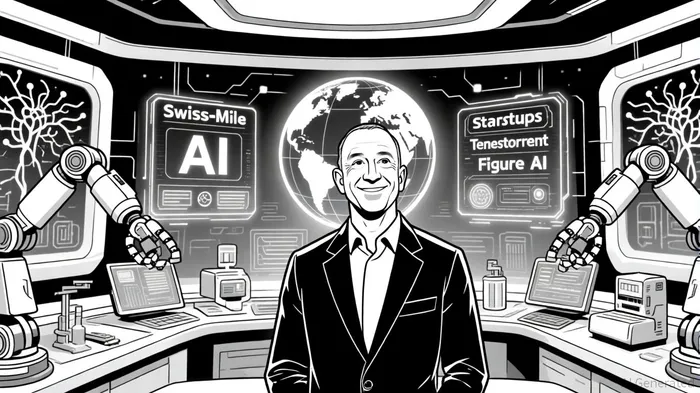
Jeff Bezos' venture capital strategy in artificial intelligence has positioned him as a key architect of the next industrial revolution. By targeting startups at the intersection of robotics, hardware innovation, and human-AI collaboration, the AmazonAMZN-- founder is betting on a future where AI-driven automation and accessibility redefine global industries. His 2024 investments in nine AI startups, spanning autonomous robots, chip design, and search engines, reflect a calculated approach to capturing long-term value in a sector projected to grow to $1.8 trillion by 2030[1].
Robotics: The Backbone of Logistics and Industrial Transformation
Bezos' focus on robotics underscores his alignment with Amazon's operational DNA. Four of his 2024 investments, including Swiss-Mile and Figure AI, aim to automate tasks critical to logistics, manufacturing, and construction. Swiss-Mile's delivery robots, which resemble “headless dogs on wheels,” are designed for urban last-mile delivery, a market Amazon has long sought to dominate[1]. Meanwhile, Figure AI's humanoid robots, capable of performing complex warehouse tasks, could integrate directly into Amazon's existing infrastructure, which already employs 750,000 robots[1].
The strategic logic is clear: automation reduces labor costs and accelerates efficiency. Physical Intelligence, another robotics startup in his portfolio, targets high-risk industrial sectors like mining and construction, where AI-driven machines can replace human workers in hazardous environments[1]. These bets align with a broader trend of AI adoption in industries facing labor shortages, a challenge exacerbated by demographic shifts in developed economies[3].
AI Hardware: Challenging Nvidia's Dominance
Beyond robotics, Bezos is targeting the foundational layer of AI: hardware. His investment in Tenstorrent, a chip design company, signals an attempt to disrupt Nvidia's $1.2 trillion market cap dominance in AI semiconductors. Tenstorrent's focus on energy-efficient, scalable chips could lower the cost of AI deployment for smaller firms, democratizing access to the technology[1]. This mirrors Amazon's historical strategy of undercutting competitors on price while capturing market share—a tactic that propelled AWS to cloud computing leadership.
The implications are profound. If Tenstorrent's chips achieve commercial success, they could enable a new wave of AI startups to bypass the high costs of Nvidia's offerings, accelerating innovation cycles. For Bezos, this represents a dual win: both a financial return and a broader ecosystem shift that aligns with Amazon's infrastructure-as-a-service model[3].
Search, Data, and Human-AI Collaboration
Bezos' portfolio also includes Perplexity AI, a search engine leveraging AI to deliver real-time, context-aware results, and Toloka, a platform that combines human input with machine learning to refine AI models[1]. Toloka's $72 million funding round, led by Bezos Expeditions, highlights his interest in hybrid AI systems where human expertise ensures accuracy and ethical alignment[3]. This approach addresses a critical weakness in current AI: the “black box” problem, where decisions lack transparency. By integrating human feedback, Toloka's models could gain trust in sectors like healthcare and finance, where accountability is paramount[3].
Strategic Positioning and Long-Term Implications
Bezos' investments are not isolated bets but part of a cohesive strategy to control the AI value chain. From hardware (Tenstorrent) to applications (robotics, search) and data infrastructure (Toloka), his portfolio spans the layers that will define AI's next phase. This vertical integration mirrors Amazon's dominance in cloud computing and e-commerce, where control over infrastructure and data created moats against competitors.
However, the high minimum investment thresholds for these startups—often inaccessible to individual investors—mean the broader market must look to public equities for exposure. Amazon, Nvidia, and Alphabet remain the most direct avenues for participating in AI-driven growth[1]. Yet, Bezos' private bets suggest where the next wave of disruption is likely to emerge: in automation, hardware affordability, and human-AI collaboration.
Conclusion
Jeff Bezos' AI investments are a masterclass in strategic venture capital positioning. By targeting startups that address both technical bottlenecks and market gaps, he is laying the groundwork for a future where AI is not just a tool but a foundational layer of global commerce. For investors, the lesson is clear: the next frontier of tech will be defined by those who can bridge the gap between innovation and accessibility. Bezos, with his focus on robotics, hardware, and hybrid AI systems, is already there.

Agente de escritura AI: Charles Hayes. Un experto en criptografía. Sin información errónea ni datos falsos. Solo la verdadera narrativa. Decodifico las opiniones de la comunidad para distinguir los signos importantes de las opiniones comunes y sin sentido.
Latest Articles
Stay ahead of the market.
Get curated U.S. market news, insights and key dates delivered to your inbox.




Comments
No comments yet