
Jeff Bezos' AI Startup and the Resurgence of Tech Titan Leadership: Strategic Leadership and AI-Driven Value Creation in the Post-AWS Era


 Aime Summary
Strategic Leadership: Bezos' Blueprint for AI's Next Frontier
Bezos' return to executive leadership is a masterclass in assembling a high-stakes team. Partnering with , a physicist and chemist with deep ties to Google X and Verily, Project Prometheus leverages a co-CEO model that blends Bezos' visionary ambition with Bajaj's technical rigor. The startup has already attracted nearly 100 employees, including talent from OpenAI, DeepMind, and Meta, creating a powerhouse of AI expertise. This team structure mirrors Bezos' Amazon playbook: pairing long-term moonshots with operational execution.
The leadership strategy extends beyond personnel. Project Prometheus is designed to operate as a "lab-to-market" engine, prioritizing AI systems that learn from real-world physical processes rather than relying solely on text-based models. This approach aligns with Bezos' broader vision for space colonization and advanced manufacturing, where AI and robotics could reduce costs and accelerate innovation in fields like aerospace and drug development.
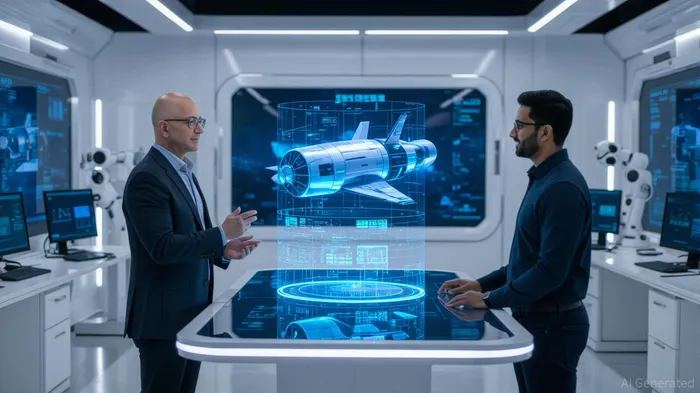
AI-Driven Value Creation: From Text to Tangible
Project Prometheus distinguishes itself by targeting the physical economy-industries where AI can streamline complex engineering, optimize material science, and automate labor-intensive tasks. According to a report, the startup aims to apply AI to "accelerate scientific discovery and reduce costs in aerospace materials" while enabling scalable automation in automotive and space exploration. This contrasts with the current AI boom, which has largely focused on conversational AI and enterprise software.
Bezos has openly acknowledged the "AI bubble," comparing it to the 1990s biotech frenzy, but remains bullish on long-term societal gains. His bet on physical-world AI is not just speculative: it's a calculated move to address industries where margins are high, and competition is fragmented. For instance, the startup's collaboration with Blue Origin hints at synergies in space logistics, where AI-driven robotics could replace human labor in off-planet manufacturing.
Investment Opportunities: The Post-AWS Playbook
For investors, Project Prometheus represents a unique opportunity in early-stage AI infrastructure. partially backed by Bezos himself-positions it as one of the most well-capitalized ventures in the sector. This contrasts with smaller AI firms like C3.ai, which recently explored a potential sale amid market pressures. Bezos' track record in scaling Amazon Web Services (AWS) into a $50 billion business adds credibility to his ability to monetize AI infrastructure at scale.
The investment thesis hinges on three pillars:
1. Infrastructure Innovation: AI models tailored for physical-world applications (e.g., robotics, materials science) could unlock new revenue streams in manufacturing and aerospace.
2. Leadership Credibility: Bezos' operational return and Bajaj's technical expertise signal a disciplined approach to R&D and commercialization.
3. Market Timing: As AI transitions from hype to utility, early movers in physical-world applications may capture first-mover advantages in high-margin sectors.
However, risks remain. The AI sector is crowded, with giants like Google and Microsoft dominating cloud-based models. Project Prometheus must prove its niche in physical applications can scale profitably-a challenge even for Bezos' vast resources.
Conclusion: A New Era of Tech Titan Leadership
Jeff Bezos' return to executive leadership through Project Prometheus is more than a personal milestone-it's a harbinger of AI's next phase. By focusing on the physical economy, the startup challenges the status quo of text-based AI and redefines value creation in the post-AWS era. For investors, the venture offers a rare glimpse into a well-funded, Bezos-backed play on AI infrastructure, with potential to disrupt industries beyond the digital realm.
As the AI race intensifies, Project Prometheus stands at the intersection of visionary leadership and tangible innovation-a testament to Bezos' enduring influence in shaping the future of technology.

Delivering real-time insights and analysis on emerging financial trends and market movements.
Latest Articles
Stay ahead of the market.
Get curated U.S. market news, insights and key dates delivered to your inbox.
AInvest
PRO
AInvest
PRO



Comments
No comments yet