
The JDG Premium: Decoding the LPL Ascend Market Between Skewed Odds and Handicap Contradictions
 Aime Summary
Lead
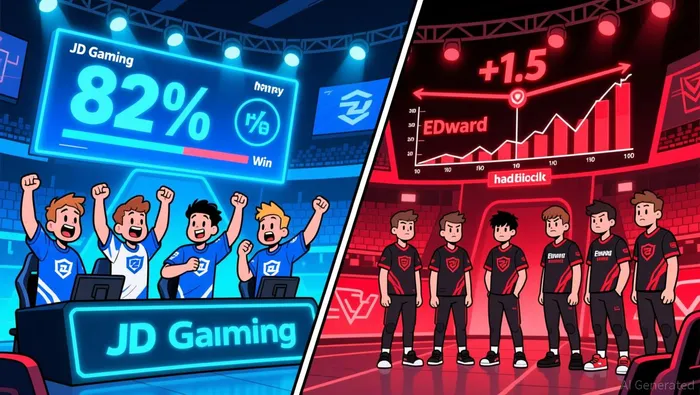
A Polymarket contract on JD Gaming versus EDward Gaming in the LPL Group Ascend shows a striking divergence: the series winner market prices JDG as a heavy favorite near 82%, yet the handicap market suggests a coin-flip margin of victory. This analytical disconnect is the core puzzle. This article examines whether the skewed pricing reflects genuine team strength, how recent news catalysts have shifted sentiment, and what the resolution rules and liquidity profile reveal about the market’s current stability.
Event Definition
This market bets on the winner of a best-of-three League of Legends match between JD Gaming and EDward Gaming in the LPL Group Ascend. The scheduled start time is August 7, 2026, at 13:00 UTC. The central disagreement is not just about who wins, but the expected margin of victory. The series winner market implies a high probability of a JDG win, while the handicap market prices EDward Gaming +1.5 as a slight favorite, indicating a belief that the match will be much closer than the outright odds suggest.
Latest News & Information Increments
The current market is operating in a low-information environment regarding the specific teams. A scan of the available news flow shows no direct reports on JD Gaming or EDward Gaming’s recent roster changes, scrim results, or internal performance metrics. The broader esports context is quiet, with no major LPL structural announcements or meta-shifting patches dominating headlines. This absence of direct catalysts means the market is likely pricing in historical team strength and long-term reputation rather than reacting to a fresh, discrete event.
In a low-catalyst regime, price movements are often driven by shifts in positioning and sentiment rather than new fundamental information. Without a headline to anchor expectations, the current price reflects a consensus built on prior data, making it potentially sticky but also vulnerable to an overreaction if a single piece of meaningful news emerges. The lack of news does not mean the price is correct; it means the price has not been recently stress-tested by a new information increment.
Market Resolution Rules Analysis
The market resolves based on the official winner of the match, as determined by the primary source, gol.gg. The contract specifies a clear time boundary: the match must produce a winner by August 7, 2026, at 13:00 UTC. If the match is canceled, ends in a tie, or is delayed for more than seven days without a winner being determined, the market resolves to 50-50, effectively refunding all positions at an equal value. A team forfeiting before the match starts also triggers this 50-50 resolution. If the primary source fails to publish results within two hours of the match’s conclusion, a consensus of credible reporting, including video evidence, can be used as a fallback.
Rule Risk Points & Disputed Scenarios
The primary risk is a technical delay or cancellation. A prolonged server issue or venue problem could push the match beyond the seven-day threshold, triggering a 50-50 resolution. This outcome would be a significant loss for traders holding a position at a high premium, such as JDG at 82%, as their expected value would be halved instantly. A secondary risk involves source latency. If gol.gg experiences an outage, the two-hour fallback window introduces a period of uncertainty where the market’s resolution depends on a subjective "consensus of credible reporting," a less binary standard than a single official source. A third, tail-risk scenario is a pre-match forfeit, which also resolves to 50-50, nullifying any perceived team strength advantage.
Market Overview
The series winner market, with JD Gaming trading at a last price of 0.82 and a mid-price of 0.815, implies a win probability of roughly 82%. This is a high-confidence bet, suggesting the market views JDG as a dominant force in this matchup. However, the Game Handicap market tells a different story. Here, EDward Gaming +1.5 is trading at a last price of 0.55 with a mid-price of 0.545, near the 0.5 threshold. This indicates a near-consensus that the match will be competitive, with EDG expected to win at least one game or keep the series close. The simultaneous pricing of a JDG outright win and an EDG handicap cover creates a tension: the market believes JDG will win, but not dominantly.
The series market shows a price middle score of 0.2, reflecting low disagreement and a strong skew, while the handicap market scores 0.875, indicating high disagreement and a balanced view. The series market also has a deeper liquidity pool, with a liquidity number of approximately 278,811 compared to 184,536 for the handicap market, though the handicap market has seen higher 24-hour trading volume, suggesting more active repositioning around the margin of victory.
Market Dynamics (Volatility & Volume)
The series winner market has experienced a significant 30% price change over the past week, a major repricing event that indicates a strong shift in long-term sentiment. However, the one-day change is a more modest 3%, suggesting that the bulk of this repricing occurred earlier and has since stabilized. The handicap market, by contrast, shows a smaller one-week change of 4.5% but a one-day upward move of 5% for EDward Gaming, pointing to a more recent, incremental shift in expectations toward a closer series.
This price action is supported by genuine trading activity. The 24-hour volume of roughly $110,000 falls into a strong range, indicating that the recent price discovery is not occurring in a vacuum. The series market’s high liquidity number and the handicap market’s higher relative turnover both suggest efficient price discovery with tight 0.01 bid-ask spreads. The divergence in signals—a high-volume, high-liquidity market with a stark probability skew between outright and handicap contracts—is not a sign of a thin or manipulated market but rather a genuine puzzle of interpretation. The volume confirms that traders are actively committing capital to both sides of this structural disagreement.
Trading Judgment & Follow-up Observation Points
The current pricing structure is a bet on JDG’s ability to win a close series. The outright price of 82% embeds a significant premium that is highly vulnerable to the 50-50 cancellation or delay rule. Going forward, the most critical variable to track is any pre-match statement from either team or the LPL regarding player health or technical readiness, as this would be the first true catalyst in a low-news environment. The second key observation point is the live betting volume and price action in the handicap market immediately after Game 1. A JDG loss in the first game would likely cause a violent repricing in the series winner market, potentially creating a dislocation between the new probability and the still-high outstanding volume.

Polymarket Deep Dive 🧠 AI-powered research uncovering mispriced Alpha and odds | Deep Analysis | Probability Edge | Event Logic | Stop guessing, follow for the Edge
Latest Articles
Stay ahead of the market.
Get curated U.S. market news, insights and key dates delivered to your inbox.


AInvest
PRO
AInvest
PRO




Comments
No comments yet