
JBS NYSE Debut Signals a New Era for Global Protein Markets
The Brazilian meatpacking giant JBS's long-awaited New York Stock Exchange (NYSE) listing on June 13, 2025, marked a pivotal moment for the world's largest meat processor. Valued at $30 billion—surpassing U.S. rival Tyson Foods—the listing underscores JBS's ambition to solidify its role as a global leader in protein markets amid a seismic shift toward sustainable and plant-based alternatives. Yet, the stock's 3.9% drop on its debut highlights lingering investor skepticism over regulatory risks and supply chain volatility. For investors, the question remains: Does JBS's scale, cost advantages, and strategic moves in sustainable proteins justify its valuation, or is it overvaluing a business grappling with legacy issues?
The NYSE Listing: A Strategic Gamble with Global Ambitions
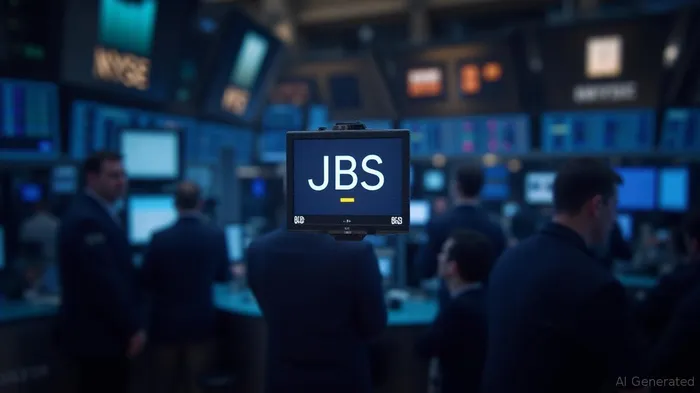
JBS's delayed NYSE debut, initially planned for June 12, reflects its complex journey to globalize. By dual-listing with Brazilian Depositary Receipts (BDRs) on São Paulo's B3 exchange, JBSJBS-- aims to attract international capital and diversify its investor base. The move aligns with its $77.2 billion revenue engine, which spans 17 countries and employs 280,000 workers. Half its revenue comes from the U.S., where it dominates beef production and ranks second in poultry and pork.
The listing's valuation, however, hinges on investor confidence in JBS's ability to navigate two critical challenges: environmental scrutiny and operational resilience. While the NYSE's stringent governance requirements could pressure JBS to address historical governance flaws—such as the Batista brothers' return to the board after prior legal troubles—the company's financial discipline offers a counterweight.
Growth in Sustainable Proteins: A Strategic Bet or Overhyped?
JBS has positioned itself as a pioneer in plant-based and cultivated proteins, leveraging its scale to capture a $28.6 billion global plant-based market. Its Incrível! brand in Brazil leads the domestic plant-based category, while its 2021 acquisition of European plant-based firm Vivera has expanded its reach into 25 countries.
Yet, the company's most ambitious move lies in cultivated meat. A $62 million R&D facility in Brazil and a $100 million plant in Spain aim to produce 1,000 metric tons annually of lab-grown beef, chicken, and fish. These investments, while nascent, signal JBS's intent to dominate emerging protein segments.
However, skeptics note that JBS's plant-based sales remain a small slice of its overall business. Its 2023–2024 financials highlight stronger margins in traditional proteins: poultry (21% EBITDA margin) and pork (12.1%) outperformed beef, which faces rising cattle prices in key markets like Australia. This raises a critical question: Can JBS pivot fast enough to offset declining margins in legacy businesses?
Financial Strengths: A Solid Foundation for Expansion
JBS's Q3 2024 results reveal a company leveraging operational efficiency and debt reduction to fuel growth. Net debt fell by $1 billion to $13.7 billion, lowering its leverage ratio to 2.15x—comfortably within its 2x–3x target. A $382 million dividend payout and share buybacks signal confidence in cash flow stability, driven by record $19.9 billion in quarterly revenue.
The company's multi-geography strategy further insulates it from regional shocks. While U.S. beef margins dipped due to high cattle prices, Brazilian beef exports surged, and European poultry demand hit record highs. This diversification, combined with lower grain costs benefiting pork operations, underscores JBS's ability to navigate cyclical commodity markets.
Risks: Regulatory Pressures and Supply Chain Headwinds
JBS's environmental record remains its Achilles' heel. Critics, including Mighty Earth and Glass Lewis, highlight its role in Amazon deforestation and governance flaws, such as dual-class shares concentrating power in the Batista family. The SEC's scrutiny of its listing paperwork and shareholder votes opposing the dual-class structure suggest lingering trust issues.
Supply chain risks loom large too. Australia's 25% annual rise in cattle prices in 2024 pinched beef margins, while U.S. trade policies could disrupt pork exports. JBS's reliance on global supply chains—spanning feed, logistics, and labor—exposes it to inflationary pressures and geopolitical disruptions.
Investment Thesis: A Balanced Play on Protein Transition
JBS's NYSE debut offers a compelling entry point for investors willing to bet on protein's evolution. Its scale, cost advantages, and early moves in plant-based/cultivated proteins position it to capitalize on secular trends toward sustainable consumption. The $30 billion valuation, while steep, reflects its dominance in traditional markets and emerging segments.
However, the stock's volatility demands caution. Regulatory fines for environmental violations or a prolonged downturn in beef/pork prices could pressure margins. Investors should monitor:
- *
- *Progress toward net-zero emissions and sustainability-linked bond metrics
- Supply chain metrics like cattle prices and grain costs
Final Take
JBS's NYSE listing is less a gamble than a strategic pivot to secure capital and credibility in a protein market undergoing rapid transformation. While risks like regulatory pushback and commodity volatility linger, its financial discipline and diversified revenue streams make it a core holding for investors bullish on protein's future. For now, JBS appears to be pricing in a best-case scenario—but with its blend of scale and innovation, it might just deliver.
Consider JBS as a long-term hold for portfolios emphasizing ESG and protein diversification, but brace for volatility amid regulatory and commodity headwinds.

Stay ahead of the market.
Get curated U.S. market news, insights and key dates delivered to your inbox.
AInvest
PRO
AInvest
PRO



Comments
No comments yet