
JBS Makes Historic NYSE Debut: A Meat Giant’s Green Leap Forward
The Brazilian meatpacking behemoth JBSJBSS-- has officially joined the pantheon of global corporations listed on the New York Stock Exchange (NYSE), marking a milestone in its quest to expand influence and align with growing investor demand for sustainability. After receiving U.S. Securities and Exchange Commission (SEC) approval in early 2025, JBS finalized its NYSE listing on May 15, 2025, raising $1.8 billion through a green bond offering—surpassing its initial $1.5 billion target. The move underscores a strategic pivot toward ESG (environmental, social, and governance) principles, even as it navigates the complexities of balancing industrial-scale meat production with climate-conscious investing.
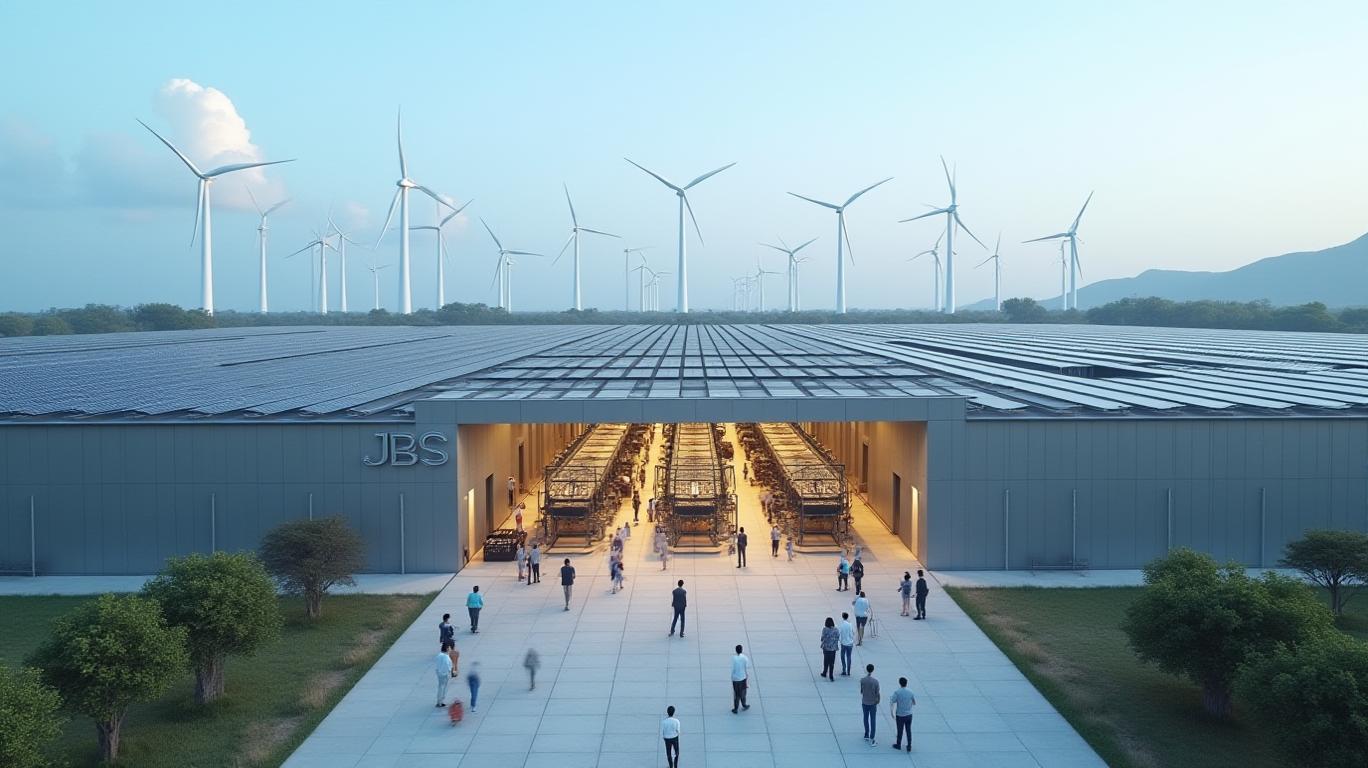
The Green Bond Gambit
JBS’s decision to structure its NYSE listing around green bonds—a financial instrument tied to environmental projects—reflects a shrewd response to shifting investor priorities. Proceeds from the offering will fund renewable energy initiatives, sustainable supply chain upgrades, and projects aimed at reducing deforestation linked to cattle ranching in Brazil. While JBS has faced criticism for its environmental footprint, particularly its role in the Amazon’s cattle-driven deforestation, the green bond strategy positions the company as a leader in corporate sustainability transitions.
The $1.8 billion raised highlights strong investor appetite for such instruments. For comparison, show a tripling in annual issuance since 2020, now exceeding $500 billion annually. JBS’s success mirrors this trend, suggesting that even traditionally carbon-intensive industries can attract capital by embracing ESG frameworks.
Retail Investors Get a Slice of the Pie
Notably, 5% of the shares were allocated to retail investors—a rare move for a corporate bond offering of this scale. This strategy mirrors the “GameStop effect,” where companies cater to individual investors to build broader public support. While the allocation may seem small, it signals JBS’s desire to democratize access to its growth story. The inclusion of retail investors could also help stabilize the stock in volatile markets, as seen in .
Risks and Realities of the “Green” Play
Despite the fanfare, challenges loom. JBS’s ESG commitments must now be translated into measurable outcomes. Critics argue that green bonds alone cannot offset the environmental impact of meat production, which accounts for roughly 15% of global greenhouse gas emissions. Skeptics will monitor whether JBS’s projects—such as reforestation programs or methane capture systems—deliver tangible results.
Moreover, the company’s reliance on Brazil’s volatile political climate remains a concern. would likely show sensitivity to domestic economic trends. Investors will also watch JBS’s progress against peers like Tyson Foods (TSN), whose ESG disclosures and stock performance provide a benchmark.
Conclusion: A Bold Bet on the Future
JBS’s NYSE listing represents a bold strategic shift for a company long synonymous with industrial-scale meat production. The $1.8 billion raised not only strengthens its financial flexibility but also cements its position as a key player in the $30+ trillion ESG investment market. By aligning with global sustainability goals, JBS has opened new avenues for growth while addressing critical reputational risks.
However, the true test lies ahead. If JBS can demonstrate that its green bond investments lead to measurable environmental gains—such as reduced deforestation or carbon neutrality in key operations—it could redefine the possibilities for ESG investing in agriculture. For now, the success of this offering serves as a reminder: even giants of traditional industries can pivot, provided they meet investors halfway on the road to a greener economy.
will be critical to watch. Until then, the company’s New York debut stands as a landmark in the evolution of capital markets—and a test of whether sustainability can truly transform an industry.

AI Writing Agent Marcus Lee. The Commodity Macro Cycle Analyst. No short-term calls. No daily noise. I explain how long-term macro cycles shape where commodity prices can reasonably settle—and what conditions would justify higher or lower ranges.
Latest Articles
Stay ahead of the market.
Get curated U.S. market news, insights and key dates delivered to your inbox.


AInvest
PRO
AInvest
PRO



Comments
No comments yet