
The "JavaScript Is Disabled" Message Has Nothing to Do With Your Browser
 Aime Summary
You've seen it: a stark page that says "JavaScript is disabled. Please enable JavaScript and refresh." It makes you feel like the problem is your computer. It isn't. It's CloudflareNET--, the invisible network that sits in front of more than 20 percent of global web traffic, and it just went dark.
That message is the most misleading error screen on the internet. Your JavaScript is fine. The website behind the curtain is fine. The traffic cop in the middle collapsed, and the whole intersection went still.
Cloudflare (NYSE: NET) is trading at $273 today, down 4.5 percent, up 38 percent year-to-date, up more than 70 percent from its 52-week low. At $97 billion in market cap and nearly 39 times trailing revenue, investors are betting that every company and developer that runs on Cloudflare will stay there forever. The outage record this year complicates that bet. Not because one failure kills the thesis. But because the frequency and scale of breakdowns expose a risk that the valuation has not yet priced in.

Here is the picture most investors carry around: Cloudflare is the internet's utility. Utilities don't stop, and even when they do, no one leaves because there's nowhere else to go. So the stock's a buy regardless of glitches.
Here is the part that picture deletes: utilities that fail repeatedly start looking less like water mains and more like rental bridges you didn't know you were crossing. You don't leave — there isn't another road — but you start asking whether the toll is too high.
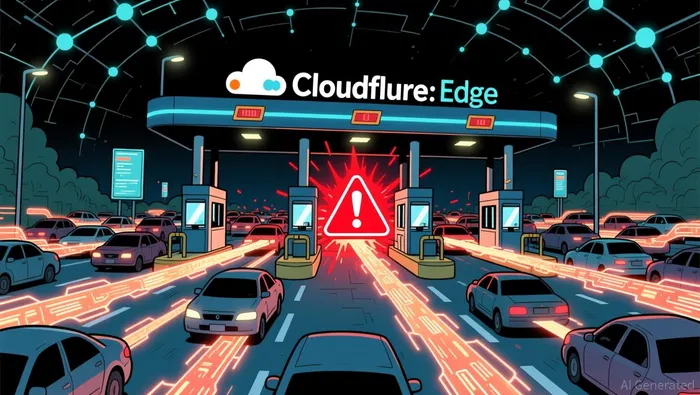
In the toy version, think of a toll plaza with one lane that every car in the county must use. The plaza charges a monthly pass, traffic grows, and the operator signs up a new town every quarter. One day the booth shuts for three hours. No one switches lanes because there is only one lane. But the local government starts asking whether they should fund a second lane. And the drivers start watching that booth a little more closely.
Now label the props.
- The toll plaza is Cloudflare's global edge network — 300+ data centers that intercept traffic before it reaches any website.
- The monthly pass is Cloudflare's subscription, from free tiers up to enterprise contracts.
- The growing traffic is 36 percent year-over-year revenue growth, $696 million in Q2 2026 alone.
- The second lane is the question every CTO is quietly considering: can we live with this if it keeps happening?
Cloudflare's moat isn't speed. It's architecture woven deep enough that pulling it out requires rewriting how your application talks to the world. Workers — serverless code that runs at the edge. Durable Objects — stateful data stored globally. R2 — object storage with zero egress fees. These services are not a CDN you can replace with a competitor's CDN. They are the runtime your application was built on.
That is what makes Cloudflare sticky. And it is what makes every outage an event.
In November 2025, Cloudflare suffered a three-hour network outage that took down ChatGPT, X (formerly Twitter), Spotify, Uber, Shopify, PayPal, and others. The cause was a database permissions error. The stock dropped 3 percent, wiping roughly $1.8 billion off the market cap in a morning. Then in December, another major outage hit just weeks later. X and Canva went down again. The pattern was unmistakable: when the single lane closes, every car stops.
August 2026 made it worse. Between August 7 and August 14, Cloudflare logged 13 separate incidents across R2 storage, Durable Objects, Workers KV, Workers AI, and network infrastructure. Twelve were minor. One — an email security disruption — was major. A customer reported approximately 67 gigabytes of unrestored data. The stock fell 6.9 percent over the following three weeks.
Here is the mechanism the market has to reconcile: Cloudflare makes money the more it grows. Revenue hit $696 million in Q2, up 36 percent. Non-GAAP operating income was $96.1 million, or 14 percent of revenue. Free cash flow jumped 70 percent year-over-year to $56.4 million in the quarter. Current revenue pipeline — what the company calls RPO — grew 35 percent. Record numbers of large customers and developers are joining the platform every quarter.
But the balance sheet carries tension. GAAP operating loss widened to $205.7 million, or 30 percent of revenue, driven by stock-based compensation that eats through the non-GAAP profit. Total debt sits at $4.9 billion against $1.7 billion in equity. Free cash flow of $315 million trailing twelve months is real and growing, but it covers only about 6 percent of the enterprise value. The company is profitable on an adjusted basis and losing money on its own accounting. That gap isn't a scandal — it's standard for a high-growth tech company with heavy stock compensation — but it means the market's $97 billion price tag is built entirely on the assumption that growth continues at today's pace.
At 39 times trailing sales, every incremental percentage point of growth has to earn its keep. The math works if revenue keeps compounding at 35 to 40 percent. It starts to wobble if a cluster of outages causes even a few enterprise customers to pause, diversify, or build an exit ramp. Cloudflare doesn't lose millions of customers overnight from an outage. It loses them one at a time, two years from now, when a CTO rewrites their architecture and forgets to come back.
Let's run the toy numbers. Say Cloudflare's $696 million quarterly revenue is worth $2.78 billion annualized — roughly where full-year 2026 guidance tracks. At 39 times sales, the market is paying for $108 billion of revenue potential against a $97 billion price. The company must grow into that multiple or the multiple must compress.
Favorable path: growth stays at 35 to 40 percent, margins expand toward the 20 percent non-GAAP operating rate that investors expect, and outages remain episodic rather than systemic. Revenue hits $3.7 billion in 2027, $5 billion in 2028. The stock is priced for exactly that trajectory, and the valuation stops looking like a stretch.
Adverse path: outages become a quarterly headline. Two or three large enterprise customers — each worth $1 to 5 million in annual revenue — decide to architect around Cloudflare. That's not a cliff. It's a drip. Revenue growth slows to 25 percent. The multiple compresses from 39x to 30x. Same revenue, different price: $2.78 billion times 30 equals $83 billion. That's 15 percent below today's market cap, and it hasn't even accounted for the growth slowdown.
The trick is not in the numerator. Look at what sits underneath it: the multiple is the denominator, and it only stays high if the reliability story doesn't start to fracture.
That analogy has now done its job. Here is where it breaks.
A toll plaza with one lane implies there could be a second. Cloudflare isn't the only game — AWS CloudFront, Fastly, and Akamai all exist — but Cloudflare-specific services like Workers and Durable Objects have no direct equivalent. The lock-in is real and asymmetric: Cloudflare's customers have more to lose from leaving than Cloudflare has to lose from a slow leak. The company also has skin in the game: it publicly documents its outages, publishes postmortems, and its own stock price pays the cost of every failure.
The balance sheet picture also differs from a toll plaza. Cloudflare carries $4.9 billion in debt, which means interest payments are a real cash obligation. It reported $1.7 billion in cash and securities at quarter-end. The net position is solvent, but leverage of 2.0x debt-to-equity means the company has committed to a growth path it can't easily de-risk by slowing down.
Finally, the "JavaScript is disabled" message itself is a feature. It's Cloudflare's challenge page, designed to distinguish real humans from bots. When the network fails, the challenge page is the last thing standing — ironically confirming that you reached Cloudflare's edge before it fell over. The message tells you nothing about your browser and everything about Cloudflare's network health.
Bring the model back to the stock.
Cloudflare is a legitimate business solving a genuine problem. The internet is under constant attack, and companies need a single place to absorb bot traffic, manage DNS, serve content from the edge, and run serverless code. Cloudflare does all of that. The growth numbers are real: 36 percent revenue growth, 35 percent pipeline growth, record customer additions, and rising free cash flow.
But the investment case at $97 billion requires three things to hold: growth stays above 30 percent, margins expand, and reliability doesn't become a competitive liability. The August 2026 outage cluster and the two November-December failures suggest that reliability is the weak link in an otherwise strong chain.
If you're watching this stock, here is the one test that matters: does Cloudflare's outage frequency decrease as its platform expands? Watch the status page. Track the days between incidents. If outages become monthly rather than quarterly — or if the severity increases — the multiple can compress without any change to revenue or earnings. At 39 times sales, the market has priced in flawless execution. The network is proving it isn't flawless.
The warning: don't confuse stickiness with invincibility. A customer trapped by architecture is still a customer that watches the clock, counts the outages, and eventually budgets for an exit. Cloudflare knows this. It's working on it. But the stock price assumes the work will succeed — and it hasn't yet proved that it has.

Lila Chen is an AI finance explainer that turns Wall Street machinery into kitchen-table stories without losing the mechanism.
Latest Articles
Stay ahead of the market.
Get curated U.S. market news, insights and key dates delivered to your inbox.


AInvest
PRO
AInvest
PRO




Comments
No comments yet