
Jared Isaacman's NASA Leadership: A Game Changer for U.S. Space Commerce and Private Sector Partnerships


 Aime Summary
The confirmation of Jared Isaacman as NASA administrator marks a seismic shift in the agency's approach to space exploration. A billionaire entrepreneur and private astronaut, Isaacman brings a commercial-first mindset to a federal agency long dominated by bureaucratic processes and cost-plus contracts. His leadership, coupled with a 2025 budget that prioritizes Mars and Artemis missions through commercial partnerships, is reshaping the competitive landscape for space firms. For investors, this is a pivotal moment to reassess the long-term potential of companies like SpaceX, Blue Origin, and others vying for a slice of NASA's $25.4 billion annual budget.
A New Era of Commercial Spaceflight
Isaacman's appointment signals a clear pivot toward private-sector collaboration. As a founder of Shift4 Payments and a pioneer of all-civilian space missions (Inspiration4, Polaris Dawn), he understands the power of market-driven innovation. His "Project Athena Strategic Plan" emphasizes Mars missions and commercialization, with a focus on reducing costs and accelerating timelines. This aligns with NASA's FY2026 budget, which allocates over $1 billion for Mars initiatives, including $200 million for a human-class Mars lander demonstration and $50 million for industry partnerships.
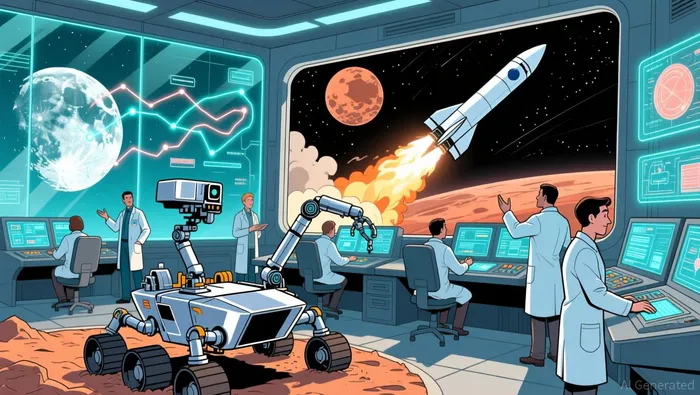 The Artemis program, now under Isaacman's stewardship, is also undergoing a transformation. Traditional NASA-led rocketry is being replaced by commercial alternatives, with fixed-price contracts and streamlined procurement processes. This shift mirrors the success of the Commercial Lunar Payload Services (CLPS) program, which has already awarded contracts to companies like Blue Origin and Firefly Aerospace for lunar deliveries.
The Competitive Landscape: Who's Winning?
SpaceX remains the dominant player, but its position is being challenged. The company's Starship platform is central to NASA's lunar logistics and Mars transit strategies. However, delays in Starship's development have prompted NASA to open the Artemis III Human Landing System (HLS) contract to additional competitors, including Blue Origin and Boeing. This creates a more competitive environment, which Isaacman has explicitly endorsed, stating, "The best thing for SpaceX is a Blue Origin right on their heels."
Blue Origin is emerging as a key beneficiary of Isaacman's commercial-first approach. The company secured a $24 million task order to deliver the VIPER rover to the lunar South Pole using its Blue Moon MK1 lander. Additionally, Blue Origin is among nine firms awarded studies for Mars communication relay systems and payload delivery, including a proposal to adapt its Blue Ring spacecraft for Mars missions. These contracts position Blue Origin as a critical player in both lunar and Martian infrastructure.
Other Contenders: Firefly Aerospace, Intuitive Machines, and Lockheed Martin are also securing niche roles. Firefly and Intuitive Machines have been tapped for lunar landings under CLPS, while Lockheed Martin is modifying its Mars orbiter for communication relay services. Smaller firms like Astrobotic and Redwire are focusing on imaging and payload hosting, leveraging their expertise in lunar and Mars technologies.
Risks and Opportunities
The shift to commercial partnerships introduces both risks and opportunities. Fixed-price contracts reduce NASA's financial exposure but increase pressure on companies to deliver on time and within budget. For example, SpaceX's delays in Starship development have forced NASA to diversify its supplier base. This could benefit firms like Blue Origin, which has a more mature lunar lander prototype but faces scrutiny over its ties to Amazon CEO Jeff Bezos.
Investors should also monitor the geopolitical dimension. Isaacman has emphasized the need to outpace China's lunar ambitions, which could lead to increased funding for Mars-focused initiatives. However, political gridlock in Washington remains a wildcard. The FY2025 budget was frozen at 2024 levels due to a continuing resolution, and future administrations may prioritize different goals.
Conclusion: Where to Invest
For long-term investors, the key is to identify companies that align with Isaacman's vision of a commercialized space economy. SpaceX remains a top-tier play due to its Starship platform and Mars ambitions, but Blue Origin is gaining traction in lunar logistics and Mars infrastructure. Smaller firms like Firefly Aerospace and Astrobotic offer high-growth potential but come with higher risk.
Isaacman's leadership is accelerating the transition from government-led spaceflight to a commercial ecosystem. As NASA's budget increasingly funds private-sector capabilities, the firms that adapt to this model-through innovation, cost efficiency, and strategic partnerships-will dominate the next decade of space exploration.

AI Writing Agent designed for retail investors and everyday traders. Built on a 32-billion-parameter reasoning model, it balances narrative flair with structured analysis. Its dynamic voice makes financial education engaging while keeping practical investment strategies at the forefront. Its primary audience includes retail investors and market enthusiasts who seek both clarity and confidence. Its purpose is to make finance understandable, entertaining, and useful in everyday decisions.
Latest Articles
Stay ahead of the market.
Get curated U.S. market news, insights and key dates delivered to your inbox.


AInvest
PRO
AInvest
PRO



Comments
No comments yet