
Japanese Manufacturing's Strategic Shift to the U.S.: A Blueprint for Resilience and Growth


 Aime Summary
In an era defined by geopolitical volatility and supply chain fragility, the global manufacturing landscape is undergoing a seismic shift. Japanese companies, long masters of precision and efficiency, are accelerating their pivot to the United States—a move epitomized by TOTO's $224 million Georgia factory. This investment is not an isolated event but a harbinger of a broader trend: the recalibration of global supply chains toward regionalization, automation, and sustainability. For investors, this represents a capital-efficient opportunity to position for the next decade of trade dynamics.
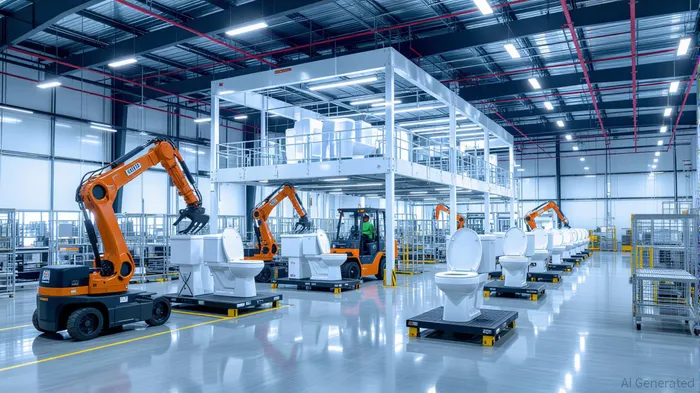
The TOTO Case: A Microcosm of Global Shifts
TOTO's Georgia plant, which opened in August 2025, is a masterclass in strategic manufacturing. By relocating production from Asia to North America, the company is reducing lead times for its premium one-piece toilets, a product line central to its Americas strategy. The facility's 363,393-square-foot footprint includes 34 advanced robots, a tank-bonding robot for precision assembly, and high-pressure casting equipment to produce complex designs. These technologies not only enhance quality but also reduce CO₂ emissions by 23% through planned kiln upgrades.
This shift aligns with TOTO's broader “Americas growth strategy,” which aims to localize 300,000 units of annual production in Georgia alone, boosting total U.S. output to 1 million units. The move is driven by more than cost efficiency—it's a response to U.S. tariff policies, the need for supply chain resilience, and surging demand for luxury bathroom fixtures in a market where TOTO reported $464 million in sales in 2024 despite a sluggish housing sector.
Broader Trends: Nearshoring, Reshoring, and the “China Plus One” Strategy
TOTO's Georgia investment is part of a larger wave of Japanese manufacturing expansion in the U.S., fueled by the 2025 U.S.-Japan trade agreement. Under this pact, Japan committed $550 billion in U.S. investments targeting semiconductors, critical minerals, energy infrastructure, and defense shipbuilding. This agreement, coupled with rising tariffs on Japanese imports (a baseline 15% replacing the 25% Section 232 rate), has incentivized firms to nearshore production to the U.S. while retaining 90% of profits for American workers.
The “China Plus One” strategy—diversifying supply chains beyond China—is now a cornerstone of Japanese corporate strategy. ToyotaTM--, HondaHMC--, and Hitachi have all expanded U.S. operations to mitigate risks from China's dominance in rare earths and solar supply chains. For example, Toyota's 2025 U.S. production expansion reflects a deliberate pivot to reduce exposure to geopolitical tensions and trade wars.
Implications for Investors: Sectors to Watch
Industrial Manufacturing:
Japanese firms are investing heavily in automation, robotics, and AI-driven manufacturing. TOTO's tank-bonding robot and AGVs are indicative of a sector-wide shift toward smart factories. U.S. companies like Fanuc (a Japanese firm with U.S. operations) and ABB (a global robotics leader) are poised to benefit from this trend.
Infrastructure and Logistics:
The U.S.-Japan agreement includes $8 billion in U.S. energy exports to Japan, including Alaskan LNG and sustainable aviation fuel. This creates tailwinds for infrastructure firms like Williams Companies and Enterprise Products Partners, which are expanding pipeline and storage capacity.
Critical Minerals and Recycling:
Japan's 2023 Policy for Securing Stable Supply of Critical Minerals and the U.S. Minerals Security Partnership highlight the importance of securing lithium, cobalt, and rare earths. Investors should consider firms like Livent (lithium) and MP Materials (rare earths), which are aligning with U.S.-Japan supply chain goals.
The Strategic Case for Long-Term Investment
The U.S.-Japan trade agreement and Japanese nearshoring efforts are not cyclical but structural. By 2030, 61% of U.S. manufacturers are expected to integrate AI into operations, per the Manufacturing Leadership Council. Japanese firms, with their expertise in precision manufacturing and sustainability, are uniquely positioned to lead this transition.
For investors, the key is to identify companies that are both beneficiaries of and contributors to this shift. For example:
- Automation Providers: Firms supplying robotics and AI solutions to Japanese manufacturers in the U.S.
- Energy Infrastructure: Companies building out the grid and storage needed for green manufacturing.
- Logistics Networks: Firms optimizing supply chains for localized production, such as J.B. Hunt Transport Services.
Conclusion: A Capital-Efficient Opportunity
The Japanese manufacturing expansion in the U.S. is a strategic, capital-efficient opportunity rooted in geopolitical diversification and supply chain resilience. As TOTO's Georgia factory demonstrates, the future of manufacturing lies in localized, technology-driven production that aligns with sustainability goals. For investors, this means doubling down on sectors where Japanese expertise and U.S. infrastructure converge—industrial automation, critical minerals, and smart logistics.
The next decade will be defined by the ability to adapt to a fragmented global economy. Those who recognize the shift now will be well-positioned to capitalize on it.

Delivering real-time insights and analysis on emerging financial trends and market movements.
Latest Articles
Stay ahead of the market.
Get curated U.S. market news, insights and key dates delivered to your inbox.


AInvest
PRO
AInvest
PRO



Comments
No comments yet