
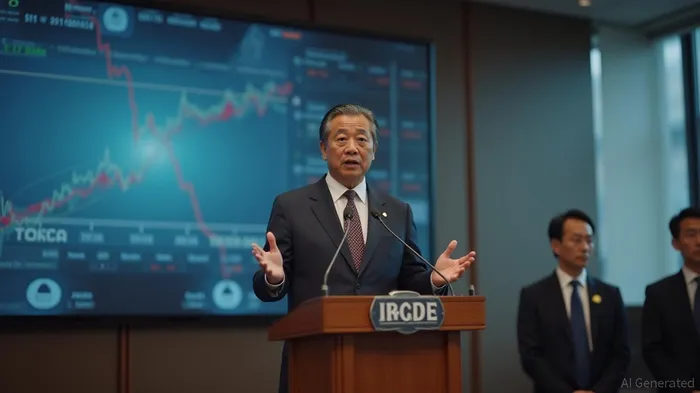
Japanese finance minister R Katsunobu Kato speaks in Tokyo
ByAinvest
Monday, Sep 1, 2025 10:18 pm ET2min read
Japanese finance minister R Katsunobu Kato speaks in Tokyo
In a press conference held in Tokyo on July 2, 2025, Japanese Finance Minister R Katsunobu Kato addressed the escalating concerns surrounding the country's debt management and bond yields. The minister's comments came in response to the recent record-high yields on Japanese government bonds (JGBs) and the broader implications of U.S. President Donald Trump's attempt to oust Federal Reserve Governor Lisa Cook.The 30-year JGB yield reached an all-time peak of 3.215% on Tuesday, July 1, 2025, following a 5 basis point jump in similarly dated U.S. Treasury yields. This increase was attributed to expectations of higher inflation under a potentially more dovish central bank, which could prioritize support for the labor market over taming consumer prices [1]. The unprecedented highs for the longest-dated JGB yields complicate Tokyo's aim to manage its significant debt burden, which stands at around 250% of GDP.
Minister Kato stated that the Ministry of Finance would closely monitor the JGB market movements and pursue appropriate debt management strategies. The ministry plans to request more than 32 trillion yen ($217.2 billion) for debt-servicing costs in the next financial year, a record amount. Harry Ishikawa, an independent macro strategist, noted that the Ministry of Finance would likely tweak issuance or other measures to cap the yields [1].
Japan's vulnerability to interest rate moves in other markets is a significant concern. As the world's biggest creditor nation, with among the lowest sovereign yields globally, Japanese markets are highly sensitive to U.S. bond yields. Japan held $2 trillion of U.S. assets at the end of 2023, and that pile has been growing as returns on U.S. bonds rise. Japanese investors seeking better yields abroad and foreign investors locking in yen-carry trades have meant JGB yields move in virtual lock-step with Treasuries [1].
The potential departure of Federal Reserve Governor Lisa Cook, if successful, could further unsettle markets. Trump's attack on Cook ratchets up his campaign to exert more influence over the path of monetary policy, further knocking confidence in U.S. sovereign debt as a safe investment [1]. Even without Cook's removal, the uncertainty surrounding U.S. monetary policy is causing ripples in global financial markets.
Minister Kato emphasized the need for coordinated efforts to manage the debt and maintain market stability. He noted that the ruling coalition's defeat in the upper house elections has ceded more influence to opposition parties promoting deficit-funded consumption tax cuts, which could exacerbate fiscal discipline concerns. Shigeru Ishiba's refusal to resign has also raised concerns that discussions on a supplementary budget could be delayed, potentially pushing yields higher [1].
In conclusion, the recent developments in the JGB market highlight the delicate balance between debt management, fiscal discipline, and monetary policy. Minister Kato's comments underscore the need for strategic debt management and market stability, as Japan navigates the complex landscape of global financial markets.
References:
[1] https://www.yahoo.com/news/articles/trumps-fed-battle-raises-risks-081409466.html
[2] https://www.zawya.com/en/capital-markets/equities/egyptian-government-considering-incentives-for-large-ipos-says-finance-minister-snhw82c5
Stay ahead of the market.
Get curated U.S. market news, insights and key dates delivered to your inbox.


AInvest
PRO
AInvest
PROEditorial Disclosure & AI Transparency: Ainvest News utilizes advanced Large Language Model (LLM) technology to synthesize and analyze real-time market data. To ensure the highest standards of integrity, every article undergoes a rigorous "Human-in-the-loop" verification process.
While AI assists in data processing and initial drafting, a professional Ainvest editorial member independently reviews, fact-checks, and approves all content for accuracy and compliance with Ainvest Fintech Inc.’s editorial standards. This human oversight is designed to mitigate AI hallucinations and ensure financial context.
Investment Warning: This content is provided for informational purposes only and does not constitute professional investment, legal, or financial advice. Markets involve inherent risks. Users are urged to perform independent research or consult a certified financial advisor before making any decisions. Ainvest Fintech Inc. disclaims all liability for actions taken based on this information. Found an error?Report an Issue


ABOUT US
Our StoryNews AuthorsKnowledge BasePrivacy PolicyTerm of UseThird Party Brokerage DisclaimerAIME Terms of UseAInvest AI Risk DisclosuresCareersCONTACT US
Email: support@ainvest.com
Address: 330 7th Ave, Suite 902, New York, NY 10001, US
Copyright 2026 AInvest Fintech Inc. All rights reserved.


Comments
No comments yet