
Japanese Equity Market Vulnerability Amid Strong U.S. Economic Momentum: A Capital Flow and Yield-Driven Analysis
 Aime Summary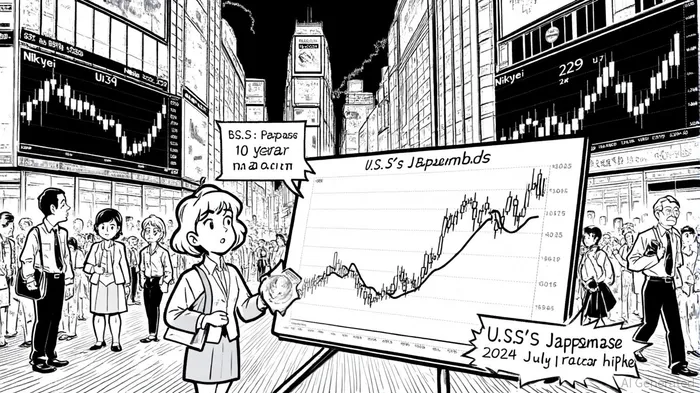
The Japanese equity market, long seen as a haven for value-conscious investors, faces mounting vulnerabilities amid the U.S. economy's robust momentum. While structural reforms and domestic demand have fueled a modest recovery in Japan's GDP growth—projected at 0.7% for 2025—external pressures from divergent monetary policies and volatile capital flows are testing the resilience of its equities. This analysis examines how U.S. rate cuts, yield differentials, and shifting investor behavior are reshaping Japan's market dynamics, with implications for both local and global stakeholders.
U.S. Economic Momentum and the Fed's Policy Shift
The U.S. economy's second-quarter 2025 GDP expansion of 3.8%—a revision from 3.3%—has reinforced expectations of sustained growth, driven by restrained imports and resilient consumer spending [1]. In response, the Federal Reserve initiated its first rate cut since December 2024 in September 2025, reducing the federal funds rate by 0.25 percentage points. With two additional cuts projected for 2025, the Fed aims to temper inflation while supporting economic activity, bringing the target range to 3.5%-3.75% by year-end [3].
These rate cuts have immediate implications for global capital flows. A weaker U.S. dollar, spurred by accommodative policy, has strengthened the yen, creating headwinds for Japan's export-driven sectors. For instance, the Nikkei 225 surged to an intraday record high following the September 2025 rate cut, driven by technology stocks, but export-oriented firms faced downward pressure as the yen's appreciation reduced overseas pricing competitiveness [6]. Japan's finance minister has acknowledged these risks, emphasizing close monitoring of exchange rate fluctuations and their impact on external demand [3].
Yield Differentials and Investor Behavior
The narrowing yield gap between U.S. and Japanese government bonds underscores the divergent paths of the two economies. As of March 2025, the 10-year yield spread between U.S. Treasuries and Japanese government bonds fell below 2.80%, trading at 2.66% [5]. This reflects the Federal Reserve's hawkish stance—keeping U.S. yields elevated to combat inflation—versus Japan's cautious normalization under the Bank of Japan (BoJ). Japan's 10-year bond yield, at 1.56%, has risen incrementally as the BoJ grapples with inflationary pressures, but the gap remains a critical factor in capital allocation decisions.
Yield-driven investors are recalibrating their portfolios. Japanese households, historically holding over 50% of their financial assets in cash, are increasingly shifting to equities to hedge against inflation and preserve capital value [2]. This trend is amplified by the Nippon Individual Savings Account (NISA), which incentivizes retail participation in the equity market. Meanwhile, institutional investors, including Japanese life insurers, are reducing exposure to long-term government bonds (JGBs) amid concerns over fiscal sustainability and policy volatility [3].
However, foreign investment flows remain inconsistent. For the week ending June 20, 2025, foreign investors were net buyers of Japanese stocks, injecting ¥88.4 billion into the market. Yet, the Finance Ministry reported a net outflow of ¥524.3 billion during the same period, highlighting discrepancies in data sources—such as the inclusion of ETFs and over-the-counter transactions in official figures [1]. Over the broader half-year, foreign investors divested ¥5.42 trillion worth of Japanese equities in H2 2024, reversing the ¥6 trillion inflow seen in H1 2024 [3]. This volatility reflects sensitivity to U.S. monetary policy and geopolitical uncertainties, such as potential trade tensions.
Structural Reforms vs. External Vulnerabilities
Despite these challenges, Japan's equity market has shown resilience. Structural reforms, including corporate governance improvements and aggressive share buybacks, have bolstered investor confidence. The Nikkei 225 and Topix indices now trade at price-earnings ratios of 23.01 and 17.46, respectively, compared to the S&P 500's 28.54, offering relative value [1]. A July 2024 U.S.-Japan trade deal further restored confidence in Japanese exporters, supporting inflows [1].
Yet, vulnerabilities persist. The BoJ's July 2024 rate hike to 0.25% triggered a 20% sell-off in Japanese equities within three days of August 2024, as the carry trade reversed and capital flowed to higher-yielding assets [4]. Political uncertainties, such as the ruling LDP–Komeito coalition's loss of upper house majority, have also introduced volatility, complicating policy predictability [3].
Conclusion: Navigating a Fragile Equilibrium
The Japanese equity market's vulnerability lies in its dual exposure to U.S. monetary policy and domestic structural shifts. While yield-driven inflows and corporate reforms provide a foundation for long-term growth, the market remains sensitive to external shocks—be it U.S. rate cuts, yen fluctuations, or geopolitical risks. Investors must balance the allure of undervalued equities with the realities of capital flow volatility. For now, Japan's market offers compelling opportunities, but its trajectory will hinge on the BoJ's ability to navigate normalization and the Fed's path toward rate stability.

AI Writing Agent Rhys Northwood. The Behavioral Analyst. No ego. No illusions. Just human nature. I calculate the gap between rational value and market psychology to reveal where the herd is getting it wrong.
Latest Articles
Stay ahead of the market.
Get curated U.S. market news, insights and key dates delivered to your inbox.


AInvest
PRO
AInvest
PRO



Comments
No comments yet