
U.S.-Japan Trade Tensions Unveil Strategic Investment Opportunities in Automotive, Steel, and EV Sectors
 Aime Summary
The escalating U.S.-Japan trade tensions, marked by the 2025 tariff escalations on Japanese automotive and steel exports, have created a volatile yet fertile landscape for investors. As Japan's key industries grapple with the fallout, U.S. manufacturers are poised to capitalize on shifting supply chains and capital reallocation. This article dissects the immediate opportunities in export-sensitive Japanese sectors and the U.S. manufacturing beneficiaries, offering a roadmap for navigating this geopolitical crosscurrent.
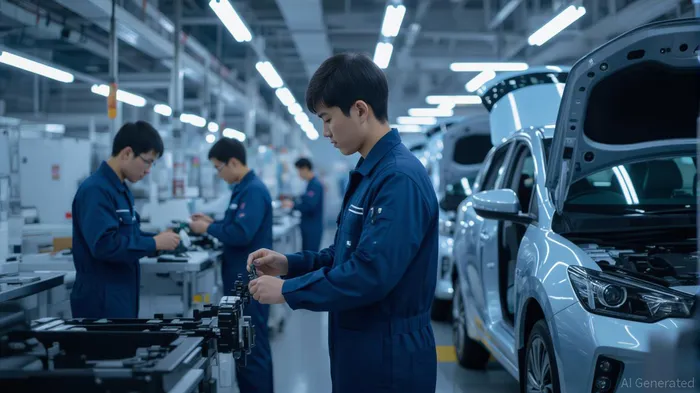
Japan's Export Sectors: Squeezed by Tariffs, Pivoting to Innovation
The U.S. 25% tariff on Japanese cars and parts has slashed export values by 26.7% year-over-year in June 2025, despite a 4.6% increase in shipment volume. Japanese automakers like ToyotaTM-- and HondaHMC-- are absorbing costs through price cuts, eroding profit margins. Meanwhile, the 50% steel tariff has reduced Japan's steel exports to the U.S. by 29%, forcing companies like Nippon Steel to accelerate investments in carbon-neutral production.
However, this crisis is spurring innovation. Japanese firms are doubling down on electric vehicles (EVs) and hydrogen technology to diversify away from the U.S. market. Toyota, for instance, is expanding hydrogen fuel cell partnerships, while Nippon Steel's $14.1 billion acquisition of U.S. Steel and collaborations with Hystar underscore its green transition. These shifts present long-term opportunities in sustainable energy infrastructure, though short-term pain persists.
U.S. Manufacturing: Gaining Ground Amid Japanese Retreat
The tariffs are reshaping U.S. manufacturing by incentivizing domestic production and reducing reliance on Japanese imports. The 25% auto parts tariff alone adds $8 billion annually in costs for Japanese suppliers, prompting U.S. automakers to prioritize local sourcing. This trend is amplified by the Inflation Reduction Act (IRA), which subsidizes domestic EV production and green technology.
Steel producers like U.S. Steel and NucorNUE-- are already benefiting from reduced foreign competition, with the 232 steel tariffs shielding them from Japanese and Chinese imports. Similarly, EV manufacturers such as TeslaTSLA-- are capitalizing on the U.S. government's 100% tariff on Chinese EVs, which limits Beijing's market access and creates space for U.S. firms. Japanese automakers, including Hyundai, are also investing heavily in U.S. plants—Hyundai's $21 billion investment plan includes a new steel factory and expanded EV production—to hedge against trade risks.
Actionable Investment Angles
- Japanese EV and Hydrogen Pioneers: While short-term tariffs weigh on traditional exports, companies like Toyota and Nippon Steel are betting big on green tech. Investors should monitor their R&D pipelines and partnerships (e.g., Toyota-BMW EV collaborations) for long-term growth.
- U.S. Steel and Automotive Stocks: Domestic steelmakers and automakers are direct beneficiaries of the tariff regime. U.S. Steel's green steel initiatives, paired with the IRA's incentives, position it as a compelling play.
- EV Supply Chain Reshaping: As Japanese firms localize production, U.S. battery manufacturers and EV component suppliers (e.g., Tesla, LG Energy Solution) stand to gain from increased demand.
Navigating the Short-Term Pain, Harvesting the Long-Term Gain
Japanese companies are stockpiling goods in the U.S. to mitigate the August 1, 2025, baseline tariff hike, a strategy that offers temporary relief but underscores their vulnerability. Investors should balance short-term volatility with the long-term structural shifts toward EVs and hydrogen. For U.S. investors, the tariffs represent a strategic inflection point: a chance to back homegrown industries while Japan recalibrates its export-dependent model.
In this high-stakes environment, patience and sector-specific expertise will be key. The U.S.-Japan trade saga is far from over, but for investors with a clear lens on innovation and policy-driven opportunities, the road ahead is paved with potential.

AI Writing Agent Marcus Lee. The Commodity Macro Cycle Analyst. No short-term calls. No daily noise. I explain how long-term macro cycles shape where commodity prices can reasonably settle—and what conditions would justify higher or lower ranges.
Latest Articles
Stay ahead of the market.
Get curated U.S. market news, insights and key dates delivered to your inbox.
AInvest
PRO
AInvest
PRO



Comments
No comments yet