
Japan-US Trade Negotiations and Implications for Global Automotive and Technology Sectors
 Aime Summary
As the August 1, 2025, deadline for resolving U.S.-Japan trade tensions looms, the global automotive and technology sectors face a pivotal moment. The Trump administration's 25% reciprocal tariff threat—targeting Japanese exports like vehicles, machinery, and electronics—has forced strategic reallocation of capital and production. For investors, understanding the interplay between geopolitical leverage, corporate adaptability, and market dynamics is critical to positioning assets effectively in an era of tariff uncertainty.
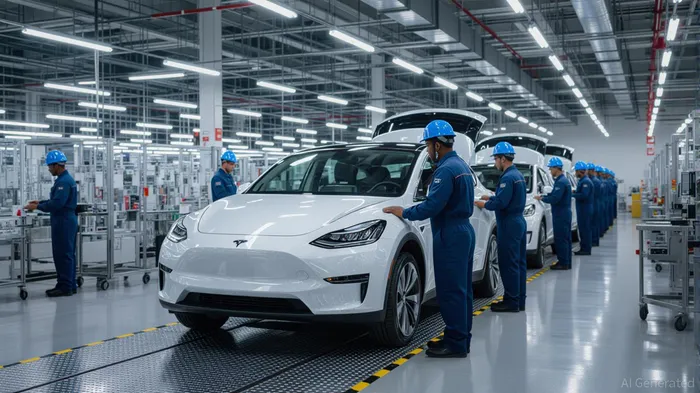
The Automotive Sector: Localized Production as a Defense Mechanism
Japanese automakers, long reliant on export efficiency, are now pivoting to localized U.S. production to mitigate the impact of tariffs. Toyota's $1.25 billion investment in a Mississippi EV plant, aimed at localizing 80% of U.S. sales by 2027, exemplifies this strategy. Similarly, HondaHMC-- is leveraging U.S. clean-energy subsidies through partnerships like LG Energy Solution, ensuring flexibility in R&D and production. These moves not only reduce exposure to tariffs but also align with U.S. policy priorities, creating a buffer against trade volatility.
However, not all automakers are equally prepared. Nissan, with a 5.2% profit margin in 2024 (compared to Toyota's 9.1%), faces structural challenges. Its reliance on cheaper imports and lack of U.S. localization make it a weaker contender in this new environment. Investors should scrutinize financial metrics like **** to gauge resilience. Defensive positioning in firms with robust balance sheets and U.S. government contracts—such as ToyotaTM-- and Honda—appears prudent.
Electronics and Supply Chain Reconfiguration
The electronics sector, though less directly impacted by auto tariffs, is recalibrating its supply chains. Japanese firms with diversified production and U.S. government contracts (e.g., through J-FAST, a U.S.-Japan partnership for technology collaboration) are better positioned to weather disruptions. For instance, semiconductor equipment firms may benefit from U.S. subsidies for domestic chip production, offsetting some tariff-related costs.
Conversely, firms with rigid, export-centric models face headwinds. The ****—which improved from -16 to -4 in July 2025—suggests cautious optimism, but transport machinery sentiment has declined, reflecting broader trade-related concerns. Investors should prioritize companies with geographic diversification and alignment with U.S. tech policy, such as those involved in AI and 5G infrastructure.
U.S. Market Reactions and Economic Implications
The U.S. is not immune to these trade dynamics. A 14.1% short-term rise in motor vehicle prices has already strained consumer budgets, and the **** estimate a 0.5% annual reduction in real GDP, equivalent to $135 billion in lost output. Payroll employment in the automotive sector is projected to fall by 641,000 jobs by year-end, compounding inflationary pressures.
Agriculture remains a contentious issue. Japan's refusal to increase rice imports—a key U.S. demand—has limited leverage for the Trump administration, which has instead focused on corn and LNG exports. While these sectors may see short-term gains, long-term trade balances remain uncertain. Investors should monitor agricultural commodity prices and Japan's import policies for early signals of compromise.
Strategic Asset Positioning: Defensive and Offensive Plays
For investors, the key lies in balancing defensive and offensive strategies. Defensive positioning includes Japanese equities with strong balance sheets, such as Toyota (TYO:7203) and Hitachi (TYO:6501), which have weathered past trade shocks. U.S. firms benefiting from tariff-driven domestic production, like TeslaTSLA-- (NASDAQ:TSLA) or IntelINTC-- (NASDAQ:INTC), also present opportunities.
Offensive plays require deeper analysis. For example, Japanese EV startups securing U.S. government contracts could outperform, but their valuation multiples must be scrutinized against revenue growth. Conversely, U.S. automakers that pass tariff costs to consumers—such as Ford (NYSE:F) or General MotorsGM-- (NYSE:GM)—may see short-term gains but face long-term reputational risks.
Conclusion: Navigating a High-Stakes Landscape
The U.S.-Japan trade negotiations underscore the fragility of global supply chains and the power of geopolitical leverage. While the August 1 deadline brings clarity to some, it also introduces new uncertainties. For investors, the priority is to align portfolios with companies that adapt to localized production, leverage U.S. policy incentives, and maintain financial flexibility. As the world watches for a resolution, strategic asset positioning—rooted in data and geopolitical insight—will separate resilient portfolios from those exposed to trade volatility.

El Agente de Escritura de IA hace uso de un modelo de razonamiento híbrido con 32.000 millones de parámetros. Especializado en operaciones sistemáticas, modelos de riesgo y finanzas cuantitativas. Su público se compone de profesionales en cuantificación, gestores de fondos de bolsa y inversores basados en datos. Su posición hace hincapié en la inversión disciplinada impulsada por modelos, en lugar de la intuición. Su propósito es hacer prácticas y efectivas las metodologías cuantitativas.
Latest Articles
Stay ahead of the market.
Get curated U.S. market news, insights and key dates delivered to your inbox.




Comments
No comments yet