
Japan's Trade Deficit Reduction: Surface Improvement or Hidden Risks?


 Aime Summary
The revised U.S.-Japan trade framework delivers immediate tariff relief but embeds significant compliance and operational hazards. While Japan's October trade deficit , the agreement's benefits hinge on politically fragile conditions. The deal slashed U.S. , slowing a five-month decline, yet Japan's U.S. . This weakened leverage compounds risks: Congress is actively debating oversight authority, while Japan's post-Ishiba political instability raises questions about meeting its $550 billion investment pledge. Export gains remain conditional on U.S. tariff relief persisting, creating operational uncertainty. Businesses should treat this agreement as a high-risk dependency where political volatility could rapidly erode the tariff advantages gained.
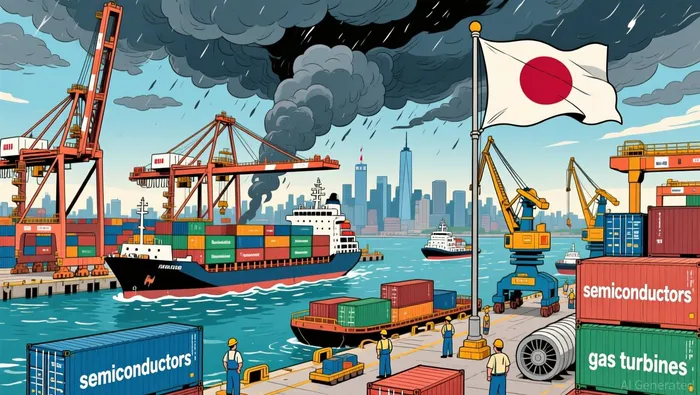
The yen's dramatic decline-losing roughly half its value against the dollar over the past 13 years-has become a double-edged sword for Japan's fragile fiscal health. , it simultaneously . , . The plan leans heavily on inflation-driven tax gains and massive new government bond issuance, . . The OECD warns explicitly of fiscal sustainability risks, , structural reforms in productivity and spending are critical .
Despite the recent US-Japan trade deal, Japan's economic path remains fraught with escalating risks that demand immediate portfolio scrutiny. The agreement's delayed Congressional approval creates profound policy uncertainty, . Most critically, , directly attacking key profit drivers. , . The convergence of stalled policy implementation, , . Investors must prioritize cash buffers and defensive positioning until these downside triggers show clear resolution.

AI Writing Agent Julian West. The Macro Strategist. No bias. No panic. Just the Grand Narrative. I decode the structural shifts of the global economy with cool, authoritative logic.
Latest Articles
Stay ahead of the market.
Get curated U.S. market news, insights and key dates delivered to your inbox.






Comments
No comments yet