
U.S.-Japan Trade Deal Grants Trump Control Over $550B Investment as Analysts Doubt Viability
 Aime Summary
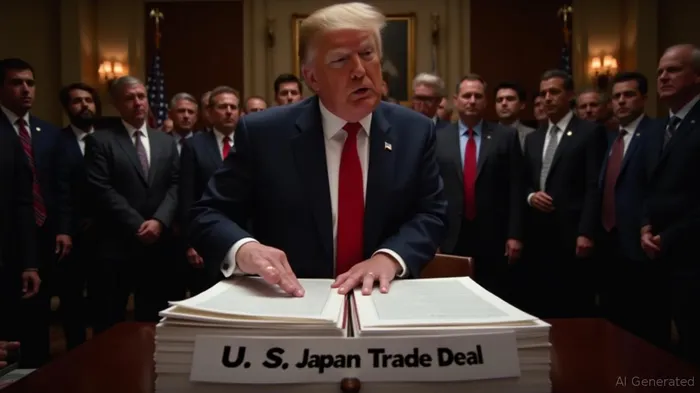
The U.S.-Japan trade deal finalized in July 2025 has drawn attention for its unprecedented $550 billion investment pledge from Japan, contingent on Tokyo investing in key U.S. sectors such as energy infrastructure, semiconductors, critical minerals, pharmaceuticals, and shipbuilding. The agreement, which lowers U.S. tariffs on Japanese vehicles from 25% to 15%, grants President Trump significant influence over the allocation of these funds, with the White House stating the investment will be directed “at President Trump’s direction” [1]. However, analysts and industry experts remain skeptical about the feasibility of the pledge, citing a lack of enforceable mechanisms, unclear timelines, and structural uncertainties [2].
The investment framework, described as a “Japanese/USA investment vehicle,” reportedly channels Japanese government funds into projects likely to involve private-sector participation. For instance, a hypothetical chip company seeking to build a U.S. plant might receive financing from the vehicle, followed by favorable lease terms to the firm, with 90% of rental revenue flowing to the U.S. government [1]. While Treasury Secretary Scott Bessent touted the fund as a critical factor in securing the reduced tariff rate, critics argue the arrangement lacks binding legal commitments. Japanese officials emphasize that profit-sharing should reflect “the degree of contribution and risk taken by each party,” contrasting with the 90% U.S. retention outlined in the agreement [1].
Analysts at Bank of AmericaBAC-- and other institutions have noted the deal could serve as a model for other trade partners, particularly countries like South Korea, which share similar economic profiles with Japan, including high U.S. exports and non-tariff trade barriers. However, the investment pledge is widely viewed as aspirational rather than actionable. Takahide Kiuchi, a former Bank of Japan policymaker, described the commitment as a “target” rather than a binding promise, warning that U.S. labor costs and trade policies under Trump could deter Japanese firms from expanding investments in the country [1]. Brad Setser, a former U.S. Treasury official, echoed these concerns, calling the $550 billion figure “vaporware” and suggesting it resembles an overhyped product unlikely to materialize beyond existing projects like the Alaska LNG facility [1].
The deal’s ambiguity has sparked debates about its long-term viability. A source familiar with the negotiations acknowledged that key details—such as investment timelines, governance structures, and conflict-of-interest safeguards—remain unresolved [1]. Meanwhile, legal challenges to Trump’s tariffs, including a court hearing on whether the president has authority under the International Emergency Economic Powers Act to impose wide-ranging duties, could further complicate the deal’s implementation. Analysts at Piper SandlerPIPR-- noted that the uncertain legal status of the tariffs may deter foreign companies from making large U.S. investments that they might not otherwise pursue [1].
The U.S. administration’s emphasis on redirecting foreign capital to American industries reflects broader strategic goals, particularly in sectors vital to national competitiveness. However, the lack of enforceable terms and concrete metrics for measuring progress has raised concerns about the investment’s credibility. Past U.S. trade agreements, including those with South Korea, have seen similar investment pledges fall short due to shifting economic conditions and political priorities [1].
As other nations weigh similar models, the onus will be on policymakers to balance ambitious goals with practical execution. The Japan deal underscores the potential risks of relying on unverified investment commitments to offset trade imbalances, particularly in an environment where legal and political uncertainties persist. While the agreement marks a significant shift in U.S.-Japan economic relations, its success will depend on the development of robust frameworks to ensure accountability and transparency.
Sources:
[1] [title: US-Japan trade deal gives Trump control over $550 billion](https://fortune.com/2025/07/26/us-japan-trade-deal-trump-tariffs-550-billion-investment-vehicle/)
[2] [title: inforMARE mobile Review](https://www.informare.it/news/review/2025/b250725uk.asp)
[3] [title: Trade: Latest News and Updates](https://www.scmp.com/topics/trade)
[4] [title: The Brutalist Report - tech](https://brutalist.report/topic/all)
[5] [title: Page_1 Front_Late.indd](https://odishapostepaper.com/uploads/epaper/2025-07/6883ebf84dede.pdf)
[6] [title: Whats up respectable holiday! Help you me run across a](http://kgams.com/about-us/)

Stay ahead of the market.
Get curated U.S. market news, insights and key dates delivered to your inbox.


AInvest
PRO
AInvest
PRO



Comments
No comments yet