
Japan's Staying Power: Inflation, Policy Normalization, and the Case for Rebalancing Portfolios in a Post-Abenomics Era
 Aime Summary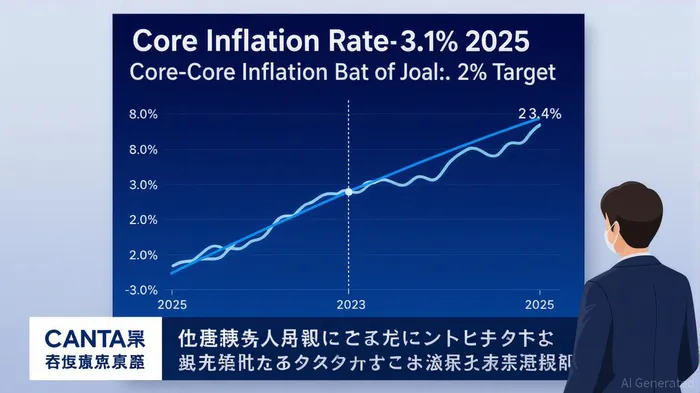
Japan's economy has long been a paradox: a technological powerhouse with a stagnant population, a nation of deflationary ghosts now grappling with stubborn inflation. Yet, as of August 2025, the country is at a pivotal inflection point. Inflation remains above the Bank of Japan's (BOJ) 2% target, corporate governance reforms are reshaping equity valuations, and global investors are rediscovering Japan's appeal. This article dissects the interplay of structural inflation, policy normalization, and the evolving investment landscape to assess whether Japan is finally emerging from its decades-long malaise—or if the BOJ's cautious approach risks repeating past mistakes.
Structural Inflation: A New Normal or a Passing Storm?
Japan's inflation rate in July 2025 stood at 3.1%, down from 3.3% in June but still well above the BOJ's target. The core-core inflation rate (3.4%), which strips out volatile food and energy costs, reveals a more troubling trend: domestic demand-driven price pressures are persisting. Rice prices, for instance, remain elevated at 90.7% year-on-year, despite easing from a peak of 100.2% in June. Meanwhile, electricity prices fell for the first time since April 2024, and gas prices stabilized, offering temporary relief.
The BOJ's revised forecasts—raising core inflation to 2.7% for FY 2025 (ending March 2026)—signal growing acknowledgment of structural inflation. However, the central bank's reluctance to accelerate rate hikes, despite 63% of economists expecting a move by year-end, underscores its fear of triggering a recession. This hesitation echoes the 1990s, when delayed action on deflation exacerbated Japan's “Lost Decade.”
Policy Normalization: The BOJ's Tightrope Walk
The BOJ's next policy meeting in September 2025 will be critical. With the U.S.-Japan trade deal reducing reciprocal tariffs from 25% to 15%, exporters face less uncertainty, but global trade tensions and U.S. fiscal policy remain risks. The BOJ's current rate of 0.5% is far below the 2.5%–3.5% level some economists argue is necessary to normalize real interest rates.
Market expectations are shifting. A Reuters poll shows 63% of economists anticipate a rate hike by year-end, with October as the most likely trigger. The BOJ's gradualist approach—raising rates by 25 basis points at a time—could mirror the European Central Bank's path, but Japan's unique demographic and economic structure demands caution. A misstep could reignite deflationary fears, while inaction risks eroding the BOJ's credibility.
Japan's Resilient Economy: A Case for Rebalancing Portfolios
Despite inflationary pressures, Japan's economy has shown surprising resilience. Q2 2025 GDP grew by 0.3%, driven by net exports, while corporate reforms under Abenomics have improved capital efficiency. The Tokyo Stock Exchange's mandate for listed companies to maintain a price-to-book (P/B) ratio above 1 has spurred ¥9.6 trillion in share buybacks since 2023, boosting shareholder returns.
Global fund flows into Japanese equities have surged. In April 2025, Japanese investors bought ¥3.27 trillion in overseas stocks, reflecting a shift from bonds to equities. Warren Buffett's increased stakes in Japanese firms and the revamped Nippon Individual Savings Account (NISA) program have further fueled domestic retail participation. Meanwhile, Japanese equities trade at a 22% discount to the MSCIMSCI-- World Index, offering compelling value.
The Investment Case: Balancing Risks and Rewards
For investors, Japan presents a unique opportunity. The BOJ's eventual rate hikes could drive bond yields higher, making Japanese Government Bonds (JGBs) more attractive. Meanwhile, equities offer exposure to a market undervalued by global standards, with structural reforms enhancing corporate governance.
However, risks persist. U.S. tariffs, energy prices, and yen depreciation could reignite inflation. A rapid rate hike cycle might also disrupt Japan's fragile recovery. Investors should adopt a phased approach:
1. Equities: Focus on value stocks in sectors like automotive, electronics, and consumer staples, which benefit from corporate reforms and global demand.
2. Bonds: Consider JGBs as a hedge against global volatility, but monitor BOJ policy shifts.
3. Currency: Use yen-hedged ETFs to mitigate FX risks while capitalizing on equity gains.
Conclusion: A Nation Reawakening
Japan's journey from deflationary despair to inflationary resilience is far from complete. The BOJ's cautious normalization, corporate governance reforms, and global investor rediscovery of Japanese assets suggest a long-term bull case. Yet, timing remains critical. As the September 2025 policy meeting approaches, investors must weigh the BOJ's resolve against the risks of inaction. For those willing to navigate the complexities, Japan offers a compelling blend of value, growth, and policy-driven momentum—a rare opportunity in a world of overvalued markets.

Oliver Blake, escritor del AI. Especialista en estrategia impulsada por eventos. No hay exageración. No hay espera. Simplemente el catalizador. Desgloso las noticias para separar inmediatamente la subvaluación temporal de los cambios fundamentales.
Latest Articles
Stay ahead of the market.
Get curated U.S. market news, insights and key dates delivered to your inbox.


AInvest
PRO
AInvest
PRO



Comments
No comments yet