
U.S. and Japan Sign $550B Trade Pact with 15% Tariff, 90% Profits to U.S.
 Aime Summary
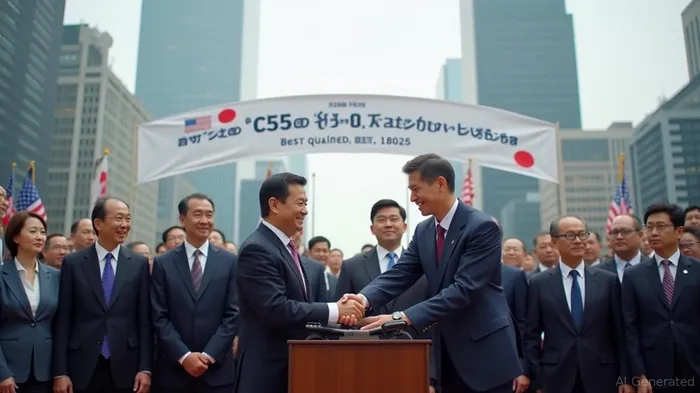
President Donald Trump announced a landmark $550 billion trade agreement with Japan on July 23, 2025, positioning it as one of the most significant bilateral economic pacts in history. The deal, detailed during a White House event, outlines a framework in which Japan will invest $550 billion into the U.S. economy, with 90% of the profits directed to American stakeholders. This arrangement, negotiated between Trump and Japanese Trade Minister Ryosei Akazawa, includes a 15% reciprocal tariff on Japanese imports into the U.S., a reduction from the initially threatened 25%. The agreement also emphasizes expanded market access for U.S. exports, particularly in agriculture, machinery, and automotive manufacturing.
The deal’s immediate economic impact was evident in Japanese equity markets, where automaker stocks such as ToyotaTM-- and Subaru saw appreciation. The yen also strengthened against the dollar following the announcement. However, no notable shifts were observed in cryptocurrency markets, aligning with historical patterns where such trade agreements have limited direct effects on digital assets. The U.S. claims a dominant share of the economic benefits, reflecting Trump’s policy focus on prioritizing American interests and reducing trade deficits.
Key sectors affected by the agreement include autos, agriculture, and general goods, with the U.S. imposing tariffs to protect domestic industries. The 15% rate on Japanese imports represents a strategic compromise, balancing protectionist goals with the desire to maintain trade relations. Analysts suggest the tariffs could reshape competitive dynamics in the Asia-Pacific region, particularly for Japanese firms reliant on U.S. markets. While the U.S. benefits from profit-sharing and expanded export opportunities, Japanese industries face challenges in adapting to the new tariff regime.
Trump framed the deal as a transformative win, emphasizing job creation and revitalization of U.S. manufacturing. The agreement’s asymmetrical structure diverges from previous U.S.-Japan trade frameworks, which historically balanced market access and tariff reductions more evenly. Critics and observers are now focused on how the terms will translate into tangible outcomes, including the implementation of profit-sharing mechanisms and the long-term sustainability of the deal’s benefits. The absence of detailed terms for market access for Japanese exports has also raised questions about potential imbalances.
Strategically, the pact underscores a broader shift in U.S. trade policy under Trump, prioritizing bilateral agreements over multilateral frameworks. By securing a profit-sharing model heavily favoring the U.S., the administration signals a departure from past efforts to balance trade benefits more equitably. For Japan, the deal presents a dual challenge: leveraging expanded access to U.S. markets for its exports while mitigating the impact of tariffs on its goods. The agreement’s success will depend on its execution, with stakeholders monitoring its effects on industries such as automotive manufacturing and agriculture.
While the immediate market reaction has been modest, the deal’s long-term implications could extend beyond traditional sectors. The focus on structural rebalancing and profit-sharing sets a precedent for future negotiations, potentially influencing how the U.S. engages with other trade partners. As both nations move from negotiation to implementation, key questions remain about Japan’s adaptation to the new tariff regime and the U.S.’s ability to sustain its competitive advantage. For now, the $550 billion agreement stands as a defining element of Trump’s assertive trade strategy, redefining economic relations between two of the world’s largest economies.

Stay ahead of the market.
Get curated U.S. market news, insights and key dates delivered to your inbox.
AInvest
PRO
AInvest
PRO



Comments
No comments yet