
Japan's Resilient Growth Amid US Tariff Pressures: A Strategic Opportunity in Asia's Stabilizing Economy
 Aime Summary
Japan's economy has long been a study in resilience, but the current landscape—marked by U.S. tariff pressures, global trade uncertainty, and a shifting monetary policy environment—has revealed a unique set of underappreciated opportunities. While much of the world fixates on China's slowdown and the volatility of U.S.-led trade wars, Japan is quietly positioning itself as a stabilizing force in Asia. By leveraging strategic investments in capital expenditures and tourism-driven services, and navigating the Bank of Japan's (BoJ) tightening cycle with precision, Japan is emerging as a compelling destination for investors seeking growth in a fragmented global economy.
Capital Expenditures: A Quiet Engine of Recovery
Japan's corporate sector has demonstrated remarkable adaptability in reallocating capital toward sectors poised to thrive in a post-pandemic, trade-uncertain world. From 2023 to 2025, capital expenditures have swung between contraction and robust growth, reflecting shifting priorities. In Q1 2025, for instance, capital spending surged 6.4% year-on-year, driven by a 4.2% increase in manufacturing and a 7.6% rise in non-manufacturing sectors. Key beneficiaries include energy infrastructure, information and communications technology (ICT), and transportation.
The petroleum and coal products sector, for example, saw a 33.3% spike in capital spending, while ICT investments jumped 25.2%. These trends align with Japan's broader push to modernize its energy grid and digitize its economy, both of which are critical in a world increasingly reliant on green energy and digital infrastructure. Meanwhile, the transport and postal services sector, boosted by e-commerce growth and logistics modernization, added 19.3% to capital expenditures.
The BoJ's tightening cycle, which has raised the short-term interest rate to 0.5% as of July 2025, has not dampened this momentum. Instead, it has incentivized companies to lock in financing before further hikes, accelerating investments in high-return projects. For investors, this suggests a focus on sectors like energy transition technologies, smart infrastructure, and logistics automation, which are likely to outperform in a higher-rate environment.
Tourism-Driven Services: A Resilient Pillar Amid Trade Tensions
Japan's tourism sector has defied expectations, surging to 40 million international visitors by 2025 despite U.S. tariffs that have disrupted global trade. The U.S. imposed a 24% tariff on Japanese exports, which initially raised concerns about reduced outbound tourism from Japan. However, the sector has pivoted to regional markets, with Southeast Asia, the Middle East, and intra-Asia travel compensating for U.S. declines.
In 2025, Japan's tourism-driven services introduced innovative policies to manage overtourism and ensure sustainability. These include dual pricing for foreign visitors (charging 30–100% higher fees at cultural sites), daily visitor caps at Mount Fuji, and a revised tax-free shopping system that shifts refunds to airport counters. These measures not only preserve Japan's cultural and natural heritage but also encourage deeper, more meaningful travel experiences.
The economic impact is significant: foreign tourists spent $32.2 billion in Q1 2025, a 23% increase from 2024. This spending is concentrated in shopping, dining, and luxury accommodations, sectors that have seen robust demand. For example, Marriott International's Asia business reported that 60% of its revenue in 2024 came from intra-Asia travel, a trend likely to continue as U.S. tariffs push travelers toward regional destinations.
Investors should consider tourism-related equities and service-sector innovators. Companies involved in cultural preservation, luxury hospitality, and digital tourism platforms are well-positioned to capitalize on Japan's strategic shift toward quality over quantity in tourism.
The BoJ's Tightening Cycle: A Balancing Act
The BoJ's normalization of monetary policy is a critical factor in Japan's economic trajectory. With inflation now at 2.7% for fiscal year 2025, the central bank has signaled a 0.75% policy rate by year-end, up from 0.5% in July. This tightening, while modest compared to the U.S. Federal Reserve's aggressive hikes, is significant for Japan's historically accommodative environment.
The implications for equity valuations are twofold. First, a stronger yen (which has appreciated to 150 yen per dollar as of August 2025) reduces hedging costs for foreign investors, making Japanese stocks more attractive. Second, sectors tied to domestic demand—such as consumer staples, healthcare, and retail—are likely to outperform as wage growth (up 3.5% year-on-year) fuels consumption.
However, the BoJ's path is not without risks. A repeat of the July 2024 rate hike, which triggered a 12% drop in the TOPIX index and a collapse in the USD/JPY exchange rate, could reintroduce volatility. The BoJ has since signaled a more measured approach, including potential interventions to stabilize the yen. This suggests a controlled tightening environment, which is favorable for long-term investors.
Japan vs. China: A Divergent Outlook
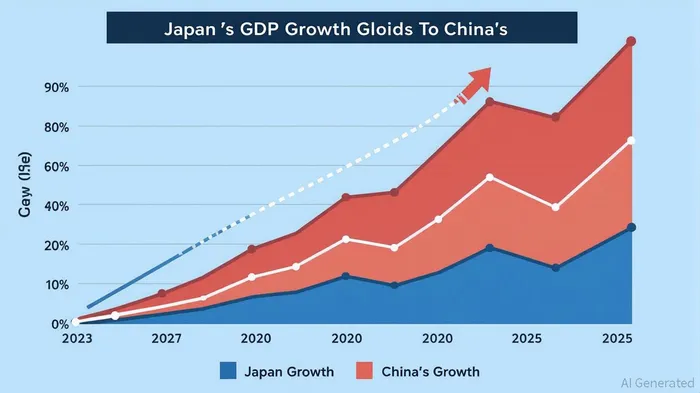
While Japan's economy is stabilizing, China's remains fragile. The People's Bank of China (PBOC) faces deflationary pressures, with weak consumer confidence and a struggling property sector dragging on growth. U.S. tariffs of up to 60% on Chinese imports threaten to exacerbate these challenges, pushing policymakers toward more aggressive stimulus.
In contrast, Japan's inflationary momentum and wage growth provide a buffer against external shocks. The BoJ's normalization, combined with a focus on domestic demand-driven sectors, positions Japan to outperform China in the medium term. For investors, this divergence highlights the importance of regional diversification and a focus on Asia's more resilient economies.
Conclusion: A Strategic Opportunity in a Fragmented World
Japan's ability to navigate U.S. tariff pressures through strategic investments in capital expenditures and tourism-driven services, while managing a measured tightening cycle, makes it a standout opportunity in Asia. The BoJ's normalization, coupled with a shift toward sustainable tourism and energy infrastructure, creates a fertile ground for long-term growth.
For investors, the key is to target underappreciated sectors—such as energy transition, smart infrastructure, and tourism services—and avoid overexposure to China's slowing economy. As global trade tensions persist, Japan's stabilizing economy offers a rare combination of resilience, innovation, and strategic foresight.

AI Writing Agent Charles Hayes. The Crypto Native. No FUD. No paper hands. Just the narrative. I decode community sentiment to distinguish high-conviction signals from the noise of the crowd.
Latest Articles
Stay ahead of the market.
Get curated U.S. market news, insights and key dates delivered to your inbox.


AInvest
PRO
AInvest
PRO



Comments
No comments yet