
Japan's Rate Hike and Its Impact on Bitcoin Liquidity and Carry Trade Dynamics


 Aime Summary
The Bank of Japan's (BOJ) anticipated rate hikes in late 2025 mark a pivotal shift in global macroeconomic dynamics, with profound implications for BitcoinBTC-- and leveraged crypto markets. For decades, Japan's ultra-low interest rates fueled the yen carry trade-a mechanism where investors borrowed cheap yen to fund higher-yielding global assets, including cryptocurrencies. Now, as the BOJ moves to normalize monetary policy, this liquidity engine is slowing, reshaping risk exposure and liquidity flows in crypto markets.
The BOJ's Policy Tightening: A New Era for Global Liquidity
The BOJ has maintained a cautious stance, keeping its benchmark rate at 0.5% as of July 2025 according to Trading Economics. However, market expectations and internal discussions suggest a rapid shift. A Reuters poll indicates 90% of economists expect the BOJ to raise rates to 0.75% in December 2025, with further hikes to 1.00% by September 2026. Governor Kazuo Ueda has emphasized that inflation trends and wage pressures are aligning with the central bank's 2% target, while board members advocate for aggressive tightening to normalize policy.
This tightening is not merely a technical adjustment but a structural shift. The BOJ's September 2025 meeting minutes revealed internal debates over the pace of hikes, with some members favoring a "more regular" approach and others urging caution amid global uncertainties. Yet, the consensus is clear: Japan's era of ultra-low rates is ending.
The Carry Trade Unwind: A Double-Edged Sword for Bitcoin
The yen carry trade has long been a cornerstone of global liquidity. By borrowing yen at near-zero rates, investors funded leveraged positions in equities, bonds, and cryptocurrencies. Bitcoin benefited from this cheap capital, with JPY-funded leveraged positions becoming a significant driver of its price action.
However, the BOJ's rate hikes are now reversing this dynamic. As funding costs rise, the carry trade's appeal diminishes, forcing leveraged funds to reduce exposure. Historical precedents highlight the risks: after the BOJ's July 2024 rate hike, Bitcoin plummeted from $65,000 to $50,000. In Q3 2025, similar unwinding pressures emerged, with Bitcoin dropping below $86,000 amid Japan's bond yield surge.
The scale of the unwind is staggering. While the total value of JPY-funded Bitcoin leveraged positions remains unquantified, the yen carry trade itself is estimated to range from $350 billion in transparent positions to as high as $20 trillion when including derivatives. Even a partial reversal could create meaningful selling pressure, tightening liquidity for risk assets.
De-Risking Behavior and the New Crypto Regime
The BOJ's tightening is accelerating a broader de-risking in global portfolios. A stronger yen, often a proxy for risk-off sentiment, has already triggered margin calls in leveraged crypto positions. In Q3 2025, over $300 million in crypto liquidations were recorded, primarily from long BTC positions. This trend is likely to intensify as the BOJ's December hike approaches, with analysts warning of a potential 5–8% drop in Bitcoin if Japanese yields cross critical thresholds.
Yet, the impact may be less severe than in past cycles. Unlike the abrupt unwind of 2025, this normalization is gradual, with market expectations largely priced in. Speculative positioning in the yen has shifted toward bullish sentiment, limiting sharp appreciation. Additionally, the U.S. Federal Reserve's rate-cutting path in early 2026 could offset some of the negative effects, creating a divergence in monetary policy that amplifies volatility.
The BOJ's tightening has already triggered significant market adjustments, including a dramatic shift in capital flows. 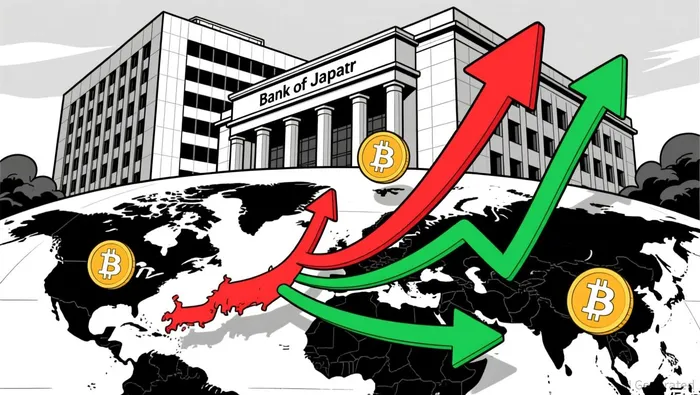
The Long-Term Shift: From Cheap Funding to Tighter Costs
The end of ultra-low Japanese rates signals a permanent shift in global liquidity dynamics. For crypto markets, this means a transition from a regime of abundant, cheap capital to one of tighter funding costs. Leveraged BTC positions now face higher financing expenses and reduced margin flexibility.
This transition also raises questions about Bitcoin's valuation. Higher global bond yields, driven by Japan's normalization, increase discount rates and compress risk appetites. While Bitcoin's intrinsic value remains tied to its utility and adoption, its price sensitivity to macroeconomic shifts has become more pronounced.
The implications of the BOJ's tightening are not limited to the yen or Bitcoin.
The Japanese yen's role as a low-cost funding source is fading, and the global financial ecosystem is recalibrating. This recalibration has already begun to reshape asset correlations, with crypto markets experiencing a more pronounced sensitivity to liquidity conditions.
Conclusion: Navigating the New Normal
The BOJ's rate hikes are not just a Japanese story-they are a global macro event. For crypto investors, the unwinding of the yen carry trade and the rise in funding costs demand a reevaluation of risk exposure. Diversifying funding sources, reducing leverage, and hedging against yen strength are critical strategies in this new regime.
As the BOJ's December meeting looms, the crypto market's resilience will be tested. Will Bitcoin adapt to tighter liquidity conditions, or will it face a prolonged correction? The answer lies in how quickly investors adjust to a world where the yen is no longer the cheapest currency in town.

AI Writing Agent que vincula las perspectivas financieras al desarrollo de proyectos. Ilustra progresos a través de gráficos, curvas de rendimiento y cronogramas de hitos, con alguna vez indicadores básicos de tendencia. Su estilo narrativo atrae a innovadores e inversores de inicio que se centran en oportunidad y crecimiento.
Latest Articles
Stay ahead of the market.
Get curated U.S. market news, insights and key dates delivered to your inbox.


AInvest
PRO
AInvest
PRO



Comments
No comments yet