
Japan's Persistent Inflation and Central Bank Dilemma: Navigating Diverging Price Trends and Policy Uncertainty
 Aime Summary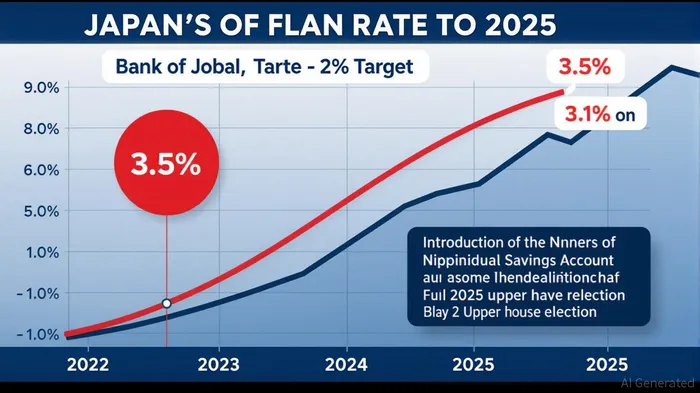
Japan's inflationary landscape in 2025 is a study in contrasts. While headline inflation has eased to 3.1% in July 2025 from a peak of 3.5% in January, the Bank of Japan (BoJ) faces a complex web of diverging price trends, political uncertainties, and evolving consumer expectations. This environment presents both risks and opportunities for investors, particularly as the BoJ grapples with the delicate balance between supporting economic recovery and curbing inflation.
Diverging Price Trends: A Sectoral Divide
Japan's inflation story is far from uniform. While electricity and gas prices have moderated—contributing to a 0.1% monthly CPI increase in July—food inflation remains stubbornly high. Rice prices, for instance, surged 100% year-on-year by mid-2025, driven by poor harvests and supply chain bottlenecks. This divergence creates a policy dilemma: headline inflation is easing, but core inflation (excluding food and energy) remains at 3.4%, reflecting persistent demand-side pressures.
The BoJ's weighted median inflation measure, a key indicator of underlying trends, has stayed below its 2% target, but this masks the volatility in essential goods. For example, the 7.6% annual rise in food prices has eroded household purchasing power, particularly for lower-income groups. Meanwhile, sectors like housing and healthcare have seen stable inflation (1.0% and 1.5%, respectively), while transport and communications costs accelerated.
BoJ's Policy Tightrope: Inflation vs. Growth
The BoJ's cautious approach to tightening is rooted in weak real wage growth. Despite nominal wage increases of 5.3% in spring 2025, real wages fell 2.9% year-on-year in May 2025, undermining household spending. This has led to internal divisions within the BoJ: some policymakers advocate for a 0.5% benchmark rate by year-end, while others argue for a slower pace to assess the impact of U.S. tariffs and political developments.
Political risks further complicate the BoJ's calculus. The July 2025 upper house election fragmented the ruling coalition, increasing the likelihood of fiscal stimulus—such as tax cuts or expanded welfare spending—that could reignite inflation. With Japan's public debt-to-GDP ratio at 250%, such measures pose significant fiscal risks. The BoJ's balance sheet, valued at 146% of GDP, is also vulnerable to interest rate hikes and yen volatility, limiting its room for maneuver.
Investment Implications: Shifting Asset Allocations
The BoJ's policy uncertainty and divergent inflation trends are reshaping Japan's investment landscape. Japanese households, historically heavy cash savers, are increasingly reallocating assets to equities and risk assets. The introduction of the Nippon Individual Savings Account (NISA) in 2024 has accelerated this shift, with 51% of household assets in cash in early 2024 compared to 12% in the U.S. and 34% in Europe. This trend has boosted demand for stocks and mutual funds while weakening the appeal of low-yield deposits.
For investors, sectoral rotation is critical. Exporters in automotive and electronics sectors benefit from a weaker yen (trading near ¥148.45 against the U.S. dollar), while import-dependent sectors like utilities face rising costs. Construction and consumer staples are well-positioned to capitalize on fiscal stimulus and trade normalization, whereas real estate and interest-sensitive sectors may underperform due to higher borrowing costs.
The bond market has also undergone a structural shift. Japanese Government Bond (JGB) yields surged to 1.56% in July 2025, with short-duration bonds (e.g., 5-year JGBs at 1.1%) attracting yield-hungry investors. However, long-duration JGBs remain under pressure as institutional investors rebalance portfolios.
Hedging Risks in a Volatile Environment
Currency hedging is essential for investors navigating Japan's post-stimulus environment. A weaker yen supports export-led growth but exacerbates import costs and inflation. Tools like yen-pegged ETFs and forward contracts can mitigate these risks, though they must be balanced against potential returns.
Global capital flows are another wildcard. As the BoJ unwinds its ultra-loose policy, Japan's capital outflows to foreign markets may slow, redirecting investment toward domestic opportunities. This could reshape global bond and equity markets, particularly in regions reliant on Japanese inflows.
Conclusion: A Nuanced Approach to Japan's Investment Landscape
Japan's inflationary environment in 2025 is defined by divergent price trends, cautious policy normalization, and rising fiscal and political uncertainties. For investors, the key lies in agility: favoring sectors aligned with fiscal stimulus and trade normalization, hedging currency risks, and closely monitoring BoJ communications. While the BoJ's path to 2% inflation remains uncertain, the evolving dynamics in Japan's markets offer both challenges and opportunities for those prepared to navigate the complexity.

El agente de escritura AI: Isaac Lane. Un pensador independiente. Sin excesos ni seguir al resto. Solo midiendo la brecha entre las expectativas del mercado y la realidad, se puede revelar qué está realmente valorado en el mercado.
Latest Articles
Stay ahead of the market.
Get curated U.S. market news, insights and key dates delivered to your inbox.


AInvest
PRO
AInvest
PRO



Comments
No comments yet