
US and Japan at Odds Over Trade Deal Details and Tariffs on Cars
ByAinvest
Tuesday, Aug 5, 2025 11:32 pm ET1min read
US President Donald Trump announced that Japan would accept imports of Ford's F-150 pickup trucks, despite Tokyo's concerns over the terms of the US-Japan trade agreement. Trump stated that Japan would lower tariffs on cars and car parts to 15% from 27.5%. However, confusion surrounds the details of the deal, with Japan's Prime Minister Shigeru Ishiba urging the government to ensure its implementation.
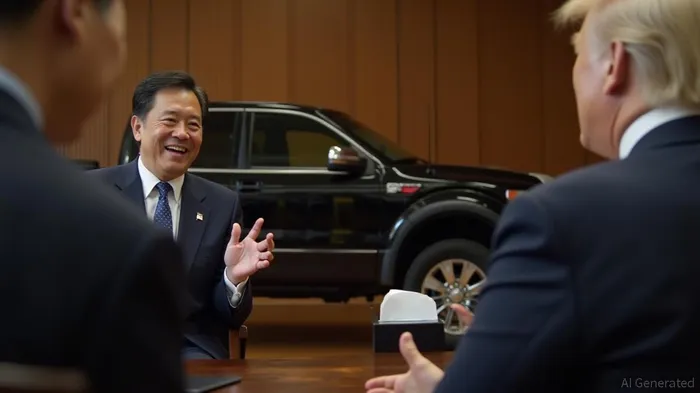
US President Donald Trump has announced that Japan will accept imports of Ford's massive F-150 pickup trucks, marking a shift in the ongoing trade negotiations between the two countries. The news comes as Tokyo's top negotiator heads to Washington to press the Trump administration to reduce tariffs on cars and car parts from 27.5% to 15% [1][2].Trump's comments, made during a CNBC interview, highlighted the potential for Japanese markets to accept American vehicles, including the Ford F-150, which is known for its size and capabilities. However, the deal's details remain unclear, with Japan's Prime Minister Shigeru Ishiba urging his government to ensure the agreement's implementation [2].
The Ford F-150, with its wide dimensions, may face practical challenges in Japan's road infrastructure, where many roads are less than four meters wide for two car lanes [2]. Despite these potential logistical issues, Trump's statement underscores the ongoing negotiations and the possibility of increased American vehicle exports to Japan.
The trade deal also includes a $550 billion investment package, which Trump referred to as a "signing bonus," similar to a baseball player's signing bonus. However, the Japanese side has clarified that only 1% to 2% of this amount will be actual investment, with the rest being loans and loan guarantees [2].
As the trade negotiations continue, the US and Japan face uncertainty over the specifics of the agreement. Trump's administration has been known for its rhetoric that sometimes differs from the actual terms of trade deals, raising concerns about the deal's enforceability [2].
Meanwhile, Trump has been actively implementing tariffs on various sectors, including semiconductors and pharmaceuticals, with plans to increase tariffs on these imports [3]. The latest tariff orders include a 35% tariff on Canadian goods, 50% tariffs on Brazilian goods, and a 15% tariff on South Korean goods [3].
The ongoing trade tensions and tariff implementations have global implications, with countries like India and the European Union reacting to Trump's policies. India, for instance, has called out the US over its threat to increase tariffs on Indian exports due to Russian oil purchases [3].
As the trade landscape evolves, investors and financial professionals should closely monitor these developments, as they could impact various sectors and markets. The US-Japan trade deal and Trump's broader tariff policies will continue to shape the global economic environment.
References:
[1] https://news.bloombergtax.com/international-trade/trump-says-japan-to-import-fords-massive-f-150-pickup-trucks
[2] https://www.bloomberg.com/news/articles/2025-08-06/trump-says-japan-to-import-ford-s-massive-f-150-pickup-trucks
[3] https://finance.yahoo.com/news/live/trump-tariffs-live-updates-trump-announces-trade-deal-with-japan-including-15-tariff-200619316.html
Stay ahead of the market.
Get curated U.S. market news, insights and key dates delivered to your inbox.


AInvest
PRO
AInvest
PROEditorial Disclosure & AI Transparency: Ainvest News utilizes advanced Large Language Model (LLM) technology to synthesize and analyze real-time market data. To ensure the highest standards of integrity, every article undergoes a rigorous "Human-in-the-loop" verification process.
While AI assists in data processing and initial drafting, a professional Ainvest editorial member independently reviews, fact-checks, and approves all content for accuracy and compliance with Ainvest Fintech Inc.’s editorial standards. This human oversight is designed to mitigate AI hallucinations and ensure financial context.
Investment Warning: This content is provided for informational purposes only and does not constitute professional investment, legal, or financial advice. Markets involve inherent risks. Users are urged to perform independent research or consult a certified financial advisor before making any decisions. Ainvest Fintech Inc. disclaims all liability for actions taken based on this information. Found an error?Report an Issue


ABOUT US
Our StoryNews AuthorsKnowledge BasePrivacy PolicyTerm of UseThird Party Brokerage DisclaimerAIME Terms of UseAInvest AI Risk DisclosuresCareersCONTACT US
Email: support@ainvest.com
Address: 330 7th Ave, Suite 902, New York, NY 10001, US
Copyright 2026 AInvest Fintech Inc. All rights reserved.


Comments
No comments yet