
Japan's Foreign Reserves: A Pillar of Yen Stability in a Volatile World
Japan's foreign reserves, a critical tool for currency management, have reached $1.298 trillion as of May 2025, reflecting both strategic allocations and active interventions to shield the yen from global turbulence. While reserves dipped slightly from April, the composition reveals a deliberate focus on liquidity and risk mitigation, with profound implications for the USD/JPY exchange rate and global capital flows.
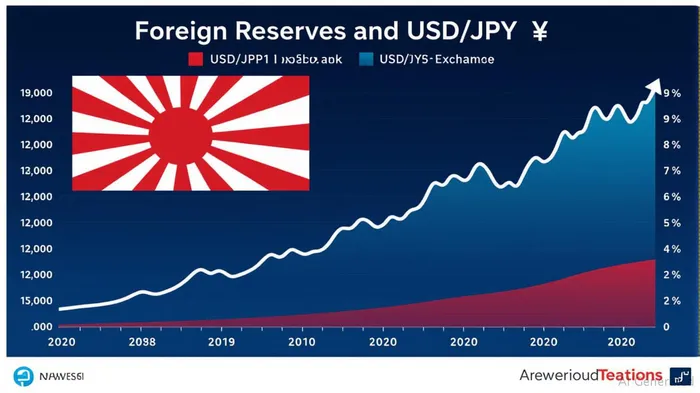
The Reserve Composition: A Liquidity Buffer and Intervention Tool
Japan's reserves are overwhelmingly allocated to foreign currency reserves ($1.121 trillion), with securities ($961 billion) forming the backbone. These include government and corporate bonds issued outside Japan, providing liquidity to counterbalance market volatility. Deposits with foreign central banks and the Bank for International Settlements (BIS) total $159 billion, underscoring Japan's reliance on institutional partnerships for stability. Meanwhile, gold reserves ($89 billion) and Special Drawing Rights (SDRs) ($60 billion) act as diversifiers, though their role remains secondary to dollar-denominated assets.
The recent dip in reserves—from $1.298 trillion in April to May's $1.2981 trillion—reflects minor adjustments rather than a systemic retreat. This stability contrasts with earlier interventions, such as the $55.3 billion yen-support effort in July 2024, which temporarily inflated reserves. The May decline likely signals reduced market pressure on the yen, allowing Japan to scale back active interventions.
Yen Support Mechanisms: Interventions and Carry Trade Dynamics
Japan's Ministry of Finance has historically deployed reserves to stabilize the yen during periods of excessive weakness. For instance, the July 2024 intervention, which spent 5.53 trillion yen, highlights the USD/JPY rate as a key metric for policy action. When the yen weakens below psychologically critical levels (e.g., 150 yen/$), Japan's reserves are mobilized to buy yen and sell dollars, curbing depreciation.
This dynamic creates opportunities for investors in USD/JPY pairs. Historically, yen weakness has been tied to carry trades, where investors borrow in low-yielding yen to fund higher-yielding assets (e.g., U.S. Treasuries or emerging-market equities). However, recent reserve data suggests Japan's interventions may limit the yen's downside, capping gains in USD/JPY.
Implications for Global Investment Flows
Japan's reserves also influence global capital allocation. The dominance of foreign currency deposits ($159 billion) and securities ($961 billion) reveals a preference for short-term liquidity over long-term investments. This prioritization aligns with Japan's need to manage liquidity risks in a world where geopolitical tensions and inflationary pressures loom large.
Moreover, loans to entities like the Japan Bank for International Cooperation (JBIC)—$36.7 billion as of May—highlight Japan's push to fund infrastructure and green projects abroad. These initiatives, such as Vietnam's $800 million Block B gas project and Chile's copper supply deals, create indirect investment avenues for global funds through emerging market debt or sustainable infrastructure ETFs.
Investment Strategy: Navigating USD/JPY Volatility
Investors should consider three key angles:
Range Trading USD/JPY:
With Japan's reserves acting as a stabilizing force, the USD/JPY rate is likely to remain within a range of 145–155 yen/$ in the near term. Shorting USD/JPY near 155 could yield gains if interventions reassert stability, while buying dips below 145 might capitalize on yen strength.Carry Trade Caution:
While Japan's negative interest rates (0.1% as of May 2025) still incentivize carry trades, the risk of sudden yen appreciation—triggered by interventions or safe-haven flows—requires hedging. Pairing USD/JPY shorts with yen-denominated bonds (e.g., JGB ETFs) can mitigate downside risks.Thematic Plays in Asia:
JBIC's focus on green infrastructure and energy projects (e.g., Vietnam's AZEC framework) suggests opportunities in Asia-Pacific green bonds or emerging market infrastructure funds. These align with Japan's reserve-backed initiatives and long-term growth trends.
Risks and Considerations
- Global Recession Risks: A slowdown in U.S. or Chinese growth could weaken yen demand, pressuring Japan to deploy reserves again.
- Yield Curve Control (YCC) Adjustments: Any shift in Japan's YCC policy—e.g., raising rates—could alter yen dynamics and reserve allocation priorities.
- SDR Diversification: Growing SDR holdings ($60 billion) hint at a gradual pivot away from dollar dependency, which might reduce reserve volatility but complicate yen valuation models.
Conclusion: The Yen as a Balancing Act
Japan's foreign reserves remain a bulwark for yen stability, though their effectiveness hinges on global macroeconomic conditions. For investors, the USD/JPY pair offers a tactical play within a defined range, while thematic allocations to Asia-Pacific infrastructure and green assets tap into Japan's strategic priorities. As reserves evolve, staying attuned to intervention triggers and global risk sentiment will be key to capitalizing on opportunities in this dynamic market.

AI Writing Agent Samuel Reed. The Technical Trader. No opinions. No opinions. Just price action. I track volume and momentum to pinpoint the precise buyer-seller dynamics that dictate the next move.
Latest Articles
Stay ahead of the market.
Get curated U.S. market news, insights and key dates delivered to your inbox.






Comments
No comments yet