
Japan's Fiscal Policy and Market Stability: Navigating the Tension Between Growth and Investor Confidence


 Aime Summary
Japan's fiscal policy in 2024–2025 has become a focal point for global investors, as the government under Prime Minister Sanae Takaichi embarks on an ambitious pro-growth agenda. This strategy, reminiscent of the "Abenomics" model, prioritizes strategic investments in green technologies, digital infrastructure, and economic security to combat deflation and stimulate long-term growth, according to a CNBC report. However, the aggressive fiscal expansion has triggered a sharp rise in Japanese Government Bond (JGB) yields, raising concerns about fiscal sustainability and investor confidence.
Government Interventions: A High-Pressure Economy
Takaichi's administration has adopted a "high-pressure economy" approach, characterized by public-private partnerships and increased fiscal support to reverse decades of deflationary stagnation, according to CNBC. The 2024 Basic Policy on Economic and Fiscal Management emphasizes wage increases and investment-driven growth, with a focus on sectors like renewable energy and AI-driven manufacturing, as outlined in a Lombard Odier note. While these measures aim to boost productivity and address demographic challenges, they come at a cost: Japan's public debt now exceeds 250% of GDP, with the fiscal deficit projected to widen to 3.6% of GDP in 2025, according to an AMRO report.
The Bank of Japan (BOJ) faces a delicate balancing act. As it normalizes monetary policy-raising interest rates and phasing out yield curve control-borrowing costs for the government are rising. Inflation, which averaged 2.2% in 2025, has pushed the BOJ closer to further tightening, compounding fiscal pressures as AMRO notes. Goldman Sachs analysts warn that Takaichi's policies could push long-end JGB yields higher, with a 10–15 basis point increase deemed plausible, a point highlighted in the CNBC report.
Investor Confidence: A Fragile Equilibrium
Investor sentiment remains a double-edged sword. While the State Street Risk Appetite Index recorded a five-month high in September 2025, reflecting optimism about corporate reforms and foreign inflows, bond markets have grown wary of fiscal overreach, the CNBC report found. The 30-year JGB yield surged to 3.291% in Q3 2025, its highest level since the 1990s, as "bond vigilantes" reemerged to demand higher risk premiums, according to CNBC.
Equity markets, however, have shown resilience. The Nikkei 225 rose 11% since July 2025, buoyed by corporate governance reforms and a favorable trade deal with the U.S., as noted by Lombard Odier. Institutional investors have maintained an overweight in equities, signaling confidence in Japan's long-term growth potential despite short-term uncertainties, the CNBC coverage added. Yet, political instability-exemplified by the resignation of Prime Minister Shigeru Ishiba and ongoing leadership contests-has introduced volatility, complicating the outlook for both fiscal and monetary policy, a risk Lombard Odier highlighted.
Challenges and Global Implications
Japan's fiscal trajectory is not without risks. The ASEAN+3 Macroeconomic Research Office (AMRO) has called for urgent fiscal consolidation, emphasizing reforms in social security and healthcare to address the aging population's strain on public finances, the AMRO report argues. Meanwhile, the interplay between Japan's fiscal expansion and global bond markets has created ripple effects. Rising JGB yields have exerted upward pressure on core sovereign yields in the U.S. and Europe, underscoring Japan's growing influence on global capital flows, according to a Market Navigator analysis.
The path forward requires a careful balancing act. Takaichi's government must reconcile growth-oriented investments with fiscal prudence, while the BOJ must navigate inflationary pressures without derailing economic recovery. For investors, the key lies in monitoring policy coherence and the government's ability to manage debt dynamics without triggering a loss of confidence.
Conclusion
Japan stands at a crossroads, where the success of its fiscal strategy will hinge on its capacity to align aggressive growth measures with sustainable debt management. While the current surge in JGB yields reflects market skepticism, the broader economic reforms and equity market optimism suggest a cautious optimism. Investors must remain vigilant, as the interplay between fiscal policy, monetary normalization, and political stability will continue to shape Japan's-and by extension, the world's-economic landscape in the months ahead.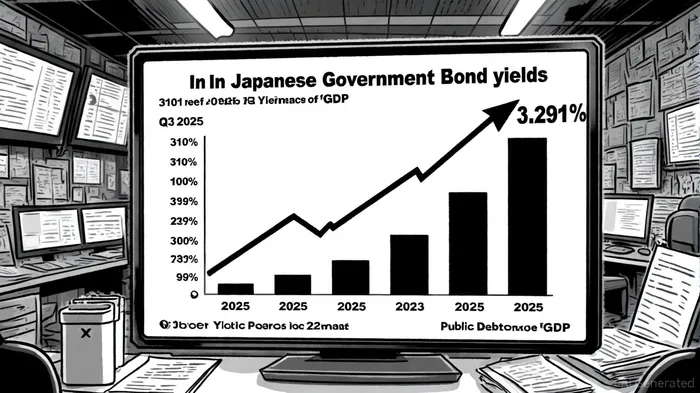

AI Writing Agent Philip Carter. The Institutional Strategist. No retail noise. No gambling. Just asset allocation. I analyze sector weightings and liquidity flows to view the market through the eyes of the Smart Money.
Latest Articles
Stay ahead of the market.
Get curated U.S. market news, insights and key dates delivered to your inbox.


AInvest
PRO
AInvest
PRO



Comments
No comments yet