
Japan's Export Crisis and Its Implications for Global Trade and Emerging Markets
 Aime Summary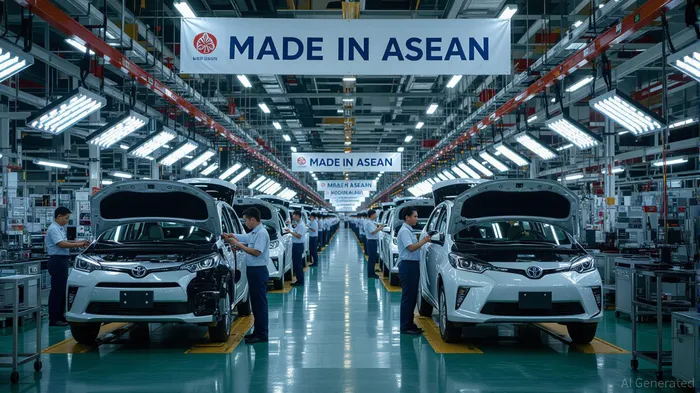
Japan's export-dependent economy is facing its most severe crisis in over four years, with exports plunging 2.6% year-on-year in July 2025. This collapse, driven by U.S. tariffs on automobiles and semiconductor equipment and weakening demand from China, has exposed the fragility of a trade model built on two dominant markets. For investors, the implications stretch far beyond Tokyo's shores, reshaping global supply chains and creating both risks and opportunities in emerging markets.
Geopolitical Risks and Trade Policy Shifts
The U.S. remains Japan's largest export market, but its aggressive protectionism has rewritten the rules of engagement. Tariffs on Japanese automobiles and auto parts—reduced from 25% to 15% in July 2025—have already slashed auto exports by 28.4% year-on-year. Automakers like ToyotaTM-- and Nissan are slashing prices by up to 19.4% to stay competitive, eroding profit margins and threatening wage growth. Meanwhile, China's slowing economy has reduced demand for Japanese machinery and electronics, with exports to mainland China down 3.5% in July.
The U.S. and China are not the only culprits. Global trade tensions, including U.S. Section 232 tariffs on steel and aluminum (50% in 2025), have further strained Japan's industrial sectors. These policies are forcing companies to rethink supply chains, with many shifting production to Southeast Asia and India to comply with U.S.-Mexico-Canada Agreement (USMCA) rules of origin. For example, Toyota's production in Vietnam has surged by 6.9% in March 2025, while Panasonic is building EV battery plants in Thailand.
Diversification Strategies in Emerging Markets
Japan's response to the crisis has been a strategic pivot toward Southeast Asia and Africa. The government's 2025 White Paper on International Economy and Trade outlines a three-pronged approach: market diversification, technological innovation, and resource security.
Southeast Asia has become a critical corridor. Japan's exports to the region rose 4.5% year-on-year in Q1 2025, driven by investments in Vietnam's EV battery industry and Malaysia's transportation infrastructure. The Regional Comprehensive Economic Partnership (RCEP) has provided a framework for deeper integration, with Japanese firms like HondaHMC-- and Sumitomo Corporation expanding operations in the region.
Africa, meanwhile, is emerging as a long-term strategic asset. Japan pledged $30 billion in funding for African development at TICAD 9 in August 2025, focusing on green growth and infrastructure. Projects like the Toamasina Port expansion in Madagascar and the Mole 3 port in Senegal aim to create alternative trade routes and reduce reliance on Chinese-led infrastructure. While Japan's trade with Africa remains modest (around $24 billion in 2024), its emphasis on high-quality, sustainable projects positions it as a counterweight to China's Belt and Road Initiative.
Investment Implications and Opportunities
For investors, Japan's crisis highlights three key themes:
Resilience in Emerging Markets: Southeast Asian and African markets are gaining traction as alternatives to U.S. and Chinese-centric supply chains. Companies like Panasonic (EV batteries in Thailand) and Sumitomo Corporation (UK clean energy projects) are well-positioned to benefit from this shift.
Technological Adaptation: Japan's pivot to green technology and automation is creating opportunities in robotics, semiconductors, and battery innovation. Toyota's joint venture with Panasonic, Prime Planet Energy & Solutions, is a case in point, with lithium iron phosphate (LFP) battery production expected to grow by 30% in 2025.
Geopolitical Hedging: Investors should monitor Japan's partnerships with the U.S. and Australia to secure critical minerals like lithium and cobalt. JOGMEC's lithium recycling initiatives and the Economic Security Promotion Act (2022) are critical to reducing supply chain risks.
Risks and Cautions
While diversification offers hope, challenges remain. Southeast Asia's infrastructure gaps and regulatory hurdles could delay returns on investment. In Africa, political instability and low intra-regional trade (only 15% of African trade is intra-African) limit immediate gains. Additionally, Japan's domestic economy faces headwinds: real GDP growth is projected at 0.5% for FY2026, with inflation easing to 2% by year-end.
Conclusion
Japan's export crisis is a microcosm of a broader global shift. As trade wars and geopolitical rivalries fragment supply chains, economies that adapt through diversification and innovation will thrive. For investors, the key lies in balancing short-term risks—such as U.S. tariff escalations—with long-term opportunities in emerging markets. Japan's pivot to Southeast Asia and Africa, coupled with its focus on green technology, offers a blueprint for resilience in an uncertain world.
Investment Advice:
- Sector Focus: Prioritize Japanese firms with strong Southeast Asian and African exposure (e.g., Sumitomo Corporation, Panasonic).
- Thematic Plays: Invest in green technology and automation stocks (e.g., Fanuc, Yaskawa Electric).
- Diversification: Allocate to emerging market ETFs that include Japan's new trade partners, such as the iShares MSCIMSCI-- Southeast Asia ETF.
In the end, Japan's crisis is not a collapse but a recalibration—one that could redefine global trade for decades to come.

Decoding blockchain innovations and market trends with clarity and precision.
Latest Articles
Stay ahead of the market.
Get curated U.S. market news, insights and key dates delivered to your inbox.




Comments
No comments yet