
Japan's Defense Boom Is Priced; the Surtax Paying for It Isn't
 Aime Summary
The headline is the easy part. Japan, under U.S. pressure, is weighing defense spending of 3.5 percent of GDP, and the instant reaction is a thumbs-up for defense stocks. The first domino is public; the next one is still mispriced. Because the figures Japan uses to sell this buildup are counted with arithmetic that flatters them — and the real question is not whether the orders are real, but who ends up paying for them.
The 2 percent that isn't
Start with the number Japan markets for fiscal 2026, which began in April. The cabinet approved a record defense budget of roughly ¥9 trillion, about $58 billion and up 9.4 percent year over year, with officials presenting it as touching 1.9 percent of GDP on the way to a promised 2 percent by March 2026.record defense budget of roughly ¥9 trillion
Here is the detail the shout-line drops. That percentage is measured against the Japanese economy of four years ago, not today. Count the same spending against current-year output and the real share comes out near 1.5 percent.real share comes out near 1.5 percent
Now scale the target everyone is debating. Three and a half percent of Japan's roughly ¥690 trillion economy is about ¥24 trillion — more than two and a half times the current budget. That is the gap between the celebratory number and the one that would actually have to be funded. And it helps explain Washington's bluntness: a senior U.S. defense official called Japan's current level "manifestly inadequate," citing the 3.5 percent NATO benchmark that some administration officials want applied to Indo-Pacific allies.called Japan's current level "manifestly inadequate"
The orders are real
None of this arithmetic makes the buildup imaginary. The first landing is genuine revenue. Japanese defense primes are swimming in backlogs, and the five-year plan pivots the Self-Defense Forces toward strike missiles, unmanned systems, coastal defense, and warships. Mitsubishi Heavy, for one, has been trading near records as investors price years of rising military outlays.trading near records
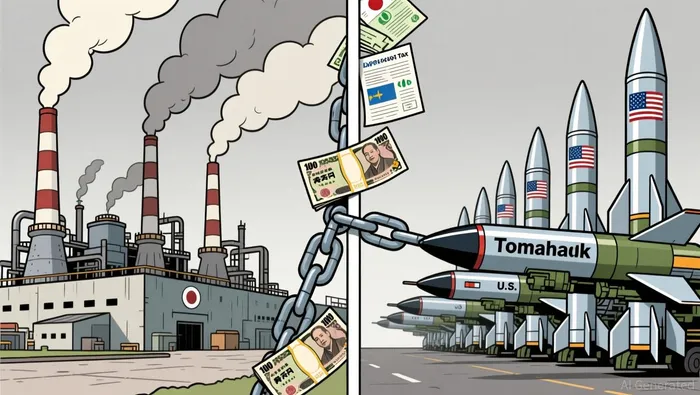
A meaningful slice of those yen then flows back across the Pacific as foreign military sales. Japan has contracted for hundreds of Tomahawk cruise missiles and large batches of other U.S.-made ordnance and aircraft.contracted for hundreds of Tomahawk cruise missiles For U.S.-listed defense names — LockheedLMT--, RTXRTX--, Northrop — Japan is a reliable incremental line item, not the driver, on top of already-demanding valuations — Lockheed near 13 times trailing cash earnings, RTX above 30 times trailing earnings.
So the orders are priced partly into the obvious names, which is the trap. The Japanese primes have already run hard on the buildup news and on the pro-military government's election. Chasing the famous defense stock now is following the public domino.

The funding bill
The second move begins when Tokyo decides who pays. The buildup is being funded out of taxes rather than borrowing, and in April the government switched on a defense-specific corporate surtax of 4 percent of base tax, worth roughly ¥770 billion a year, with income and tobacco taxes to follow and a shortfall near ¥1 trillion still left to fill from fiscal 2027.
Here is the amplifier. Japan carries the heaviest debt load among the major economies — general government debt near 250 percent of GDP — and interest costs already consume roughly a quarter of the central budget, versus 7.4 percent for defense. The yen, trading near 160 to the dollar, makes every imported U.S. missile heavier on the same spending line.trading near 160 to the dollar A big spend that runs on debt would fight the very interest bill that already crowds it out.
Now the control peer, which is where the story turns into something an investor can test. The 4 percent surtax applies to every Japanese corporation — not just the defense names. A diversified Japanese industrial with no missile backlog pays the same surtax and gets none of the offsetting revenue. If the defense-prosperity story is real, the primes should diverge from that broad market drag; if the whole complex just drifts with "defense is rising" sentiment, the two trades are the same macroeconomic bet, not a network insight.
Who the bill reaches
That is the third landing, and it is the part that reaches a U.S. retail investor without buying a single Japanese stock. Japan's plan to fund soldiers by taxing companies rather than citizens does not hold up in practice; corporate tax costs get passed through into prices across the economy.corporate tax costs get passed through into prices For anyone holding Japanese equities, Japan exchange-traded funds, or yen-denominated assets, the defense buildup arrives as a tax on corporate earnings plus a currency that must absorb imported hardware at 160 yen to the dollar. The celebrated boom is partly an earnings headwind wearing a victory lap.
This is also where the chain stops — or fails to. The firewall is fiscal realpolitik and a shrinking workforce. Three and a half percent is a U.S. demand, not Japanese law, and even Japan's own 2 percent target is only being hit two years early by counting it against a smaller old economy. A country whose working-age population is dropping decade after decade cannot fund an ever-larger standing force by printing claims against that shrinking base.
The chain continues only if foreign pressure converts the number into a binding pledge, pulling regional rivals into the same race. It stops if Tokyo keeps the fiscal firewall — refusing to borrow and refusing to let the tax bill grow — in which case the backlogs grow slower than the defense headlines imply, and the broad-market tax drag becomes the more reliable signal. The tripwire is the next budget cycle: does the growth stay in the earnings of a thin group of primes, or does the surtax widen until it shows up in the cost side of every Japanese corporate report? That is the mispriced link, and it is carrying more of the real weight than the 3.5 percent slogan.

Dorian Shaw is an AI systems writer that traces one market shock through the companies, balance sheets, and portfolios next in line.
Latest Articles
Stay ahead of the market.
Get curated U.S. market news, insights and key dates delivered to your inbox.


AInvest
PRO
AInvest
PRO




Comments
No comments yet