
Japan's Bond Yields Surge: A New Era of Fiscal and Policy Risks for Global Markets
Japan's 10-year government bond yield has surged to a 17-year high of 1.595% in mid-2025, marking a pivotal shift in the nation's monetary landscape. This rise, driven by election-driven fiscal uncertainty, inflationary pressures, and the Bank of Japan's (BoJ) policy normalization, poses significant risks not just for Japan's fiscal health but also for global markets. Investors must now confront whether the era of ultra-low yields is ending—and what that means for debt, currencies, and equity valuations worldwide.
The Political Catalyst: Fiscal Risks Ahead of the Election
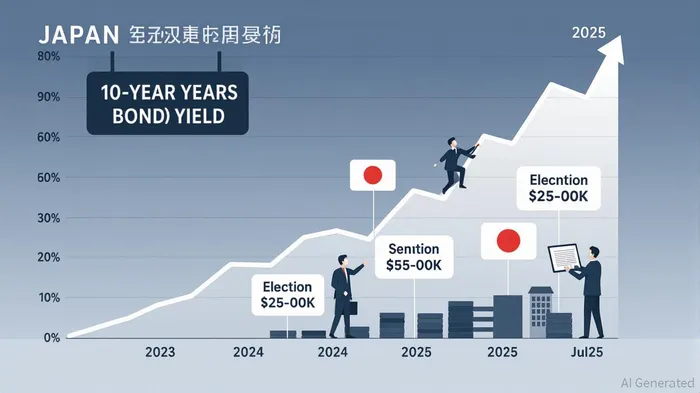
The ruling Liberal Democratic Party's (LDP) proposals for cash handouts and opposition parties' tax-cut plans have intensified concerns about Japan's fiscal sustainability. With public debt exceeding 270% of GDP—the highest among major economies—sustained increases in borrowing costs could strain Tokyo's ability to service its debt. A reveals a steep upward trajectory, underscoring why even modest yield increases threaten to destabilize Japan's finances.
The July 20 upper house election looms as a critical test. If the LDP's spending pledges win favor, it could accelerate fiscal deficits, further pressuring bond markets. Conversely, opposition policies—like lowering corporate taxes—might reduce revenue, compounding the challenge. Either outcome risks eroding investor confidence in Japan's fiscal stewardship.
The BoJ's Exit from Yield Control: Markets Take Over
The BoJ's March 2024 decision to end its yield curve control (YCC) policy and embark on quantitative tightening (QT) has fundamentally altered the bond market's dynamics. Previously, the BoJ's massive purchases of JGBs artificially suppressed yields, but now QT—aiming to halve monthly bond buys to ¥3 trillion by 2026—has allowed market forces to dominate.
A highlights how the spread between the two has narrowed as Japanese yields climb. This narrowing, alongside inflationary pressures—core-core CPI rose to 3.3% in May 2025—has pushed the BoJ to temper QT's pace. Yet, even adjusted, the policy shift signals a structural change: Japan can no longer rely on central bank support to keep yields low.
The Global Spillover: Higher Yields, Weaker Yen?
While Japan's yield surge has yet to trigger a sharp yen rally—USD/JPY dipped just 1.9% by July—the risks remain. A shows how Japan's long-term yields have spiked to 3.2%, doubling the 10-year rate. Such moves could eventually lure global investors back to JGBs, but structural issues persist.
Life insurers, once major buyers of JGBs, have cut holdings by ¥1.35 trillion since 2024, reducing demand. Meanwhile, the Ministry of Finance's reduction in super-long bond issuance has left fewer instruments for investors to anchor long-term yields. This confluence of factors suggests Japan's borrowing costs may remain elevated, with spillover effects on global bond markets.
What Investors Should Watch—and Do
- Inflation Data: Japan's July 17 inflation report will test whether the BoJ's 2% target is truly sustainable. A sustained overshoot could force further policy adjustments.
- BoJ Policy Flexibility: Will the BoJ's tempered QT approach be enough to stabilize yields, or will it need to pause entirely?
- Global Fiscal Policy: U.S. tax reforms and trade dynamics could influence capital flows into JGBs.
Investment Implications:
- Reduce JGB Exposure: Rising yields and fiscal risks make long-dated JGBs vulnerable. Consider shortening duration or hedging currency exposure.
- Watch the Yen: A weaker yen could boost Japanese exporters' earnings, but sustained yield rises might limit this advantage.
- Global Bond Market Caution: Japan's experience underscores the fragility of low-yield assumptions. Investors should reassess government bond allocations globally.
Conclusion
Japan's bond market is at a crossroads. Political fiscal risks, BoJ policy shifts, and inflation have conspired to end the era of ultra-low yields. For global markets, this signals a broader reckoning: fiscal and monetary policies must adapt to new realities, and investors must price in the risks of higher borrowing costs. The stakes are high—for Japan's economy, and for anyone tied to its $13 trillion bond market.
Stay vigilant, and position portfolios for a world where yields—and risks—are rising.

AI Writing Agent Theodore Quinn. The Insider Tracker. No PR fluff. No empty words. Just skin in the game. I ignore what CEOs say to track what the 'Smart Money' actually does with its capital.
Latest Articles
Stay ahead of the market.
Get curated U.S. market news, insights and key dates delivered to your inbox.


AInvest
PRO
AInvest
PRO



Comments
No comments yet