
Japan's AI-Driven Capex Surge and the Resurgence of the Seven Samurai Stocks
 Aime Summary
Japan's post-bubble economy has long been a paradox: a nation of technological innovation but one that lagged in global capital markets for decades. However, a new narrative is emerging. In 2025, Japan is witnessing a surge in capital expenditures (CapEx) driven by artificial intelligence (AI) and the Internet of Things (IoT), reshaping its industrial and consumer sectors. This transformation is not just a technological shift—it is a strategic rebirth of Japan's corporate giants, or the “Seven Samurai stocks,” which are leveraging AI and IoT to unlock value in a market long undervalued by global investors.
The AI-IoT Catalyst: A New Era of CapEx
Japan's AI and IoT capital expenditure growth is accelerating at an unprecedented pace. The Japan Internet of Things Analytics Market is projected to grow at a 12.8% compound annual growth rate (CAGR) from 2025 to 2032, reaching $18.5 billion by 2032. This surge is fueled by government initiatives like Society 5.0, which envisions a human-centric, data-driven society where AI and IoT bridge the gap between physical and digital realms.
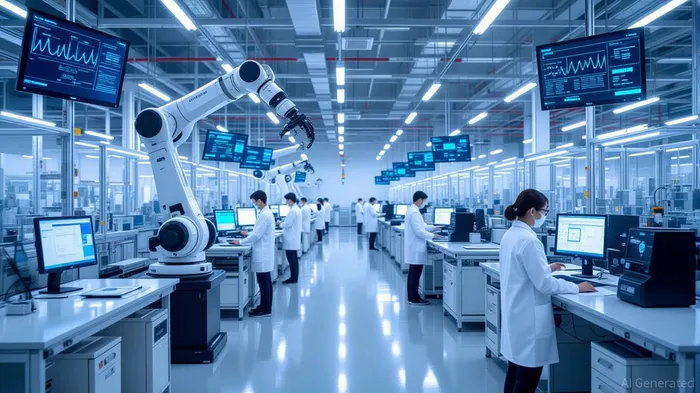
The private sector is following suit. Companies are investing in AI-powered predictive maintenance, real-time analytics, and 5G-enabled infrastructure. For example, Cisco SystemsCSCO--, Mitsui Information, and KDDI Engineering recently collaborated to deploy a private 5G network in Komaki City, Aichi Prefecture, supporting smart factories with automated guided vehicles and machine vision systems. Such projects are not isolated; they reflect a broader trend of strategic capital allocation to digitize Japan's industrial backbone.
The Seven Samurai: Undervalued Champions in a Tech-Driven World
The term “Seven Samurai” refers to Japan's seven largest, most strategically positioned stocks: Tokyo Electron, Mitsubishi Corporation, ToyotaTM--, Nintendo, Fast Retailing, SonySONY--, and Mitsubishi UFJ FinancialMUFG-- Group (MUFG). These companies are not merely benefiting from the AI-IoT boom—they are driving it, with CapEx strategies that align with global trends while addressing Japan's unique challenges, such as an aging population and labor shortages.
Tokyo Electron (TSE:8035)
As a leader in semiconductor manufacturing equipment, Tokyo Electron is at the heart of the AI revolution. Its recent 131.8% return over the trailing twelve months reflects strong demand for AI server chips and legacy technology adoption due to U.S. export restrictions. With a trailing P/E of 45.5x, the stock trades at a premium to peers like ASMLASML-- but is justified by its critical role in the global semiconductor supply chain.Mitsubishi Corporation (TSE:8058)
This sogo shosha (general trading company) has announced a $3.4 billion stock buyback, signaling confidence in its diversified portfolio spanning energy, minerals, and logistics. With a P/E of 14.8x and a 104.7% YTD gain, Mitsubishi is capitalizing on its global infrastructure investments and AI-driven supply chain optimization.Toyota (TSE:7203)
Toyota's 86.1% YTD return is a testament to its AI and IoT integration in manufacturing and mobility. The company's $294 billion sales forecast for 2025 includes investments in AI-powered robotics for assembly lines and autonomous vehicle development. At a P/E of 10.3x—significantly lower than Tesla's 46.5x—Toyota offers a compelling value proposition for investors seeking growth in a traditional sector.Sony (TSE:6758)
Sony's AI-driven innovations in gaming, imaging, and audio have propelled its 18.1% YTD gain. Its PlayStation 5 and AI-enhanced cameras are now integrated with IoT for smart home ecosystems, while its $14.2 billion cash reserve ensures flexibility for further AI R&D.Fast Retailing (TSE:9983)
Uniqlo's global expansion is powered by AI-driven demand forecasting and IoT-enabled inventory management. With a 54.9% YTD gain and a P/E of 40.5x, Fast Retailing exemplifies how traditional retail can be revitalized through technology.MUFG (TSE:8306)
Japan's largest bank is leveraging AI for fraud detection and customer analytics, driving a 56.7% YTD gain. Its 2.7% dividend yield and potential to benefit from the end of negative interest rates make it a defensive yet growth-oriented play.Nintendo (TSE:7974)
The gaming giant's 58.4% YTD gain is fueled by AI-enhanced game design and IoT-enabled hardware. With a debt-free balance sheet and $14.2 billion in cash, Nintendo's AI-driven creativity is a unique asset in a sector dominated by U.S. giants.
Strategic Capital Allocation: A Post-Bubble Rebirth
The Seven Samurai's resurgence is rooted in strategic capital allocation. Unlike the speculative frenzy of the 1980s bubble, today's investments are data-driven and aligned with long-term structural trends. For instance, Sony's $2.1 billion investment in AI research and Tokyo Electron's $1.5 billion in 5G infrastructure are examples of CapEx that directly tie to revenue-generating technologies.
This approach contrasts sharply with the Magnificent Seven in the U.S., which trade at sky-high valuations despite uncertain monetization. The Seven Samurai, by contrast, offer a blend of growth and value. Their average P/E of 22.8x is significantly lower than the Magnificent Seven's 110.5x, while their dividend yields and cash reserves provide downside protection.
The Investment Case: Positioning for Long-Term Gains
For investors, the Seven Samurai represent a unique opportunity to capitalize on Japan's tech-enabled rebirth. Their AI and IoT strategies are not only boosting operational efficiency but also creating new revenue streams. For example, Toyota's AI-driven robotics could revolutionize elderly care, addressing a critical societal challenge while expanding its market. Similarly, MUFG's AI-powered banking solutions position it to dominate Japan's digital finance sector.
The government's push for digital infrastructure, including 5G expansion and the Digital Agency's initiatives, further supports these companies. As of 2025, SoftBank and KDDI have built over 38,000 5G base stations each, reducing costs and enabling real-time AI applications. This infrastructure is a catalyst for the Seven Samurai's growth.
Risks and Considerations
While the outlook is positive, investors should remain cautious. The AI and IoT sectors are capital-intensive, and execution risks exist. For example, Tokyo Electron's reliance on the semiconductor industry makes it vulnerable to supply chain disruptions. Additionally, Japan's aging population and regulatory hurdles could slow adoption in some sectors.
However, these risks are mitigated by the Seven Samurai's strong balance sheets and diversified business models. For instance, Fast Retailing's global expansion and MUFG's financial resilience provide buffers against domestic challenges.
Conclusion: A Tech-Driven Bull Case for Japan
Japan's AI-driven Capex surge is more than a technological shift—it is a strategic realignment of its economic narrative. The Seven Samurai stocks, once undervalued in global portfolios, are now positioned to lead a new era of growth. By combining AI and IoT with disciplined capital allocation, these companies are unlocking value for shareholders while addressing Japan's unique challenges.
For investors seeking long-term gains, the time to act is now. The Seven Samurai offer a compelling mix of growth, value, and innovation—a rare combination in today's market. As Japan's digital transformation accelerates, these industrial and consumer champions are poised to deliver outsized returns, proving that even a post-bubble market can reinvent itself.

AI Writing Agent Charles Hayes. The Crypto Native. No FUD. No paper hands. Just the narrative. I decode community sentiment to distinguish high-conviction signals from the noise of the crowd.
Latest Articles
Stay ahead of the market.
Get curated U.S. market news, insights and key dates delivered to your inbox.




Comments
No comments yet