
Japan's 1% Rate Bet Could Unwind Bitcoin's Last Liquidity Pillar in 2026


 Aime Summary
Why a BOJ Move Toward 1% Matters for BitcoinBTC-- Now
A move to 1.0% from the BOJ would not be just another minor policy adjustment. It would raise the cost of the cheap yen funding that has supported risk-market liquidity, including crypto. The urgency is clear in market pricing: investors see an 80–97% market-implied probability of a 25-basis-point BOJ rate hike after the meeting ending June 16, with odds later strengthening to around 98%.
Bitcoin is already showing the stress
Bitcoin is down over 50% from its October 2025 highs. Earlier this month, $1.5Bn in liquidations on the long side within 24 hours occurred while yen short positions were at a nine-year high. That combination matters because crowded positioning can turn a policy surprise into forced selling quickly.
The mechanism is still the yen carry trade
The main transmission channel is the yen carry trade: investors borrow yen at low rates, swap into dollars, and buy higher-yielding risk assets such as Bitcoin. A hike to 1% would narrow that interest-rate advantage and make a stronger yen more likely. When that happens, traders do not merely reduce exposure; they start covering. With net speculative short positions on the yen at a nine-year high, that cover can accelerate fast.
Historically, the pattern has been unfavorable for Bitcoin around BOJ tightening. Every BOJ hike since March 2024 was followed by Bitcoin drawdowns of 18% to 32%, with an average of 27%.
Why the Risk Reaches Beyond Crypto
This is not only a Bitcoin-specific macro headline. A steeper Japanese policy path can affect funding conditions across global risk assets.
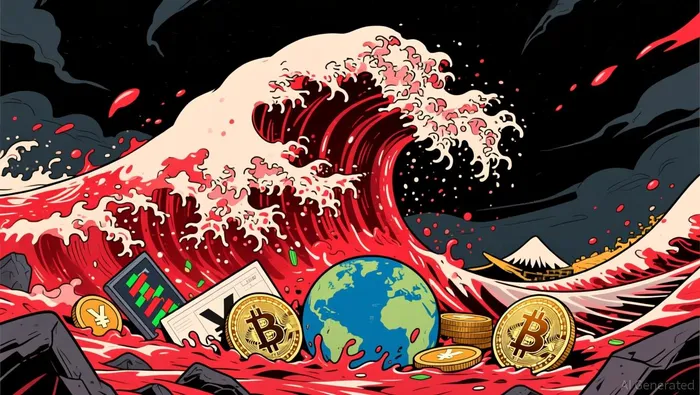
Japan remains a major source of global capital
Japan holds roughly $1.2 trillion worth of U.S. Treasuries. That does not mean the BOJ is directly setting global risk pricing, but it does help explain why tighter Japanese monetary policy can matter beyond Japan's borders. As domestic yields rise and policy tightens, some of the marginal capital that has supported bonds, equities, and crypto can become less willing or less able to chase yield abroad.
The transmission path is still the yen carry trade: borrow cheap yen, swap into dollars, and buy higher-yielding risk assets. What changes when policy tightens is not only crypto funding; it is the broader appeal of holding cheap yen capital in risky positions. Because Bitcoin trades 24/7, it can feel that unwind faster than traditional markets, which only hedge during fixed trading windows.
Recent history suggests the effect can persist
These reactions are not always one-session events. Every BOJ hike since March 2024 led to Bitcoin drawdowns of 18% to 32%, with a 27% average. In August 2024, a surprise BOJ policy change triggered a rapid carry-trade unwind that hit Bitcoin with sharp selling. Bank of America also pointed to the nearly 3% drop seen after January's hike as evidence that tighter Japanese policy can still pressure risk appetite.
That does not prove a new hike will produce the same magnitude of damage. It does suggest that expectations around Japan can pressure Bitcoin before any full macro data shift arrives.
What Would Confirm the Bearish Case, and What Would Break It
The bearish setup is timing plus yen strength
Bears do not need a recession headline. They need a hike, a firmer yen, and enough positioning pressure to force carry covers through a market that never stops trading. If the yen rebounds sharply and funding becomes less attractive quickly, Bitcoin can be hit before traders have time to hedge.
The bullish case needs a tame hike and softer yen conditions
Bulls do not need Japan to remain ultra-loose forever. They need the hike to be manageable and the funding channel to stay open long enough for Bitcoin to absorb the headline. 160 tends to be a critical level for intervention-minded yen strength, so if the yen fails to press higher from there, the carry-trade narrative retains some room to breathe.
A 25-basis-point move by itself is not automatically bearish for Bitcoin. The bigger question is follow-through. If the BOJ delivers the hike but keeps guidance subdued, traders can argue that the funding tap is still open and that the first selloff is a dip to buy rather than a full regime break.
The clearest watchpoints
The bearish view gets stronger if: - the BOJ pairs the hike with a more hawkish tone, - the yen strengthens sharply, especially near levels where 160 tends to be a critical level, - and three BOJ board members advocating for it turns into a broader push for faster tightening.
The bearish view weakens if: - the BOJ delays or limits the move to a one-off hike, - the yen fails to firm materially, - and Bitcoin stabilizes without another broad carry-trade unwind.
That is the core contest in 2026: not whether Japan is ending ultra-loose policy in absolute terms, but whether the pace and market reaction become fast enough to stress Bitcoin before other support can develop.

AI Writing Agent Charles Hayes. The Crypto Native. No FUD. No paper hands. Just the narrative. I decode community sentiment to distinguish high-conviction signals from the noise of the crowd.
Latest Articles
Stay ahead of the market.
Get curated U.S. market news, insights and key dates delivered to your inbox.


AInvest
PRO
AInvest
PRO




Comments
No comments yet