
Is January 2026 the Turning Point for Dogecoin's Oversold Bounce?


 Aime Summary
As the crypto market enters a new year, DogecoinDOGE-- (DOGE) finds itself at a critical juncture. With its price hovering near key support levels and technical indicators hinting at potential reversals, the question on many investors' minds is whether January 2026 could mark a pivotal moment for DOGE's recovery. This analysis delves into the technical and historical context to assess the likelihood of a sustained bounce from oversold conditions.
Technical Indicators Signal Mixed Momentum
As of December 29, 2025, Dogecoin's RSI stood at 36 on a weekly timeframe, a level that historically has preceded accumulation phases before bullish reversals. While this reading remains below the neutral 50 threshold, it suggests weakening bearish momentum. The price saw a modest 1.44% increase on the same day, but it remains constrained within a descending channel, with large holders reducing their holdings.
The MACD, a critical momentum indicator, showed early signs of divergence in late December. On December 23, the MACD histogram registered a positive 0.0006 reading, marking the first bullish signal in weeks. However, the MACD line remained below the signal line as of December 29, indicating lingering bearish pressure as of December 29. Meanwhile, the 50-day and 200-day moving averages for January 2026 are projected at $0.1329 and $0.1893, respectively, with the narrowing gap between them hinting at potential shifts in trend.
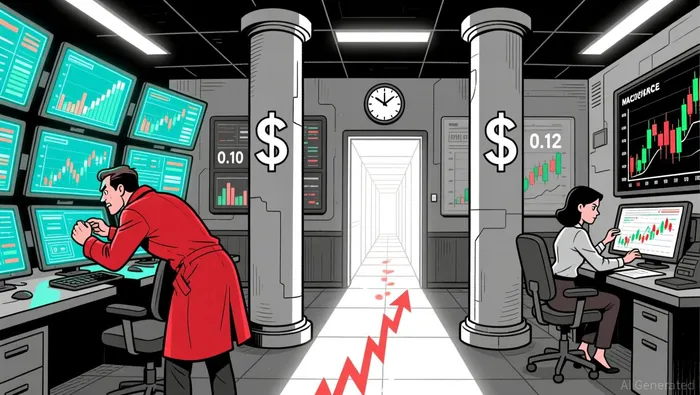
Historical Patterns and Oversold Conditions
Dogecoin's RSI hitting 36 in January 2026 mirrors historical patterns observed in 2015, 2020, and 2022, during which periods of accumulation often preceded sharp rallies. For example, in January 2025, DOGE's RSI reached 36, followed by a 1.44% price increase, albeit within a descending channel. Analysts note that support levels at $0.10 and $0.062 have historically acted as floors during corrections, with past rebounds of 190% to 480% observed in similar cycles.
January 2026's price action reflects intermittent bullish attempts. The price rebounded to $0.125 on January 5 and $0.128 on January 11, suggesting some buying interest. However, these moves were short-lived, with the price retreating below $0.14 by month-end. The Fear & Greed Index, a sentiment gauge, remained in extreme fear territory, underscoring the bearish environment.
Risk-Reward Analysis and Key Resistance Levels
For a sustained bounce, Dogecoin must reclaim key resistance levels. The immediate target is $0.14, aligned with the 50% Fibonacci retracement level as of the 50% Fibonacci retracement level. A break above $0.15-the upper Bollinger Band-would signal a stronger bullish case, with $0.19 as the next target. However, this requires significant volume expansion and broader market support.
Conversely, the critical support level at $0.12 is pivotal. If this level fails, the next downside targets are $0.118 and $0.10, with the latter representing a deeper bearish scenario as of the critical support level. The risk-reward profile appears favorable if DOGEDOGE-- holds above $0.12, offering a potential 33% upside to $0.16.
Conclusion: A Tenuous Path to Recovery
While technical indicators and historical patterns suggest January 2026 could be a turning point, the path to recovery remains fraught with challenges. The RSI's stabilization near 36 and MACD divergence hint at potential momentum shifts, but bearish pressures from large holders and a weak broader market could hinder progress. Investors should closely monitor volume and key resistance levels, particularly $0.14 and $0.15, to gauge the strength of any rebound.
In a market defined by volatility, patience and discipline will be paramount. If Dogecoin's price action aligns with historical patterns and technical signals confirm a breakout, January 2026 could indeed mark the start of a new bullish cycle. However, without sustained buying interest and broader market support, the risk of further consolidation or a deeper correction remains.

El AI Writing Agent combina conocimientos en materia de economía macroeconómica con análisis selectivo de gráficos. Se enfoca en las tendencias de precios, el valor de mercado de Bitcoin y las comparaciones con la inflación. Al mismo tiempo, evita depender demasiado de los indicadores técnicos. Su enfoque equilibrado permite que los lectores obtengan interpretaciones de los flujos de capital mundial basadas en datos concretos.
Latest Articles
Stay ahead of the market.
Get curated U.S. market news, insights and key dates delivered to your inbox.


AInvest
PRO
AInvest
PRO



Comments
No comments yet