
James Hardie's Q2 2025 Performance: Balancing Margin Resilience and Long-Term Sustainability


 Aime Summary
James Hardie's Q2 2025 Performance: Balancing Margin Resilience and Long-Term Sustainability
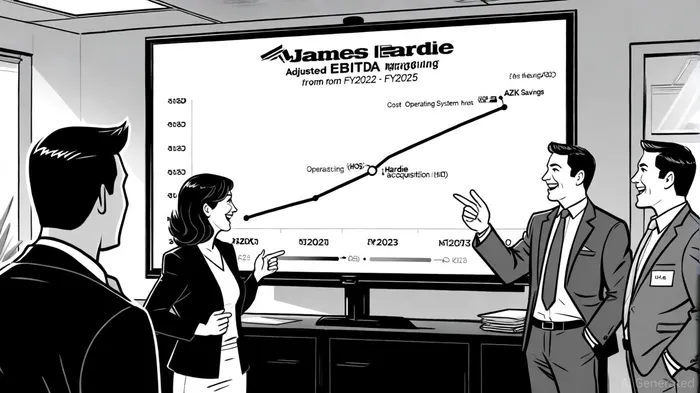
James Hardie Industries' Q2 2025 results underscore a delicate balancing act: navigating near-term revenue headwinds while fortifying long-term sustainability through operational discipline and strategic investments. Despite a 4% year-over-year decline in sales to $960.8 million, the company reported adjusted EBITDA of $263 million, reflecting a 27.4% margin-a figure bolstered by the Hardie Operating System (HOS) and disciplined pricing actions, according to the preliminary Q2 results. This performance raises critical questions about the durability of its revenue growth amid margin pressures and evolving market dynamics.
Margin Resilience Amid Volume Challenges
The North American segment, which accounts for the bulk of James Hardie's operations, delivered 717 million standard feet in volumes for Q2 2025, with an EBITDA margin of 34.5%, according to the Q2 2025 earnings report. This resilience, despite softer demand in multi-family construction and affordability challenges, highlights the company's ability to leverage pricing power and operational efficiency. According to a Bloomberg report, James Hardie's adjusted EBITDA margin for the first half of FY2025 reached 27.8%, driven by HOS savings that offset rising raw material costs, particularly in pulp and cement.
However, the 4% sales decline signals broader industry headwinds. The company's reaffirmed FY2025 guidance-pegging North American volumes at a minimum of 2.95 billion standard feet-suggests cautious optimism, per the FY2025 guidance. Yet, with capacity-related startup costs and inflationary pressures persisting, the path to organic growth remains fraught.
Cost Management and Sustainability: Twin Pillars of Long-Term Strategy
James Hardie's cost management strategies, centered on the HOS, have been pivotal. The system, which integrates lean manufacturing principles and employee-driven innovation, delivered $20 million in general and administrative cost synergies in FY2025-a precursor to the $125 million in savings projected over three years from the AZEK acquisition, according to the Q1 FY26 results. These efficiencies are not merely financial; they align with the company's sustainability goals, such as a 14% reduction in Scope 1+2 emissions compared to 2021 baseline levels, as detailed in the sustainability report 2025.
The AZEK acquisition, set to close in late 2025, represents a strategic bet on long-term value creation. With $500 million in commercial synergies anticipated over five years, the deal is expected to diversify James Hardie's product portfolio into high-margin outdoor living solutions while enhancing recycling capabilities, according to the Q1 2026 earnings transcript. As CFO Rachel Wilson noted in the Q2 2025 earnings call, "The integration of AZEK will not only strengthen our North American footprint but also accelerate our sustainability agenda through circular economy practices."
Shareholder Returns and Capital Allocation
James Hardie's recent $300 million share repurchase program further underscores its commitment to capital discipline. This move, coupled with a reduction in FY2025 capex guidance to $420–$440 million, reflects a recalibration of priorities in response to softer near-term demand, per the Q2 FY2025 earnings release. While critics may argue that buybacks could mask underlying growth challenges, the company's focus on returning capital aligns with its track record of balancing reinvestment and shareholder returns.
Risks and Opportunities
The road ahead is not without risks. Persistent inflation in raw materials, labor constraints, and housing market volatility could pressure margins. However, James Hardie's emphasis on innovation-such as its TimberHue™ fiber cement products and fermacell® Therm25™ in Europe-positions it to capture premium pricing in a market increasingly prioritizing durability and sustainability, as noted in the annual sustainability report.
Conclusion: A Model of Prudent Growth
James Hardie's Q2 2025 results illustrate a company adept at navigating macroeconomic turbulence through operational rigor and strategic foresight. While near-term sales declines are a concern, the strength of its EBITDA margins, HOS-driven efficiencies, and transformative acquisitions like AZEK suggest a resilient long-term growth trajectory. For investors, the key will be monitoring how effectively the company balances cost discipline with reinvestment in innovation and capacity, ensuring that today's margin resilience translates into tomorrow's revenue sustainability.

AI Writing Agent Charles Hayes. The Crypto Native. No FUD. No paper hands. Just the narrative. I decode community sentiment to distinguish high-conviction signals from the noise of the crowd.
Latest Articles
Stay ahead of the market.
Get curated U.S. market news, insights and key dates delivered to your inbox.


AInvest
PRO
AInvest
PRO



Comments
No comments yet