
Jack in the Box Shutters Restaurants Amid Industry Cost Pressures
 Aime Summary
- Jack in the Box is closing 150-200 underperforming locations through its "Jack on Track" turnaround plan to address financial strain according to market analysis.
- The company sold Del Taco for $115 million to reduce debt after same-store sales fell 7.4% amid industry challenges.
- Rising beef costs and reduced spending among core Hispanic customers are pressuring margins across the sector .
- Activist investor Sardar Biglari acquired a 9.9% stake, triggering poison pill defenses during this restructuring .
Jack in the Box faces intense pressure as it executes a major contraction strategy. The 75-year-old chain battles rising ingredient expenses and shrinking consumer spending while navigating activist investor demands . This restructuring reflects broader challenges across the fast food restaurant industry as operators grapple with inflation and shifting consumption patterns .
Why Is Jack in the BoxJACK-- Closing Hundreds of Fast Food Restaurants?
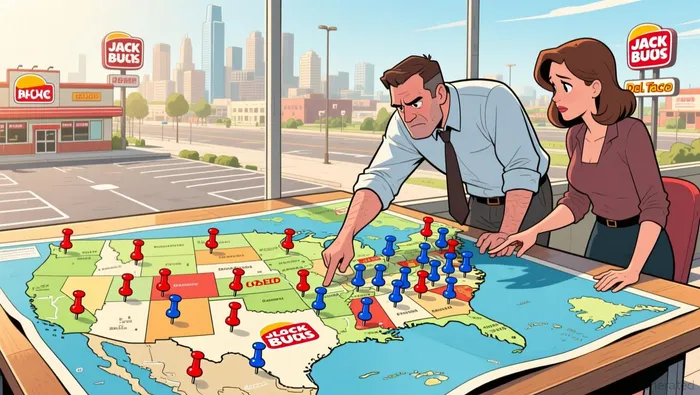 Jack in the Box targets 150-200 closures under its "Jack on Track" turnaround initiative . Most locations slated for shutdown operated for over three decades and faced persistent underperformance . The company completed 86 closures by September 2025 with another 80-120 planned by year-end .
Concurrently, Jack in the Box sold its Del Taco subsidiary for $115 million to Yadav Enterprises . This divestiture followed Del Taco's 3.9% same-store sales decline and represents a significant loss versus its $575 million acquisition price in 2021 . CEO Lance Tucker stated the move simplifies operations and reduces debt amid challenging conditions .
How Are Rising Costs Impacting Fast Food Restaurant Margins?
Commodity inflation, particularly beef prices, has hammered profitability . Drought-impacted cattle herds drove beef costs up 6.9% in Q3 2025, eroding restaurant-level margins by 240 basis points to 16.1% . Core Hispanic customers in key markets like Texas and California reduced visits amid economic strain .
Industry-wide value wars compound these pressures . Jack in the Box launched $7 "Munch Better Deals" combos to compete, further squeezing margins . Prime costs now consume over 65% of revenue across the sector as operators balance value offerings against inflationary pressures . This dynamic creates intense margin compression across fast food restaurant chains .
What Does the Future Hold for Fast Food Restaurant Chains?
Jack in the Box's $1.7 billion debt load constrains flexibility during this transition . Activist investor Sardar Biglari Capital opposes management's strategy, prompting poison pill adoption after their 9.9% stake acquisition . Analysts project potential EBITDA recovery by 2026 if closures succeed but warn of terminal decline risks .
Successful chains increasingly leverage digital integration and franchising for growth . Operators like Wingstop added 255 net new units in H1 2025 through franchise-heavy models . However, chains reliant on limited-time offers or experiencing traffic declines face heightened vulnerability in this environment . The path forward demands balancing cost discipline with innovation amid persistent inflation .

Stay ahead of the market.
Get curated U.S. market news, insights and key dates delivered to your inbox.




Comments
No comments yet