
Jack in the Box's 15-Year Worst Same-Store Sales Decline and Stock Drop Signal Broader Fast-Food Sector Risks
 Aime Summary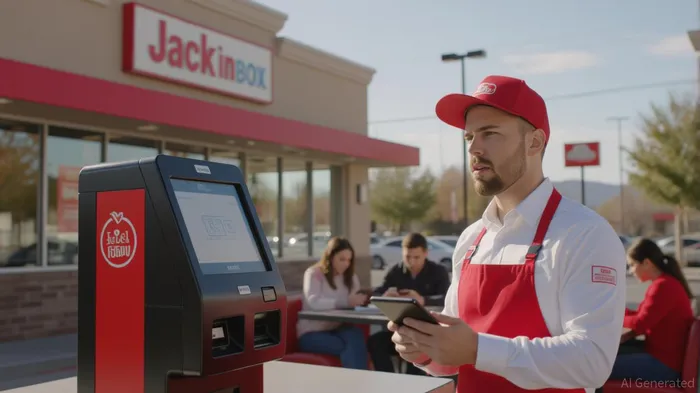
The fast-food industry, once a bastion of predictable demand and low-cost convenience, is now grappling with a perfect storm of inflation, shifting consumer behavior, and operational fragility. Jack in the Box Inc.JACK-- (JACK) has become a cautionary tale in this unfolding crisis, with its 7.1% year-on-year same-store sales decline in Q2 2025—the worst in over a decade—highlighting vulnerabilities that extend far beyond a single brand. This collapse is not an isolated event but a symptom of systemic challenges facing the quick-service restaurant (QSR) sector in a post-pandemic world where affordability and value are no longer self-evident.
The Fracturing Value Proposition
The core issue for JackJACK-- in the Box—and the sector at large—is the erosion of the fast-food value equation. For decades, fast food thrived on its ability to deliver cheap, consistent meals to a broad demographic. But inflation has rewritten the rules. Since 2019, away-from-home dining costs have surged by 30%, with menu prices at major chains rising between 39% and 100%. A Lending Tree survey reveals that 80% of Americans now view fast food as a luxury, not a staple. This shift is particularly acute among low- and middle-income households, which have cut dining-out frequency by over 40% since 2020. Jack in the Box's reliance on Hispanic customers—a demographic disproportionately affected by uncertainty around U.S. immigration policies—has further amplified its vulnerability.
The company's Q2 results underscore this fragility. Despite a 6.19% earnings-per-share beat, the stock fell 3.3% post-earnings, as investors fixated on the 9.8% revenue drop to $333 million. The disconnect between earnings and revenue highlights a dangerous trend: Jack in the BoxJACK-- is squeezing profits from a shrinking pie. Its adjusted EBITDA of $61.63 million fell short of expectations, and full-year guidance of $272.5 million—below the $284.3 million consensus—signals a lack of confidence in reversing the sales slump.
Operational Adaptability: A Double-Edged Sword
In response, Jack in the Box has launched the “JACK on Track” initiative, a restructuring plan involving store closures, digital transformation, and menu reengineering. The company plans to shutter 150–200 underperforming locations by 2025, a move that has already triggered a 6% post-announcement stock drop. While rationalization is necessary, the speed and scale of these closures risk alienating loyal customers and further eroding brand equity. The elimination of its long-standing dividend—a 7% yield in late 2024—has compounded investor unease, signaling a prioritization of debt reduction over shareholder returns.
The broader sector is similarly struggling to adapt. McDonald'sMCD--, Wendy'sWEN--, and ChipotleCMG-- have all reported same-store sales declines in 2025, with Domino's seeing a 30% drop in delivery orders due to added fees. Automation and digital kiosks, once hailed as a panacea, have introduced new bottlenecks. For instance, 52% of global operators plan to invest in kitchen automation in 2025, yet 70% of consumers report longer wait times when using apps or kiosks. The irony is palpable: technology meant to enhance convenience is now a source of frustration.
Structural Challenges and the Path Forward
Jack in the Box's financial position is precarious. With $1.7 billion in debt, negative equity of -$976 million, and a net debt-to-EBITDA ratio of 5.5x, the company lacks the flexibility to invest in growth or weather further shocks. Its Q3 2025 earnings—marked by a 118% surge in net income to $22.03 million—offer a glimmer of hope, but this turnaround is driven by cost-cutting, not organic growth. The company's average unit volume of $1.62 million pales in comparison to Chick-fil-A's $9.2 million, underscoring the structural gap in unit economics.
The key to recovery lies in redefining the value proposition. Jack in the Box's reintroduction of the Bonus Jack Combo and limited-time offerings like Sauced and Loaded Potato Wedges is a step in the right direction, but these gimmicks are unlikely to offset deeper issues. The company must address pricing misalignment between its Munchie Meals and combos, while also leveraging digital tools to enhance, not complicate, the customer experience.
Investment Implications
For investors, Jack in the Box presents a high-risk, high-reward scenario. Its valuation—trading at a P/S ratio of 0.22 and EV/EBITDA of 6.31—appears attractive relative to industry peers like McDonald's (EV/EBITDA ~14x) and StarbucksSBUX-- (EV/EBITDA ~12x). However, these metrics must be weighed against the company's heavy debt load and uncertain execution of its turnaround plan. The stock's 43% decline over six months reflects market skepticism, and while Q3 earnings provided a temporary bounce, the 13.15% month-to-date drop as of August 2025 suggests lingering doubts.
The broader sector offers mixed signals. While the QSR industry is projected to reach $780.61 billion in revenue in 2025, this growth will depend on operators' ability to balance price increases with value offerings. Companies that successfully integrate AI-driven analytics, cloud-native platforms, and sustainable sourcing may outperform. Jack in the Box's “JACK on Track” strategy, if executed effectively, could position it for a rebound, but the path is fraught with execution risk.
Conclusion
Jack in the Box's 15-year worst same-store sales decline is a microcosm of the fast-food sector's broader struggles. Inflation has turned affordability into a luxury, while shifting consumer behavior and operational inflexibility have eroded margins. The company's restructuring efforts, though necessary, are unproven and come at the cost of short-term revenue and brand stability. For investors, the key question is whether the current discount in Jack in the Box's stock represents a compelling opportunity or a warning sign. Given the sector's structural challenges and the company's precarious balance sheet, a cautious approach is warranted. Those willing to bet on a turnaround should monitor the success of “JACK on Track,” particularly in closing underperforming units, improving digital engagement, and deleveraging the balance sheet. Until then, the fast-food sector remains a high-stakes gamble in a world where value is no longer self-evident.

Stay ahead of the market.
Get curated U.S. market news, insights and key dates delivered to your inbox.
AInvest
PRO
AInvest
PRO



Comments
No comments yet