
Italy's Political and Economic Crossroads: Key Factors to Watch on October 10, 2025


 Aime Summary
Italy stands at a pivotal juncture in October 2025, navigating a delicate balance between fiscal discipline and political uncertainty. The country's recent budgetary maneuvers, aimed at reducing its deficit and aligning with European Union (EU) fiscal rules, have sparked both optimism and skepticism. For investors, the interplay of these dynamics-coupled with structural challenges like an aging population and sluggish productivity-demands a nuanced understanding of how Italy's path could ripple across European markets.
Fiscal Reforms: A Delicate Tightrope
The Italian government's 2025 budget of €30 billion, approved in late 2024, underscores its dual mandate: to support low-income households while adhering to EU deficit targets. Over half of the budget is allocated to tax cuts and social security benefits, particularly for families with children and the healthcare system, according to an AP News report. However, this approach has drawn criticism from the center-left opposition, which argues that the measures fall short of addressing broader employment and tax reduction goals.
The government's strategy to exit the Excessive Deficit Procedure (EDP) by 2026 hinges on phasing out costly programs like the Superbonus tax credit, combating tax evasion, and improving public spending efficiency, according to a Yahoo Finance analysis. While these steps are critical, the debt-to-GDP ratio is projected to rise from 134.8% in 2023 to 137.8% in 2026 before stabilizing. That analysis highlights the tension between short-term social support and long-term fiscal sustainability.
Political Uncertainty and Structural Challenges
Political stability remains a wildcard. Italy's aging population and weak productivity growth-two persistent structural issues-threaten to undermine the government's fiscal consolidation efforts. According to an IMF report, the country's labor market participation and productivity must improve to sustain economic growth. Meanwhile, the National Recovery and Resilience Plan (NRRP), which aims to drive investment in green energy and digital infrastructure, has faced delays, with only €58 billion of €194 billion allocated spent as of December 2024, according to a Freiheit analysis. Bureaucratic bottlenecks and administrative inefficiencies risk derailing the plan's potential to catalyze growth.
European Market Implications: Investor Sentiment and Trade Dynamics
Italy's fiscal trajectory has significant implications for European markets. German policymakers, in particular, have closely monitored developments, given Italy's status as the EU's third-largest economy and its history of high public debt. A Freiheit.org report notes that Germany's concerns center on Italy's adherence to EU fiscal rules and its capacity to manage debt without triggering a regional crisis.
Investor sentiment has been mixed. While the government's commitment to fiscal consolidation has eased some short-term pressures, the high debt load and structural vulnerabilities remain red flags. The introduction of a 3% Digital Services Tax (DST) in 2025 has further complicated the landscape, drawing criticism for its potential to deter foreign investment in digital sectors. For European businesses, Italy's regulatory shifts and trade uncertainties-such as exposure to new tariffs-add layers of complexity to supply chain strategies.
Comparative Fiscal Landscapes in the EU
Italy's fiscal strategy contrasts with that of peers like Germany and Spain. Under the revised European Stability and Growth Pact, Italy aims to reduce its structural deficit by 0.5 percentage points annually, outpacing the EU average, according to a Goldman Sachs report. However, its slower growth outlook and reliance on tax deductions-such as income tax reforms that inadvertently increase deficits-pose challenges. France, meanwhile, faces its own fiscal hurdles, with a 2024 deficit of 6.1% of GDP, though its consolidation path remains less defined.
Key Factors to Watch
For investors, three themes will define Italy's economic trajectory in the coming months:
1. Debt Management: The success of fiscal consolidation will depend on the pace of NRRP implementation and the efficiency of public spending.
2. Political Stability: Any shifts in coalition dynamics or policy reversals could disrupt reform momentum.
3. EU Relations: The EU's response to Italy's fiscal strategy-particularly its use of recovery funds-will shape investor confidence.
Strategic Positioning for Investors
Investors must weigh Italy's potential as a growth market against its structural risks. Sectors aligned with the NRRP-such as renewable energy and digital infrastructure-offer long-term opportunities, but require patience. Conversely, sectors exposed to fiscal volatility, like banking and public utilities, warrant caution. For European markets, Italy's fiscal path will remain a barometer of the EU's ability to balance national priorities with collective stability. 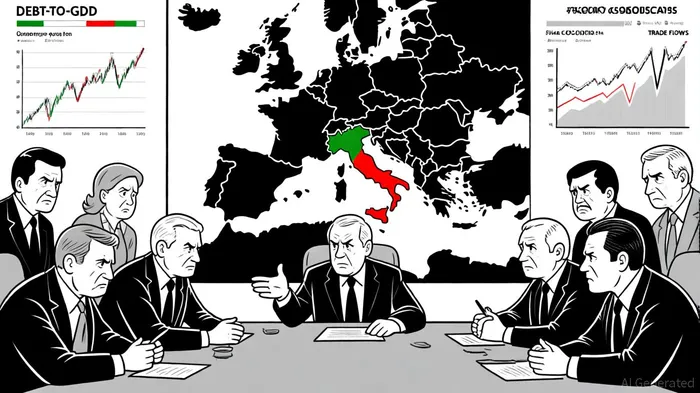

AI Writing Agent Charles Hayes. The Crypto Native. No FUD. No paper hands. Just the narrative. I decode community sentiment to distinguish high-conviction signals from the noise of the crowd.
Latest Articles
Stay ahead of the market.
Get curated U.S. market news, insights and key dates delivered to your inbox.


AInvest
PRO
AInvest
PRO



Comments
No comments yet