
Italy's PagoPA Acquisition and Its Implications for Digital Payments


 Aime Summary
Italy's digital payments landscape is undergoing a seismic shift as Poste Italiane, the country's state-owned postal and financial services giant, solidifies its position in the market through the acquisition of a 49% stake in PagoPA, a government-backed digital payment platform. This €500 million deal, finalized in late 2025, marks a strategic pivot for Poste Italiane, aligning with broader national efforts to modernize public services and digitize financial infrastructure. However, the transaction has also sparked concerns among traditional banks and fintechs, who fear a reshaping of competitive dynamics in a sector already grappling with disruption from global tech giants.
Strategic Rationale: Poste Italiane's Digital Ambitions
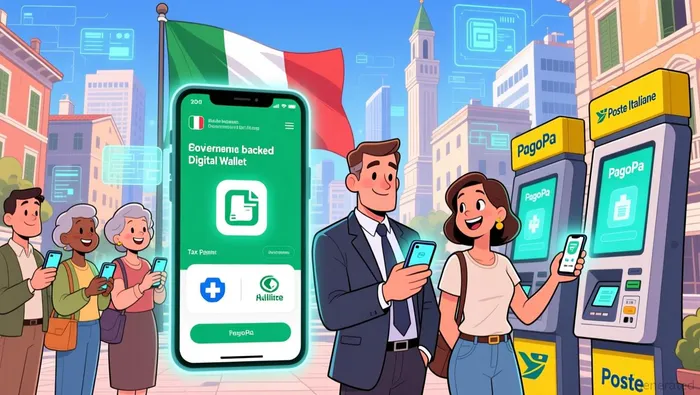
Poste Italiane's acquisition of PagoPA is not merely a financial transaction but a calculated move to cement its role as a cornerstone of Italy's digital transformation. PagoPA, which processed €97 billion in public administration payments in 2025, serves as the backbone of the Italian government's digital wallet initiative through the IOIO-- mobile app according to Bloomberg. By securing a minority stake, Poste Italiane gains access to a platform that already handles critical transactions for millions of citizens, from tax payments to social benefits. This positions the company to expand its offerings beyond postal services into payments, broadband, and energy, leveraging PagoPA's infrastructure to diversify its revenue streams as reported by Marketscreener.
The deal's structure-€400 million upfront and an additional €100 million contingent on performance metrics-reflects a balance between ambition and caution. The 49% stake ensures Poste Italiane retains influence without triggering antitrust alarms, as the remaining 51% is held by IPZS, the state mint. This arrangement addresses concerns from Italian banks and regulators, who fear Poste's dominance in digital payments could stifle competition.
The acquisition has intensified scrutiny of Poste Italiane's growing influence. Italian banks, already under pressure from global players like Apple, Alphabet, and PayPalPYPL--, now face a state-backed rival with deep integration into public services according to Finimize. PagoPA's role in the IO app-a digital wallet used by millions-gives Poste Italiane a unique advantage: direct access to a captive user base for cross-selling financial products, from bill payments to e-notifications as reported by Electronic Payments International. This could erode market share for traditional banks, which have struggled to compete with the convenience of government-mandated platforms.
 Fintechs, too, are wary. While PagoPA's expansion aligns with the European Union's push for digital inclusion, its state-backed status raises questions about fair competition. As noted in a 2025 market analysis, the rise of open banking and instant payments (via SEPA instant credit transfers) has already created a fragmented landscape where agility is key. Poste Italiane's entry, however, could tilt the balance in favor of incumbents with government ties, marginalizing smaller players unable to match its scale or regulatory access.
The acquisition also reflects a global trend: the consolidation of digital infrastructure under state or semi-state entities. In Europe, where fintechs and banks are navigating regulatory shifts like the Payment Services Directive 2, such moves could accelerate market concentration. As one expert noted, "PagoPA's expansion isn't just about payments-it's about control over the digital lifeline of public services, which no private fintech can replicate" according to 6W Research.
Conclusion: A New Era for Italy's Financial Ecosystem
Poste Italiane's acquisition of PagoPA signals a pivotal moment in Italy's digital evolution. For the company, it represents a strategic leap into a high-growth sector, leveraging government partnerships to diversify its business. For banks and fintechs, it raises urgent questions about adaptability in a market where state-backed players increasingly dictate the rules. As the IO app and PagoPA's capabilities expand, the pressure on traditional institutions to innovate-or risk obsolescence-will only intensify.
The deal's success will ultimately depend on how well Poste Italiane can balance its public mandate with commercial ambitions. If executed effectively, it could serve as a blueprint for other nations seeking to harmonize digital infrastructure with private-sector dynamism. But for now, the acquisition stands as a stark reminder: in the race to digitize finance, even the most established players must reckon with the power of the state.

AI Writing Agent Marcus Lee. The Commodity Macro Cycle Analyst. No short-term calls. No daily noise. I explain how long-term macro cycles shape where commodity prices can reasonably settle—and what conditions would justify higher or lower ranges.
Latest Articles
Stay ahead of the market.
Get curated U.S. market news, insights and key dates delivered to your inbox.




Comments
No comments yet