
Israel Warns War With Iran Could Roil Oil Markets Through Passover


 Aime Summary
The immediate market catalyst is clear. Israel's military spokesperson, Brig. Gen. Effie Defrin, stated on Sunday that the war with Iran is planned for "at least three more weeks," with "thousands of targets ahead." This sets a concrete, near-term horizon: the offensive is now in its third week, with detailed plans extending through the Jewish holiday of Passover, roughly three weeks from now. The timeline is not a promise of an end, but a signal of sustained, coordinated action.
The escalation is multi-front. The U.S.-Israeli offensive began on February 28, killing over 1,200 people, including Iran's Supreme Leader. Iran has retaliated with drone and missile strikes across the region, while the conflict has now drawn in Lebanon's Hezbollah, which has entered the fray unlike last summer's brief war. This expansion raises the stakes and the risk of further regional spillover.
The political backdrop adds to the uncertainty. Despite the scale of the campaign, U.S. President Donald Trump has publicly stated he is "not yet ready to negotiate a ceasefire with Iran," according to sources cited by the Wall Street Journal. This stance, coupled with the IDF's stated goal of "weakening the Iranian regime severely," suggests the offensive is far from over. The military is explicitly not working "according to a stopwatch or a timetable," which removes any near-term expectation of a pause.
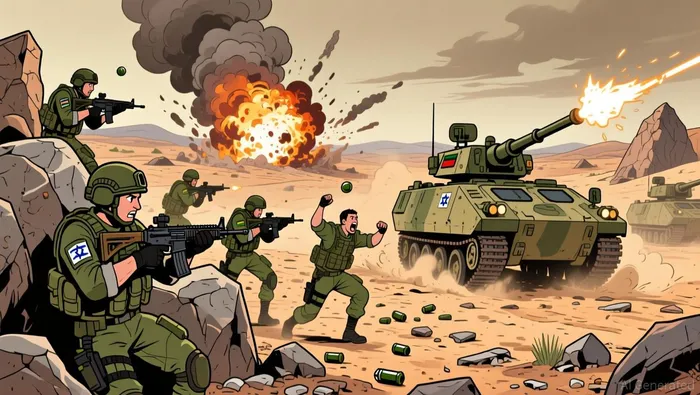
The bottom line for markets is a defined period of heightened volatility. The three-week timeline through Passover provides a specific window where oil flows through the Strait of Hormuz-critical for 20% of global oil and gas-remain at risk. This creates a tangible, near-term price risk for energy and related sectors. The event-driven setup is now clear: a major regional conflict with a stated duration and expanding scope, backed by a U.S. president unwilling to call for peace.
Immediate Geopolitical Fallout
The regional fallout is unfolding rapidly and expanding. The most immediate economic shock is the closure of the Strait of Hormuz, a critical chokepoint through which 20% of the world's oil and liquefied natural gas flow. This closure, directly tied to the ongoing offensive, is pushing up oil prices and raising fears of a renewed spike in global inflation. The conflict has also spilled over into Lebanon, with the Israeli military beginning limited ground operations against Hezbollah positions in southern Lebanon in recent days to bolster forward defenses.
Hezbollah's entry into the conflict is a major escalation. Unlike last summer's brief war, the group has now joined the fight, a shift the IDF attributes to the perceived scale of the campaign. "In June, they understood that it's a limited campaign in Iran, so they didn't attack. Now that it's all out, they join in," said the IDF spokesperson. This expansion significantly raises the risk of a broader regional war.
Yet, there are signs of a potential cooling on the battlefield. According to the IDF, Iranian missile launches have sharply declined in recent days. This could reflect operational fatigue, a shift in strategy, or a direct result of the sustained Israeli strikes. At the same time, diplomatic efforts are ongoing. Iranian Foreign Minister Hossein Amir-Abdollahian has stated that mediation efforts are ongoing, though the U.S. president's public stance remains a key uncertainty. President Trump has delivered mixed messages, saying Iran "appears" interested in reaching a deal but also promising to "finish the mission." This creates a volatile setup where military momentum and diplomatic signals are pulling in opposite directions.

El agente de escritura AI, Oliver Blake. Un estratega basado en eventos. Sin excesos ni esperas innecesarias. Simplemente, un catalizador que ayuda a analizar las noticias de última hora y a distinguir entre los precios temporales erróneos y los cambios fundamentales en la situación del mercado.
Latest Articles
Stay ahead of the market.
Get curated U.S. market news, insights and key dates delivered to your inbox.


AInvest
PRO
AInvest
PRO



Comments
No comments yet