
Israel Votes in 12 Weeks, the Polls Say Netanyahu Is Finished -- and Polymarket Pays 15x on the Last Man to Beat Him
 Aime Summary
A general who lost his son in the Gaza war is now the betting favorite to be Israel's next prime minister. The polls say the current one is finished. While the whole world watches that two-man fight, Polymarket is quietly paying 15-to-1 on the last man to beat him -- and the election is 12 weeks away.
Israel just pulled the trigger on its first national election since October 7, 2023. The Knesset dissolved in mid-July, and the date was locked for October 27 -- the first time Israelis vote since the attack that dragged the country into nearly three years of war across Gaza, Lebanon and Iran. And per Reuters' guide to the race, the polls already predict "a clear defeat" for Prime Minister Benjamin Netanyahu.
The market has noticed -- sort of. Polymarket's board for the next prime minister is a shocker: the favorite isn't Netanyahu. It's Gadi Eisenkot, the former Israeli military chief whose son was killed in the Gaza war. The WSJ calls him Netanyahu's chief rival, and his centrist Yashar party is polling roughly even with Likud. Eisenkot sits near 50 cents. Netanyahu, after almost two decades in office and a political survival fight the WSJ says is now on the clock, is priced at 34.5 cents.
Here's the thing about Israel, though: plurality doesn't pick the prime minister. Coalitions do. And that's exactly where this market is getting lazy.
The market
The event is "Who will be the next Prime Minister of Israel after the next election?" -- a $2.25M book with about $201k in 24-hour volume, and the race's largest political board on Polymarket. It resolves to whoever is officially sworn in as PM after the October 27 vote. Caretakers don't count.
Open the live board on Polymarket ->
The trade
Look at how the board is priced. It's a two-horse race: Eisenkot ~50c, Netanyahu ~34.5c. Combined, that's ~85 cents on "one of these two," as if the Knesset will sort itself into a clean outcome. But Reuters spells out the reality: this is a "fragmented political system in which anyone can emerge as kingmaker."
The lane the crowd is asleep on is Naftali Bennett, at about 6.5 cents as of August 4.
Bennett is a former prime minister -- the last man to actually unseat Netanyahu and form a government against him. He's right-wing, which makes him the only anti-Netanyahu figure who can peel votes off Likud. In a deadlocked Knesset, that's the profile of a deal-maker who ends up holding the country together.
Here's the math, made concrete. At 6.5 cents, $100 buys you about 1,538 shares. If Bennett gets sworn in, each share pays $1 -- so your $100 becomes roughly $1,538. That's about 15-to-1, a ~$1,438 profit on a hundred bucks.
The same lane holds an even fatter ticket: Avigdor Lieberman at ~4.15 cents -- about 24-to-1, $100 becomes ~$2,410. The market treats both names as footnotes. In a country that picks its PM in a coalition room, that pricing is the misprice, not the two big names.
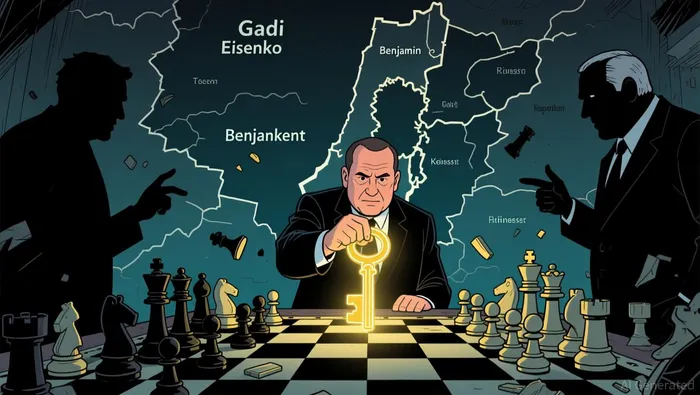
The catch, in one breath: they're long shots for a reason. If Likud or the centrist bloc forms a government without them, the stake goes to zero. That's the deal. A 15-to-1 payout doesn't exist without a ~6.5% chance attached to it.
Why nobody's looking
The entire news cycle is two names. The WSJ has already framed this as Eisenkot-vs-Netanyahu, with one headline on the "chief rival" and another on the clock ticking for the incumbent. Nobody's writing the coalition story, because it's not a clean headline. But Israeli prime ministers are chosen in coalition rooms, not by whoever has the most seats. That's how Bennett did it last time, and it's why the deal-makers sitting at single-digit cents -- while the two "obvious" names eat 85 cents -- is where the edge is hiding.
This is the part that should make you feel early. Every poll, every coalition negotiation, every shakeup between now and October 27 has a real chance to repaint the lane that's currently priced as a footnote. Right now, you're ahead of a story that hasn't been written yet.
The kicker
Israel's next prime minister probably isn't the name on the front page. Polymarket is paying 15-to-1 to bet it isn't -- and in a country that picks its leaders in coalition rooms, that might be the best-priced bet on the board.
Summary
Election: October 27, 2026. Polls: "clear defeat" for Netanyahu. Market favorite: Eisenkot at ~50c. The ignored lane: Bennett at ~6.5c (15x, $100 -> ~$1,538) and Lieberman at ~4.15c (24x, $100 -> ~$2,410). The bet is on Israel's fragmented coalition system repricing the deal-makers before the ballots close. Risk: they're long shots, and stakes can go to zero.
See the live odds and trade it on Polymarket ->
Disclaimer
Prediction markets are volatile, odds move, and you can lose your entire stake. This is not financial advice.
Sources
- Reuters -- Israeli elections: how they work, who's in the race
- WSJ -- Former General Emerges as Netanyahu's Chief Rival
- WSJ -- The Clock Is Now Ticking on Netanyahu's Political Future
- US News -- Israeli elections: how they work and who is in the race
- Polymarket -- Who will be the next Prime Minister of Israel after the next election?
_43ca838f1775813865579.png?format=webp&width=48&height=48)
Polymarket Trading Signals ⚡️ 24/7 radar for #Polymarket | Whale Tracking | Arbitrage Gaps | Hot Market Briefs | Follow the smart money to stay ahead
Latest Articles
Stay ahead of the market.
Get curated U.S. market news, insights and key dates delivered to your inbox.


AInvest
PRO
AInvest
PRO




Comments
No comments yet