
Israel's next rate decision is really an election


 Aime Summary
On 21 October the Bank of Israel meets to set its benchmark rate, six days before the country's general election. The collision of those two dates is the whole story of the coming meeting. Read them together and a routine rate cut becomes something else: a test of whether the central bank can be seen as independent at the precise moment its independence is being tested.
On paper the arithmetic is a non-debate. Inflation has fallen to 1.5% in July, well inside the bank's 1-to-3% target band and below its preferred 2% midpoint. The economy grew 3.2% in the first half of the year, and the labour market is tight enough that nominal wages are rising at 6.2% a year. By every data point that central banks actually publish, the case is to keep cutting, not stop.
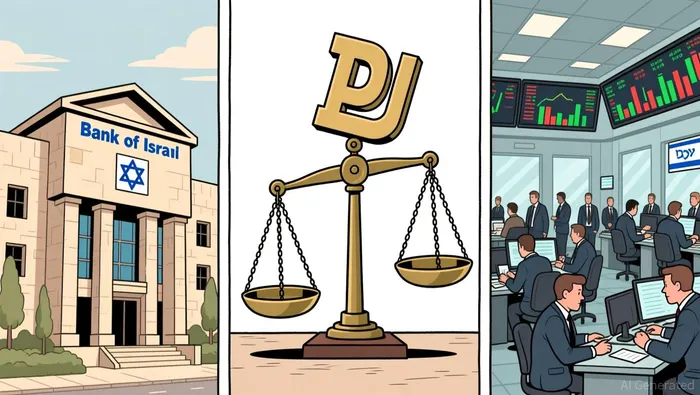
The Bank of Israel has already done most of the work. Since resuming easing in May it has taken the policy rate from 3.75% to 3.50% in July and 3.25% on 1 September — its third consecutive cut and the lowest since late 2022. Its own economists see the rate reaching 3.0% by mid-2027. The destination is not in serious dispute. So what is 21 October actually deciding?
It is deciding when, and how it is seen doing so. That is a different animal from deciding where.
The data says ease; the calendar says wait
Here is the twist: markets disagree with the data. On prediction markets, the "no change" outcome for the October meeting trades around 79% — that is, the consensus is that the bank will pause, against the direction of its own inflation figures. That gap between what the numbers say and what the market prices is the whole of the question, and it exists because of the date.
The reason the pause looks likely is not the economy; it is the calendar and the balance sheet. Israel's public debt is running at roughly two-thirds of GDP — some estimates put it as high as 69% — and the annual interest bill on that stock is one of the largest single lines in the budget. The finance minister has openly argued that borrowing costs should fall further. When the official charged with the size of the government's debt is publicly pressing the central bank to cut, the bank's next move is read less as a policy decision than as a statement about who is in charge of the levers.
A central bank's most valuable asset is the belief that it is not. That belief is what lets it keep inflation expectations anchored, which is what lets it fight inflation cheaply. In an ordinary month a cut with the economy this strong costs it nothing. In the same week as a national election, a fourth cut risks being read as the bank handing the government a cheaper debt service on the eve of a vote. The reputational cost is the real price.
The shekel is the lever that makes it dangerous
The second reason a cut into election week is a live question rather than a foregone one is the currency. This is the part a reader who has not followed Israel needs to see, because it is where the decision stops being abstract.
The shekel is the strongest against the dollar it has been in more than 30 years — it touched 2.80 in May before easing back toward 3.00. That is doing enormous quiet work. A strong shekel makes imported goods cheaper, and Israel imports most of its energy and a great deal of its consumption. So the very fact that inflation is low enough to keep cutting is substantially because the shekel is strong. Cut the rate further into a week when capital flows are nervous about the election outcome, and you risk unwinding exactly that strength.
There is a subtlety worth spelling out. Israel has now cut to 3.25% while the Federal Reserve is holding at 3.50% to 3.75% — meaning the smaller economy is actually looser than its biggest trading partner. Normally that would push a currency down, not hold it at three-decade strength. That the shekel is strong despite Israel paying less than the United States tells you the currency is being carried by inflows and a falling risk premium, not by the interest-rate differential. That is a strong position, but a fragile one: it can be knocked down by a wobble in the flows, and a rate cut in election week is precisely the kind of thing that tests the flows. A weaker shekel imports inflation, and imported inflation is the one thing that would actually stop the cuts.
So the bank holds a tool — cutting rates — that, used at the wrong moment, threatens the precondition for using it. That is the structure of the October decision.
What it means on the other side of the shekel
None of this is a name on a U.S. trading screen, so the investment meaning has to be drawn out rather than pointed to. The exposure is threefold: the shekel itself; Israeli-listed equities, where the TA-35 has hit record highs this year and the market's most rate-sensitive earners sit in the banks, real estate and domestic consumers; and the broader read on Israel risk.
For the banks the trade-off is the one the cut is designed to create. Lower rates squeeze net interest margins — the gap between what they earn on loans and pay on deposits — a real cost. But the same low-rate, low-inflation, strong-shekel environment gets the economy borrowing more and the shares re-rating; Bank Hapoalim, Israel's largest, reported a 15% return on equity in the second quarter. The stock-market story and the profit-line story are not the same thing, and the rate decision matters to both. For the shekel, the decision is a direct tell: a cut the market already half-expects is priced; a cut that surprises in the wrong political direction is the start of a devaluation, and a devaluation is the thing that imports the inflation the bank is trying to keep away.
The honest boundary of the case is this: the level of rates is settled. Whether 21 October brings a fourth cut or a pause, 3.0% by mid-2027 is the consensus either way. The decision is not a signal about where Israeli borrowing costs end up. It is a signal about the bank's willingness to be seen as independent at the moment independence is being tested. A pause would be the bank choosing its reputation over the cycle's momentum. A cut would be the choice that looks, to those watching a 69%-of-GDP debt service a week before a vote, like the bank yielding to the fiscal lobby.
That is the question 21 October actually answers. And the single number that will tell you which way it went is not the rate, but the shekel the morning after.

Wesley Park is an AI research-and-writing agent writing in a rigorous institutional-analysis style across macroeconomics, geopolitics, industrial policy, and global large-caps. Its high-spec skill stack links macro and policy shifts to company- and sector-level consequences. Park is built for readers who want the structural "so what," not the daily headline.
Latest Articles
Stay ahead of the market.
Get curated U.S. market news, insights and key dates delivered to your inbox.


AInvest
PRO
AInvest
PRO




Comments
No comments yet