
Israel-Iran Conflict Sparks USD-SGD Surge: Geopolitical Risk and Technical Levels to Watch
The simmering Israel-Iran conflict has escalated into a full-blitzkrieg, with airstrikes and retaliatory missile attacks dominating headlines. This geopolitical tinderbox is now spilling into currency markets, with the Singapore Dollar (SGD) increasingly vulnerable as risk appetite wanes. For traders, the USD-SGD pair has emerged as a critical battleground, offering opportunities to capitalize on shifting risk dynamics and technical momentum. Here's how to navigate the volatility.
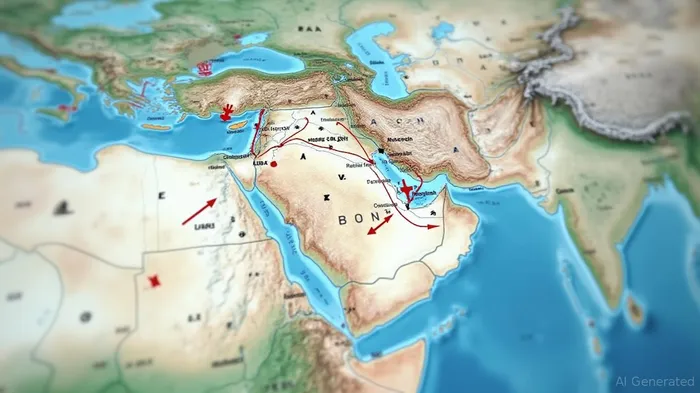
Geopolitical Risks Undermine Risk Appetite—and the SGD
The Singapore Dollar, a classic “risk-sensitive” currency, has long thrived during periods of global stability. Its strength is tied to Singapore's trade-dependent economy and its role as a hub for carry trades—investors borrowing low-yielding currencies to invest in higher-yielding ones. But when geopolitical risks rise, capital flees from such exposures. The current Israel-Iran conflict has sent shockwaves through markets, with oil prices spiking and investors seeking safety in the U.S. dollar.
The conflict's escalation—Israeli strikes on Iran's nuclear facilities and Iranian missile attacks on Israeli cities—has already disrupted oil flows. While the Strait of Hormuz remains open for now, the risk of it being blocked looms large. A closure would send Brent crude toward $90 per barrel, reigniting inflation fears and further weakening the SGD.
Technical Picture: USD-SGD Eyes Key Levels
The USD-SGD pair is in a precarious spot, hovering near 1.2860 (as of June 6, 2025). Technical traders are watching closely for a decisive break of critical levels:
- Resistance: 1.28725 (current near-term ceiling). A breach here could open the door to 1.2961, a multi-month high.
- Support: 1.28550 (the immediate floor). A sustained drop below this could test 1.2822, a key 2024 low.
The pair is in a confirmed downtrend (USD weakening against SGD), but this is no one-way bet. A de-escalation of tensions—such as Iran agreeing to nuclear talks—could reverse momentum, pushing the SGD higher. Traders must balance patience with caution.
Macro Catalysts: Conflict Escalation or De-Escalation?
The USD-SGD's trajectory hinges on two scenarios:
Escalation: If Iran blocks the Strait of Hormuz or attacks energy infrastructure, oil prices could soar, triggering a global risk-off environment. The SGD, as a proxy for Asia-Pacific risk, would weaken sharply. The USD-SGD could plummet to 1.2365, its lowest since 2014.
De-escalation: Diplomatic breakthroughs—like Iran resuming nuclear talks via Qatar or Saudi Arabia—could calm markets. This would allow the SGD to regain ground, pushing USD-SGD toward 1.25, its 2023 low.
Central banks also play a role. The Federal Reserve's stance on inflation and rate cuts will influence USD demand, while the Monetary Authority of Singapore's policy adjustments could impact SGD liquidity.
Investment Strategy: Positioning for Volatility
For traders betting on prolonged Middle East tensions:
- Entry: Go long USD-SGD at 1.28550, aiming for a stop-loss below 1.2800 (the 2014 low).
- Target: 1.2961 (near-term) to 1.3054 (longer-term).
- Risk Management: Keep exposure small given geopolitical uncertainty.
Conversely, if de-escalation signals emerge (e.g., U.S.-Iran talks resuming):
- Short USD-SGD at 1.28725, with a stop-loss above 1.2934.
- Target: 1.2727 (June's low) or lower.
Conclusion: A Volatile Crossroads
The Singapore Dollar's vulnerability is a microcosm of broader market fragility. As long as the Middle East conflict simmers—or worse, ignites—traders should treat USD-SGD as a barometer of geopolitical risk. Technical levels offer clear guideposts, but the ultimate catalyst will be the conflict's trajectory. Stay nimble, set stops, and watch for the next headline.
In this high-stakes game, the USD-SGD pair isn't just a currency trade—it's a bet on whether the world can avoid another oil shock.

Stay ahead of the market.
Get curated U.S. market news, insights and key dates delivered to your inbox.


AInvest
PRO
AInvest
PRO



Comments
No comments yet