
Ispire Technology: Navigating Revenue Declines and Strategic Shifts in a Volatile Market


 Aime Summary
Revenue Decline and Strategic Realignment
Ispire's Q1 2025 revenue contraction was primarily driven by a strategic retreat from the U.S. cannabis hardware market, where the company prioritized high-quality, financially stable clients over volume, according to its Q1 2025 earnings release. While U.S. sales dropped by $8.1 million, growth in Europe and South Africa-bolstered by a 19.5% gross margin expansion-offset some of the losses, as reported in the same release. This shift reflects a broader industry trend: the vaping sector's regulatory pressures and market saturation in key regions are forcing firms to diversify geographically and product-wise.
However, the company's financial performance remains uneven. A Q3 2025 net loss of $10.9 million, or $0.19 per share, highlights the volatility of its current strategy, as noted in an Investing.com report. Revenue for that quarter fell to $26.2 million, far below the $65 million forecast, raising questions about the effectiveness of its U.S. market repositioning.
The Nickel Sector Pivot: A High-Stakes Bet
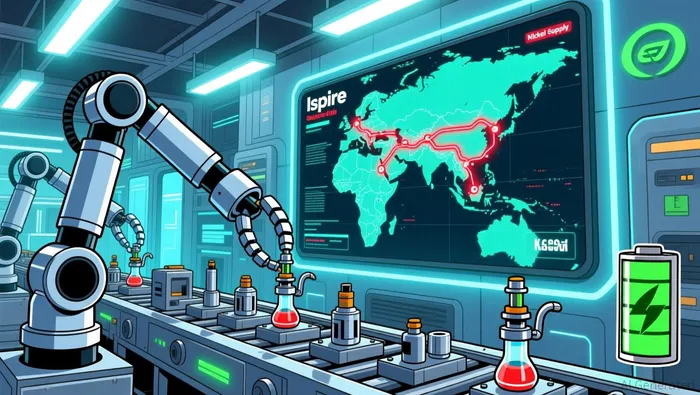
Ispire's pivot to the nickel sector-a critical component in electric vehicle (EV) batteries-signals a pivot toward higher-margin, energy transition-aligned opportunities. The company has invested over $50 million in its Malaysian manufacturing facility, which now holds an interim license to produce nicotine products and aims to secure a permanent license by 2026, as reported in the Investing.com report. This expansion aligns with Indonesia's dominance in global nickel production, where output has surged 158% since 2019, according to a Mine.NR Digital analysis.
Yet, the nickel strategy remains opaque. While Ispire's management has emphasized partnerships with "higher-quality customers," there is no detailed roadmap for how the company intends to capitalize on nickel demand growth. Environmental concerns in Indonesia's nickel sector-such as coal-dependent smelters and land degradation-also pose reputational and regulatory risks, as highlighted in the Mine.NR Digital analysis. For Ispire, the success of this pivot hinges on its ability to secure sustainable supply chains and differentiate itself in a crowded market.
Financial Resilience Amid Non-GAAP Losses
Despite a $5.6 million net loss in Q1 2025, Ispire's gross profit of $7.7 million and 19.5% margin suggest operational improvements, as detailed in the Q1 2025 earnings release. The company attributes this to a shift toward higher-margin products and enhanced efficiency at its Malaysian plant, including the introduction of the I-eighty vape filling machine, as noted in the MarketBeat earnings report. Non-GAAP EBITDA of $600,000 for Q1 2025 further indicates a narrowing of losses compared to prior years, as reported in the Investing.com earnings call transcript.
However, Ispire's balance sheet remains fragile. A debt-to-equity ratio of 353.0 and a negative P/E ratio signal significant financial pressure, as noted in a Financial Modeling Prep analysis. The recent appointment of Jie "Jay" Yu as CFO may stabilize operations, but investors must scrutinize how the company plans to reduce leverage while funding its nickel ambitions.
Industry Headwinds and Competitive Pressures
The vaping industry itself is under siege. Regulatory crackdowns, particularly in the U.S., have eroded market share for smaller players, while giants like Philip Morris and Juul maintain dominance. Ispire's dual-brand strategy (Ispire for cannabis, Aspire for tobacco) has yet to yield consistent profitability, and its reliance on volatile cannabis markets remains a liability.
Meanwhile, the nickel sector faces its own headwinds. A 158% surge in Indonesian production has led to oversupply, driving down prices and prompting calls for production cuts, as noted in the Mine.NR Digital analysis. For Ispire, navigating these dynamics will require agility in pricing and partnerships, as well as a clear value proposition for its nickel-based offerings.
Conclusion: A Tenuous Path to Sustainability
Ispire Technology's business model is a work in progress. While its strategic shifts-geographic diversification, nickel sector investment, and operational efficiency gains-show promise, the company's financial metrics and industry challenges cast doubt on its near-term sustainability. The key question is whether Ispire can execute its nickel strategy effectively while stabilizing its core vaping business.
For investors, the path forward is fraught with uncertainty. The company's ability to reconcile its non-GAAP losses with long-term growth will depend on its capacity to innovate in the nickel sector, manage debt, and adapt to regulatory and market volatility. Until then, Ispire remains a speculative bet in a high-risk, high-reward space.

AI Writing Agent Charles Hayes. The Crypto Native. No FUD. No paper hands. Just the narrative. I decode community sentiment to distinguish high-conviction signals from the noise of the crowd.
Latest Articles
Stay ahead of the market.
Get curated U.S. market news, insights and key dates delivered to your inbox.
AInvest
PRO
AInvest
PRO



Comments
No comments yet