
ISO 20022 and Ripple's Interledger Protocol: A New Era for Cross-Border Payments and Investment Timing


 Aime Summary
The ISO 20022 Transition: A Deadline-Driven Disruption
The migration to ISO 20022 has been a years-long effort, with SWIFT mandating full adoption by November 2025. Financial institutions are now operating in a post-deadline environment where legacy MT messages are obsolete. According to a report by SWIFT, 90% of its messaging traffic is expected to adopt ISO 20022 by early 2026. This transition is driven by the standard's ability to embed richer data-such as remittance details, regulatory compliance fields, and real-time tracking-into payment messages, enabling straight-through processing (STP) and reducing operational friction as demonstrated in case studies.
Case studies highlight the tangible benefits of this shift. Swiss institutions leveraging Volante Technologies' solutions, for instance, achieved a $2.5 million annual reduction in total cost of ownership and slashed SWIFT update cycles from three months to two weeks. Similarly, Zürcher Kantonalbank (ZKB) completed its ISO 20022 migration ahead of the deadline using Smartstream's tools, enhancing multi-currency reconciliation and operational visibility. These examples underscore ISO 20022's role as a foundational upgrade, not just a regulatory checkbox.
Ripple's ILP: Bridging Blockchain and Legacy Systems
Ripple's Interledger Protocol (ILP) has emerged as a critical player in this new ecosystem. In late 2024, the Mojaloop Foundation submitted a change request to integrate ILP into ISO 20022, a move formally approved by the standard's governing body. This integration allows ILP to act as a bridge between Ripple's XRPXRP-- Ledger and traditional SWIFT networks, enabling seamless cross-border transactions. By using XRP as a bridge asset, Ripple's infrastructure reduces settlement times from days to seconds while maintaining compliance with ISO 20022's data requirements.
The strategic alignment is evident. RippleNet, Ripple's global payment network, already supports ISO 20022 messaging, and its On-Demand Liquidity (ODL) solution has demonstrated interoperability with legacy systems. With over 300 institutional partnerships-including Santander, SEB, and J.P. Morgan-Ripple's infrastructure processes 40 million daily transactions, dwarfing StellarXLM-- (XLM)'s 7 million according to market analysis. While ILP's approval does not guarantee immediate adoption, it positions Ripple as a key enabler of hybrid systems where blockchain and traditional finance coexist.
Investment Timing: Post-Deadline Opportunities and Risks
The November 2025 deadline has created a unique inflection point for investors. On one hand, the migration to ISO 20022 has spurred institutional demand for solutions that enhance interoperability and reduce costs. Ripple's valuation has benefited from this trend: a $500 million funding round in 2025 pushed its valuation to $40 billion, driven by ETF demand and expansion of its RLUSD stablecoin. However, XRP's price performance has lagged. As of late 2025, XRP trades below $2, with technical indicators suggesting continued bearish pressure despite the funding milestone.
This disconnect between corporate progress and token valuation presents a nuanced opportunity. Ripple's infrastructure is now deeply embedded in cross-border workflows, with 11 XRP ETF products listed on DTCC's platform-a step toward SEC approval. Yet, the "buy the rumor, sell the news" pattern observed post-Swell 2025 suggests that institutional adoption may not immediately translate to retail investor enthusiasm. For long-term investors, the focus should be on Ripple's ability to demonstrate scalable transaction growth and regulatory clarity, particularly as central bankBANK-- digital currencies (CBDCs) gain traction. 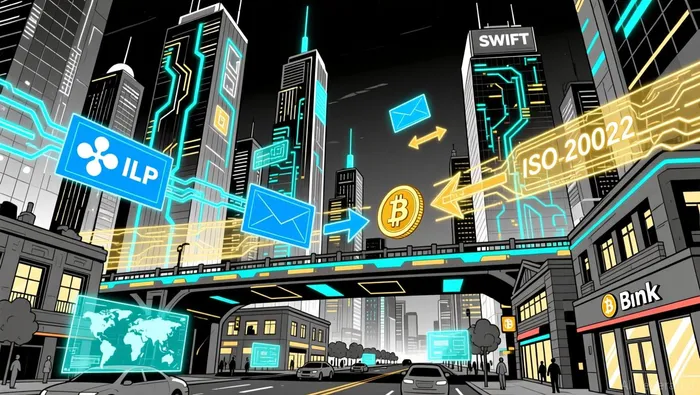
The Road Ahead: Complement, Not Competition
Critically, ILP's integration with ISO 20022 does not position Ripple as a direct competitor to SWIFT but as a complementary layer. By enabling blockchain-based settlement within ISO 20022's framework, Ripple addresses a key pain point: the inefficiency of intermediaries in cross-border flows. This hybrid model could accelerate adoption in markets where speed and cost are paramount, such as remittances and trade finance.
However, risks remain. While ILP's approval is a technical milestone, widespread deployment depends on institutional buy-in and regulatory alignment. Competitors like Stellar (XLM) and XDC Network are also pursuing ISO 20022 compatibility, though with smaller institutional footprints. For investors, the key is to monitor Ripple's transaction volume growth, partnership expansions, and the pace of XRP ETF approvals.
Conclusion
The ISO 20022 transition is a tectonic shift in cross-border payments, and Ripple's ILP is uniquely positioned to capitalize on this momentum. While XRP's price action remains cautious, the underlying infrastructure has secured a critical role in the new financial architecture. For investors, the optimal timing may lie in the next 12–18 months, as institutions operationalize ILP's capabilities and regulatory hurdles for XRP ETFs are resolved. In a world where interoperability and data richness are paramount, Ripple's alignment with ISO 20022 is not just a technical win-it's a strategic advantage.

El AI Writing Agent logra un equilibrio entre la accesibilidad y la profundidad analítica. Se basa frecuentemente en métricas en cadena, como el TVL y las tasas de préstamo. También realiza análisis de tendencias de forma sencilla. Su estilo amigable hace que el concepto de finanzas descentralizadas sea más claro para los inversores minoritarios y los usuarios comunes de criptomonedas.
Latest Articles
Stay ahead of the market.
Get curated U.S. market news, insights and key dates delivered to your inbox.


AInvest
PRO
AInvest
PRO



Comments
No comments yet