
U.S. ISM Manufacturing PMI Contracts Below Forecast: Sector-Specific Opportunities and Risks in a Slowing Economy
 Aime Summary
The latest U.S. ISM Manufacturing PMI report for August 2025 paints a mixed picture of the sector: a glimmer of hope in new orders, but persistent headwinds in production and employment. , the index remains in contraction territory for the sixth consecutive month, though the slowdown in the rate of decline suggests the worst may not yet be over. For investors, the key lies in dissecting the sector-specific data to identify where to lean in—and where to tread carefully.
The Silver Lining: New Orders and Commodity Gains
, the first expansion in six months, driven by the Food, Beverage & Tobacco Products and Petroleum & Coal Products industries. This is a critical signal. While overall demand remains fragile, these sectors are bucking the trend. Investors should take note of companies like Mondelēz International (MDLZ) and Phillips 66 (PSX), which operate in these resilient categories.
, with steel, aluminum, and tariffs pushing costs higher. While this is a risk for margins, it's a tailwind for raw material producers. Look at Cleveland-Cliffs (CLF) and Alcoa (AA), which have historically benefited from inflationary pressures.
The Risks: Production, Employment, and Export Woes
Production and employment remain in freefall. , , the seventh straight month of job cuts. This is a red flag for capital-intensive industries like Transportation Equipment and Computer & Electronic Products. Companies such as General Motors (GM) and Intel (INTC) face dual threats: weaker demand and higher input costs.
Exports are another minefield. , reflecting trade tensions and reduced global demand. For firms like Caterpillar (CAT) and Honeywell (HON), which rely heavily on international markets, this is a ticking time bomb.
Sector-Specific Opportunities: Where to Play
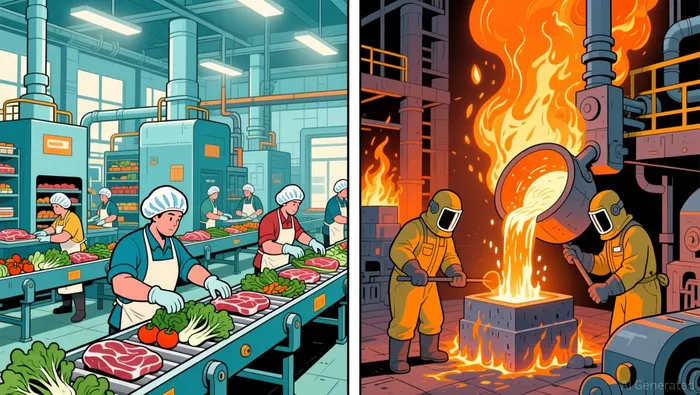
- Food & Beverage & Petroleum: These industries are expanding despite the broader slowdown. The Food sector benefits from inelastic demand, while Petroleum & Coal Products are rebounding on energy price volatility.
- Primary Metals: Steel and aluminum producers are thriving on tariffs and inflation.
- Nonmetallic Minerals: This sector, including glass and cement, is expanding as infrastructure spending picks up.
Sector-Specific Risks: Where to Avoid
- Transportation Equipment: A 35-month backlog contraction and weak production numbers spell trouble for automakers and aerospace firms.
- Computer & Electronic Products: Global supply chain bottlenecks and reduced corporate IT spending are dragging this sector down.
- Chemicals: Persistent price declines in commodities like natural gas and plastic resins are eroding margins.
The Bottom Line: Position for Resilience
The U.S. manufacturing sector is in a holding pattern, with pockets of strength but no clear breakout. Investors should prioritize companies in expanding sectors with pricing power and avoid those in contraction zones with high fixed costs. For a balanced approach, consider a mix of defensive plays (e.g., food and energy) and cyclical bets on infrastructure-related materials.
In a slowing economy, the key is to stay nimble. The PMI data isn't just a number—it's a roadmap. Follow the trends, and you'll find the opportunities hiding in plain sight.

Stay ahead of the market.
Get curated U.S. market news, insights and key dates delivered to your inbox.
AInvest
PRO
AInvest
PRO



Comments
No comments yet